
Magazine coverage, issue by issue
These are research notes, written to keep track of evidence. They're precise but dense. The AW-NET and game pages tell the same story in plainer language.
Detailed research notes. Quoted source text may be machine-translated.
Notes on AW-NET coverage in Arcadia magazine, issue by issue, from 2003 to 2006. The scans come from the Internet Archive; only the relevant passages are translated.
Phone reward prices: November 2004, issue 54
Printed page 85, PDF page 87: unchanged facsimile · visual reading copy · public issue.
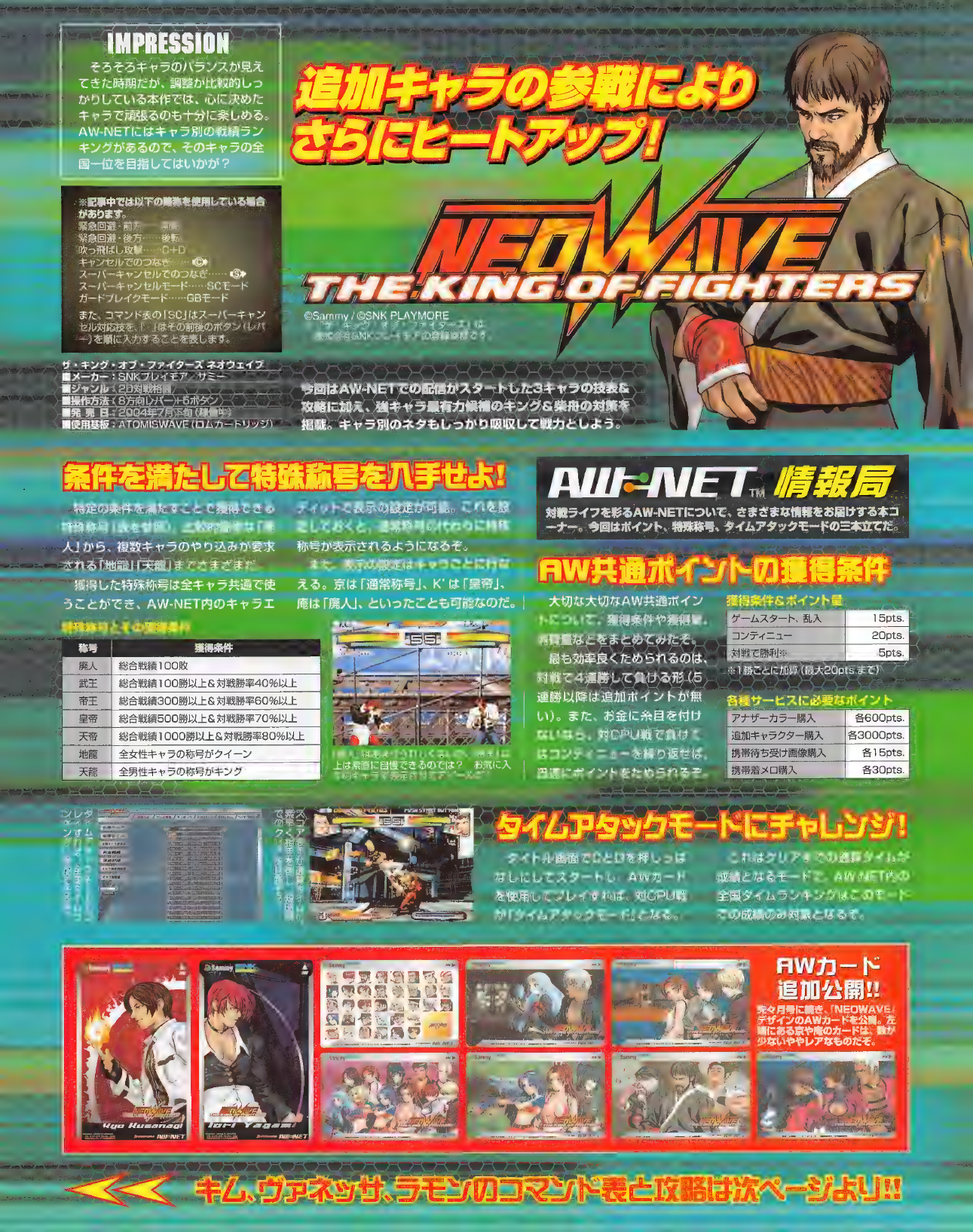
The NEOWAVE AW-NET Information Bureau — AW-NET Information Bureau column contains a table explicitly headed Points required for each service:
| Printed Japanese label | English meaning | Shared AW points price |
|---|---|---|
| アナザーカラー購入 | Buy an alternate colour | 600 each |
| 追加キャラクター購入 | Buy an additional character | 3, 000 each |
| 携帯待ち受け画像購入 | Buy a mobile phone standby wallpaper | 15 each |
| 携帯着メロ購入 | Buy a mobile ringtone melody | 30 each |
This is the strongest recovered specific phone reward price evidence so far. The adjacent heading is Conditions for earning shared AW points. These are shared AW points, not NEOWAVE Fight Money, rank rings or the separately documented GGX Mobile balance. The character price appears in coverage introducing Kim, Vanessa and Ramon, whose command lists follow. It is not evidence that Geese cost 3, 000: dated player purchases instead report 3, 500 for Geese.
The earning table lists game start / challenger entry: 15, continue: 20, versus / CPU victory: 5. Its victory footnote says points are added for each win, up to 20 points; it does not supply a fully worked example. Do not silently combine the two into a universal formula.
The column also urges readers to attempt Time Attack with an AW card. It says an AW-NET member can use their chosen/purchased character; it does not claim nationwide live fighting.
NEOWAVE special titles on the same page
The separate special-title table is achievement-based, not a phone reward price list. The text says acquired special titles can be used across characters:
| Title as printed | English gloss | Requirement as printed |
|---|---|---|
| 廃人 | Obsessive player / gaming addict | 100 total defeats |
| 武王 | Martial King | At least 100 total wins and versus win rate at least 40% |
| 帝王 | Sovereign | At least 300 total wins and versus win rate at least 60% |
| 皇帝 | Emperor | At least 500 total wins and versus win rate at least 70% |
| 天帝 | Heavenly Emperor | At least 1, 000 total wins and versus win rate at least 80% |
| 地龍 | Earth Dragon | Every female character has the Queen title |
| 天龍 | Heavenly Dragon | Every male character has the King title |
English glosses are translations, not recovered official localization. The table does not say these special achievements cost the 5, 000 Fight Money used elsewhere for ordinary titles.
Four alternate colours and planned NEOWAVE melodies: September 2004, issue 52
Printed page 39, PDF page 41: facsimile · reading copy · public issue page.
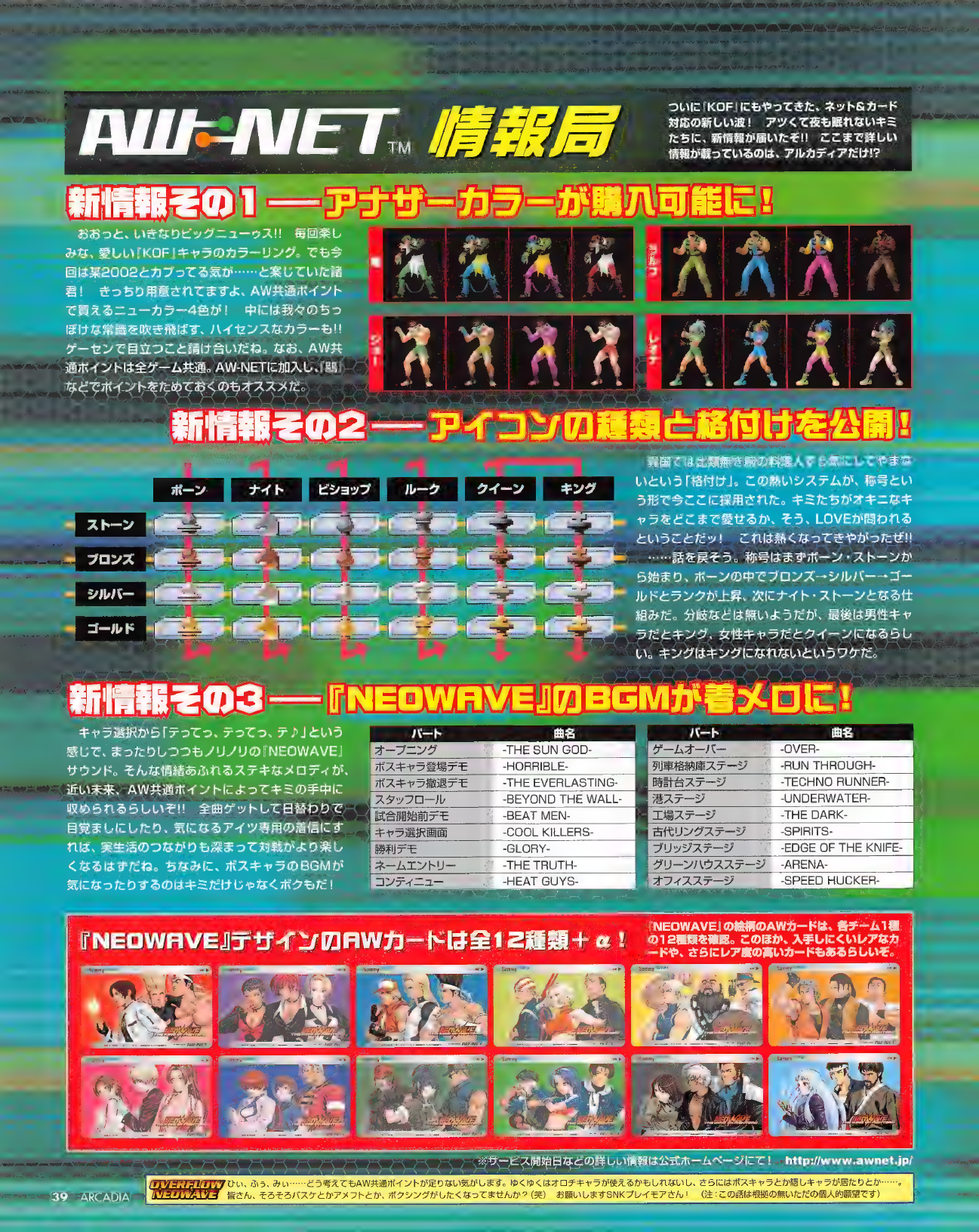
The AW-NET column announces four new purchasable alternate colours, with four-colour example sprite rows, using shared AW points. It recommends accumulating those points in Isuka beforehand, explicitly describing them as common to all games. Do not infer that each pictured sprite is a recovered downloadable phone wallpaper.
Its next announcement concerns NEOWAVE BGM becoming Ringtone — ringtone melodies. The prose describes receiving these melodies through shared AW points in the near future. Thus this page is evidence of an announced music service, while issue 54 gives later advertised purchase prices. A track table accompanies the announcement, but exact downloaded files, handset formats, per-track release dates and a working download catalog remain missing.
The rank-icon diagram shows stone, bronze, silver and gold variants and the labels Pawn, Knight, Bishop, Rook, Queen and King. The text describes a progression toward King for male characters and Queen for female characters. Its joke says the female character named King cannot become a King. The diagram is not a points-spending table and does not give every advancement threshold.
Twelve ordinary NEOWAVE AW-card designs are pictured. The article additionally mentions rare and very rare cards; 12 is not an exhaustive count of all card variants.
A card-album ID redeemed for a phone wallpaper
Issue 52, printed page 150, PDF page 152: reading copy · public issue page.
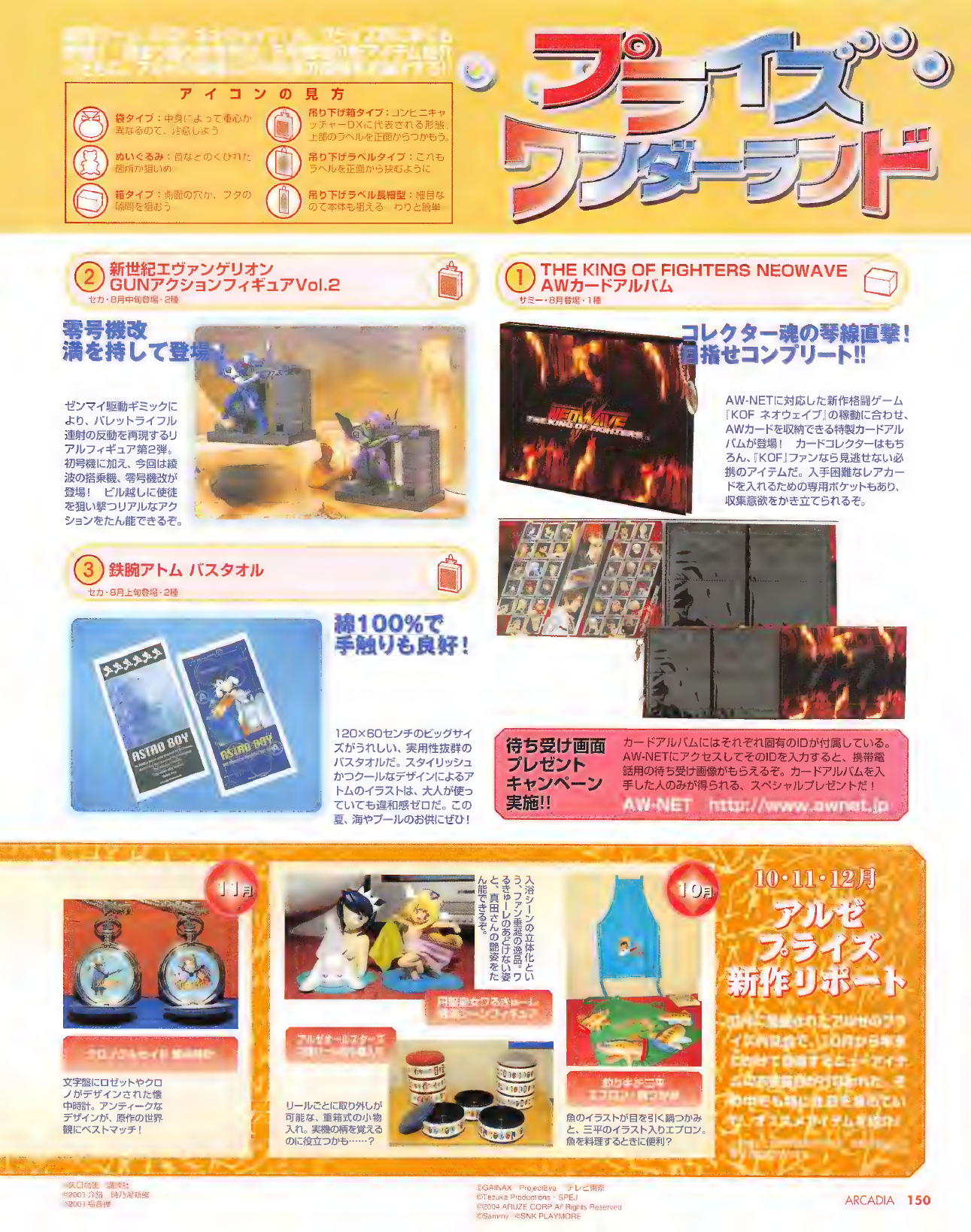
The Prize Wonderland feature advertises THE KING OF FIGHTERS NEOWAVE AW card album — AW-card album, Sammy, scheduled for August, one type. It illustrates the cover and interior pockets, including pockets for rare cards. The campaign box says each album has its own unique ID. Access AW-NET and enter that ID to receive a mobile phone standby image; the special gift is restricted to people who obtain the album.
This is a distinct reward acquisition route: physical album → unique ID → AW-NET entry → phone wallpaper. The box gives no shared-point charge, does not show the actual ID input form, and does not identify the wallpaper's filename or resolution. The promotional page's surrounding unrelated prize advertisements do not belong in an AW-NET rewards catalog.
Registration and Web Garage screenshots: January 2004, issue 44
Printed pages 24–25, PDF pages 26–27: original downloaded PDF · page 24 reading copy · page 25 reading copy · public issue.
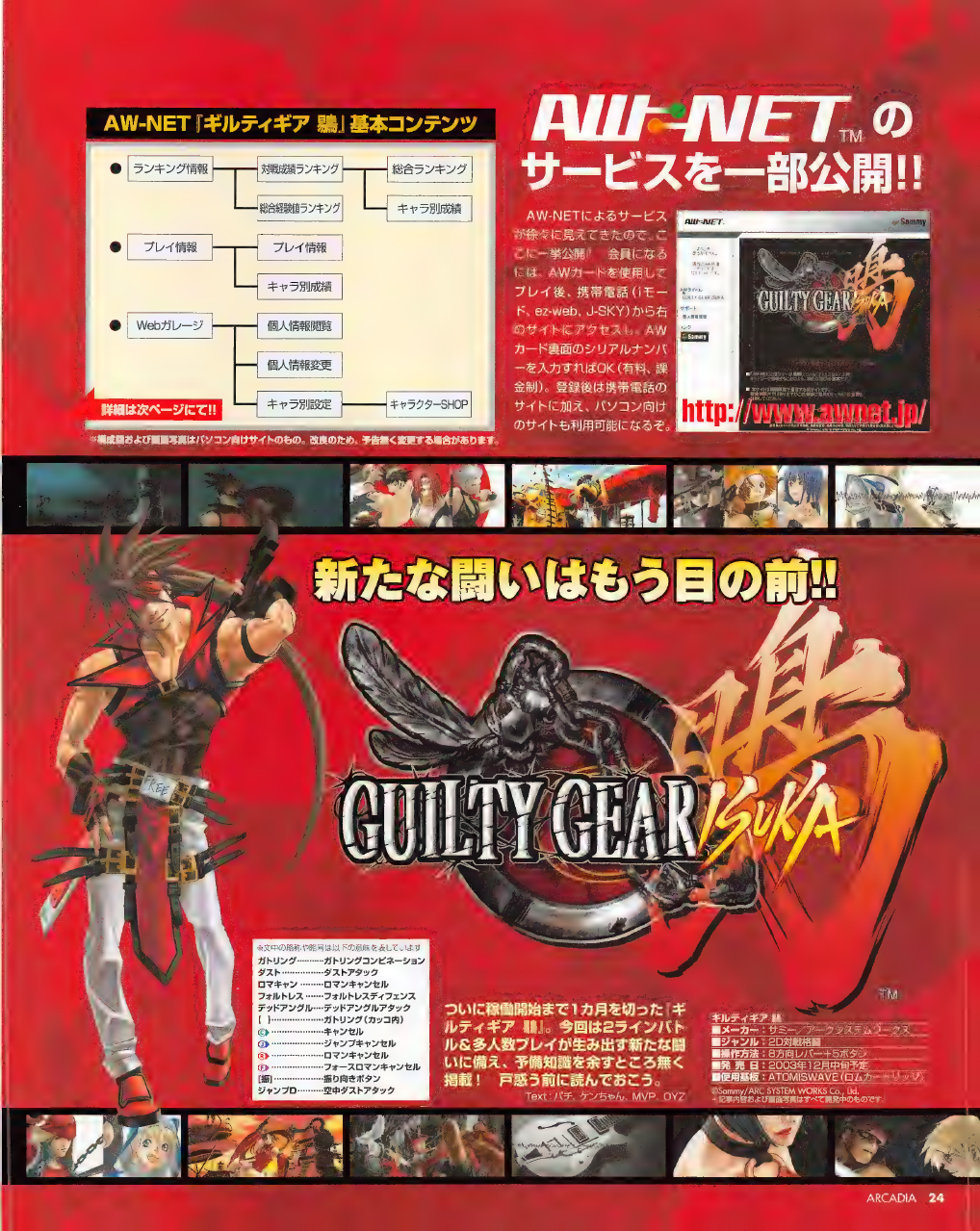
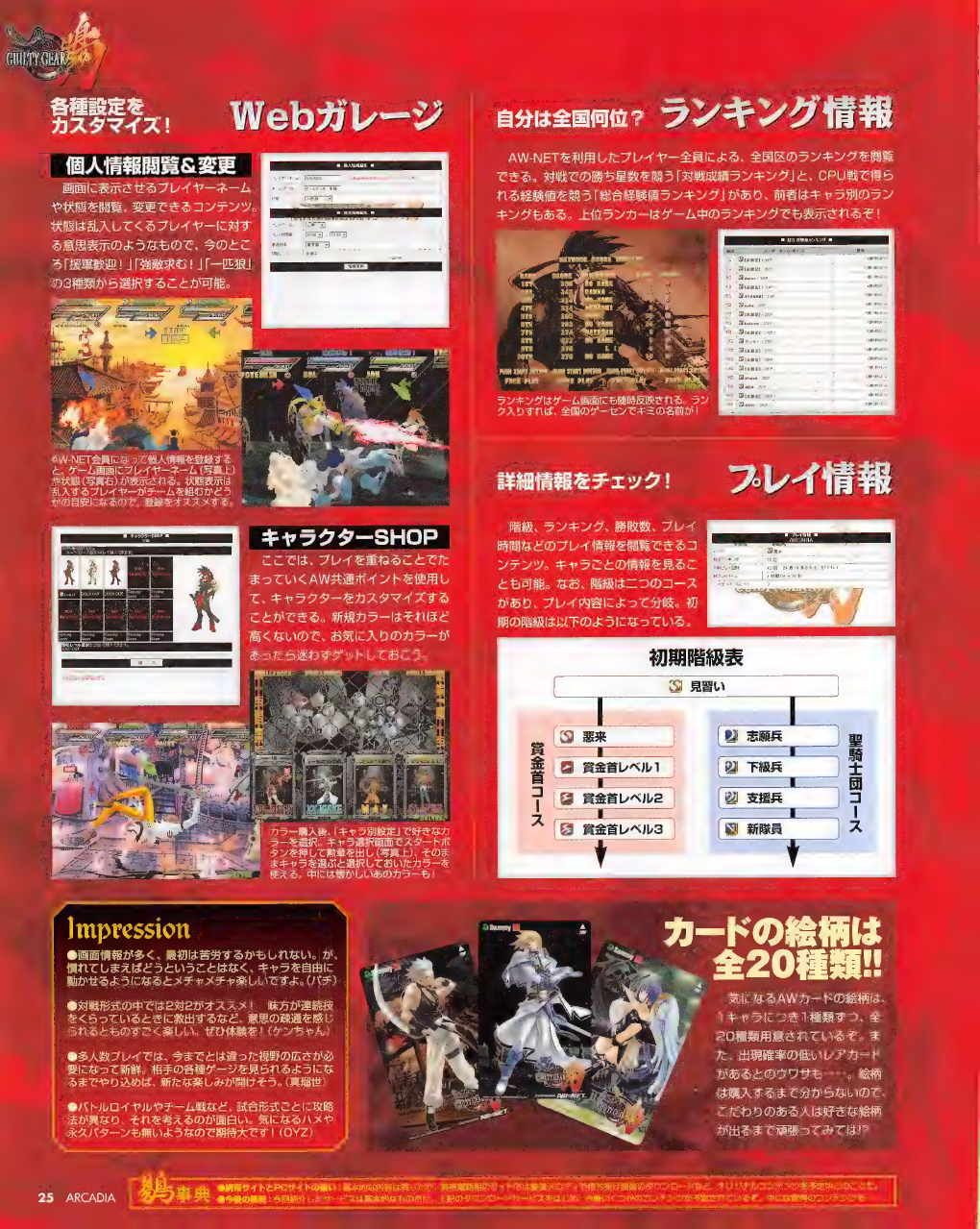
The membership paragraph says: play using an AW card, then use a mobile phone on i-mode, ez-web or J-SKY and enter the serial number on the card's reverse. Registration is paid. After registering, both the mobile site and the PC site can be used. The early carrier branding is the magazine's wording; it is not a statement that J-SKY remained the commercial brand in all later years.
The service map translates as:
| Section | Displayed branches |
|---|---|
| Ranking information | Versus results → overall / character results; total experience rankings |
| Play information | General play information; character results |
| Web Garage | View personal information; change personal information; character-specific settings → Character Shop |
The next page contains screenshots of personal information settings, Character Shop, a ranking table and play information, plus in-game name/status displays. Its descriptions explain choosing a player name and a status message; checking rank, wins/losses and play time by character; purchasing colours with shared AW points; then selecting a colour in character settings and pressing Start to show the medal at character selection. The three initial status messages are Reinforcements welcome! — Reinforcements welcome!, Looking for a strong enemy! — Strong opponents wanted!, and Lone wolf — Lone wolf.
Dating limit: the article says all shown images/material are under development and the content/screenshot layout may change. It says release is less than a month away despite being the January-dated issue. Therefore these screenshots are prelaunch publication evidence, not authenticated commercial member-session captures. They add visual layout clues without replacing the March 2004 commercial update dates for two additional colours per character.
The page also describes 20 regular card artworks, one per character, with possible rarer variants whose pictures were not yet disclosed. Again, 20 regular artworks is not a count of every manufactured card.
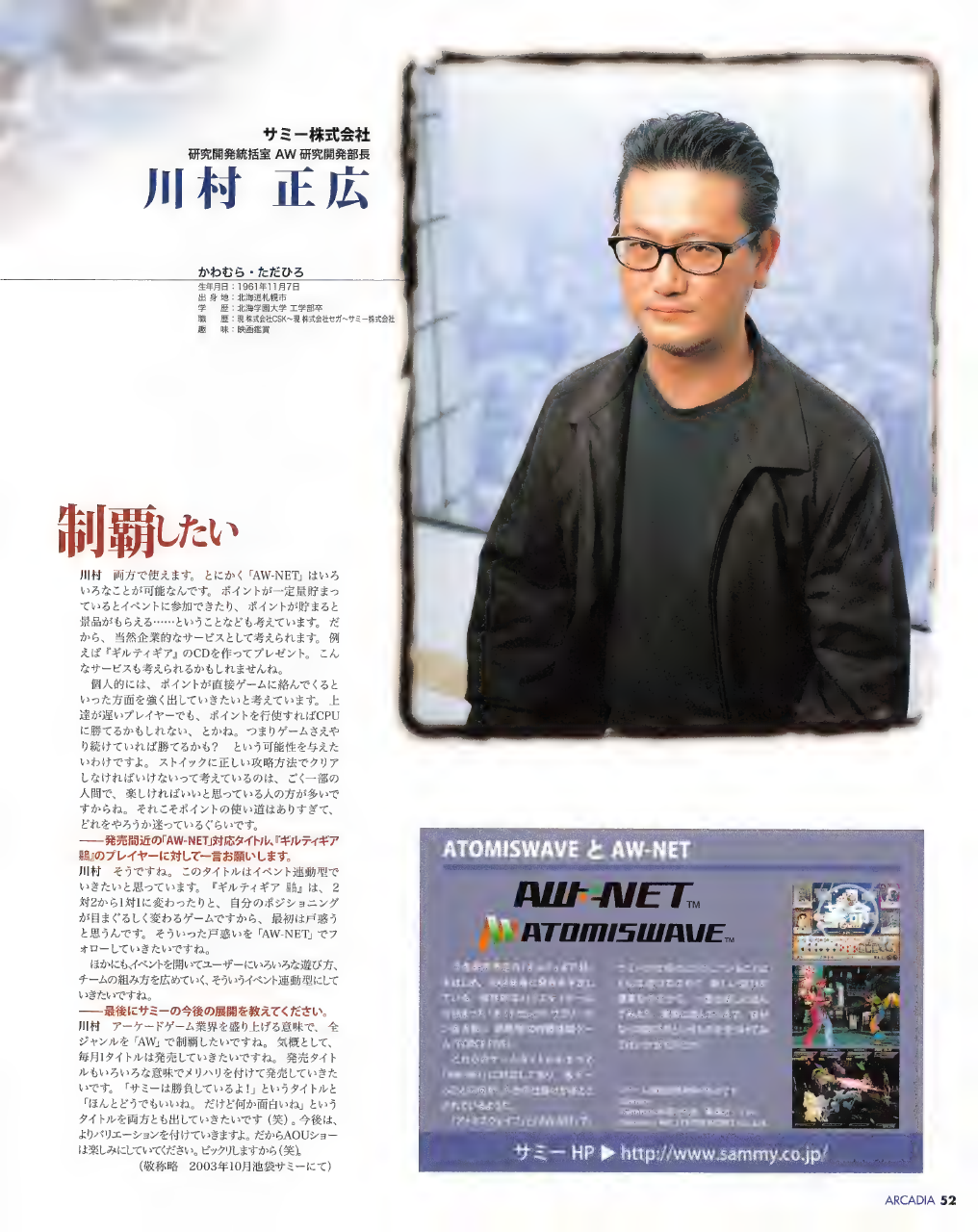
The October 2003 developer interview in issue 44
Printed pages 52–53, PDF pages 54–55: page 52, page 53. The feature interviews Masahiro Kawamura, Sammy AW R&D department head; the footer dates the interview to mid-October 2003.
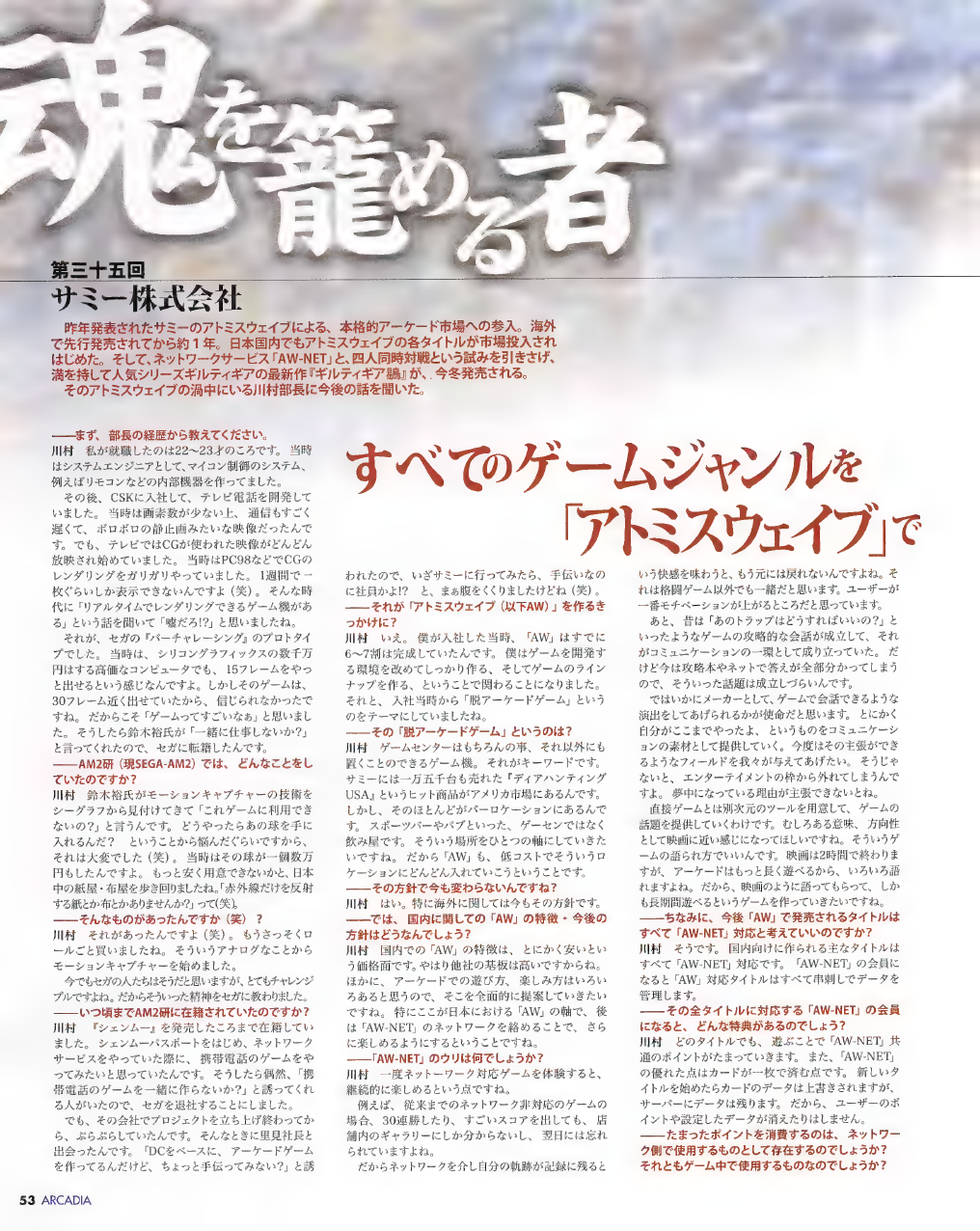
He explains that a common AW-NET card retains server-stored data as users begin different supported games, and points earned in those games are shared. He discusses possible point-qualified events, prizes such as a Guilty Gear CD, assistance for less experienced players, and event-linked approaches to Isuka. These are ideas being considered, not proof of a released CD-redemption catalog, purchasable CPU-win item, or completed event system. His statement that future domestically produced AW titles would all support AW-NET is a prelaunch intention; subsequent non-supporting releases show it was not universally fulfilled.
Spring campaign print evidence: July 2004, issue 50
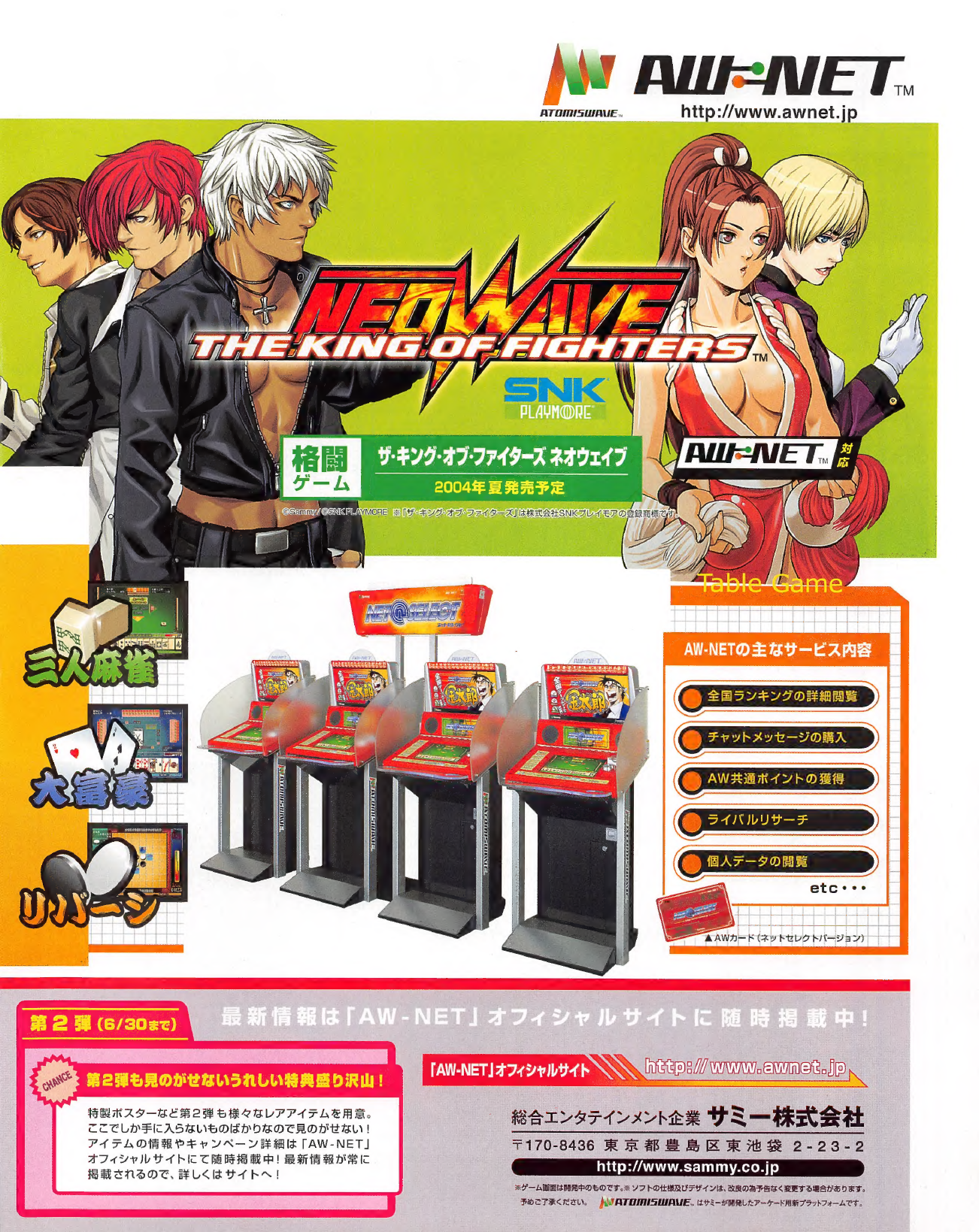
PDF page 6 is a full Sammy AW-NET advertisement: reading copy. It shows NEOWAVE planned for summer 2004 and the three commercial Kintaro games. Its Kintaro service list reads: detailed national rankings; buy chat messages; earn shared AW points; rival search; view personal data. The bottom promotes a second campaign wave through June 30, including special posters.
Printed page 63, PDF page 65: reading copy. Four campaign components are described: 1, 500 shared points for existing members and new registrations by the initially stated May 31 deadline; 100 limited Roger plush winners; expanded handset support; and special posters/AW cards.
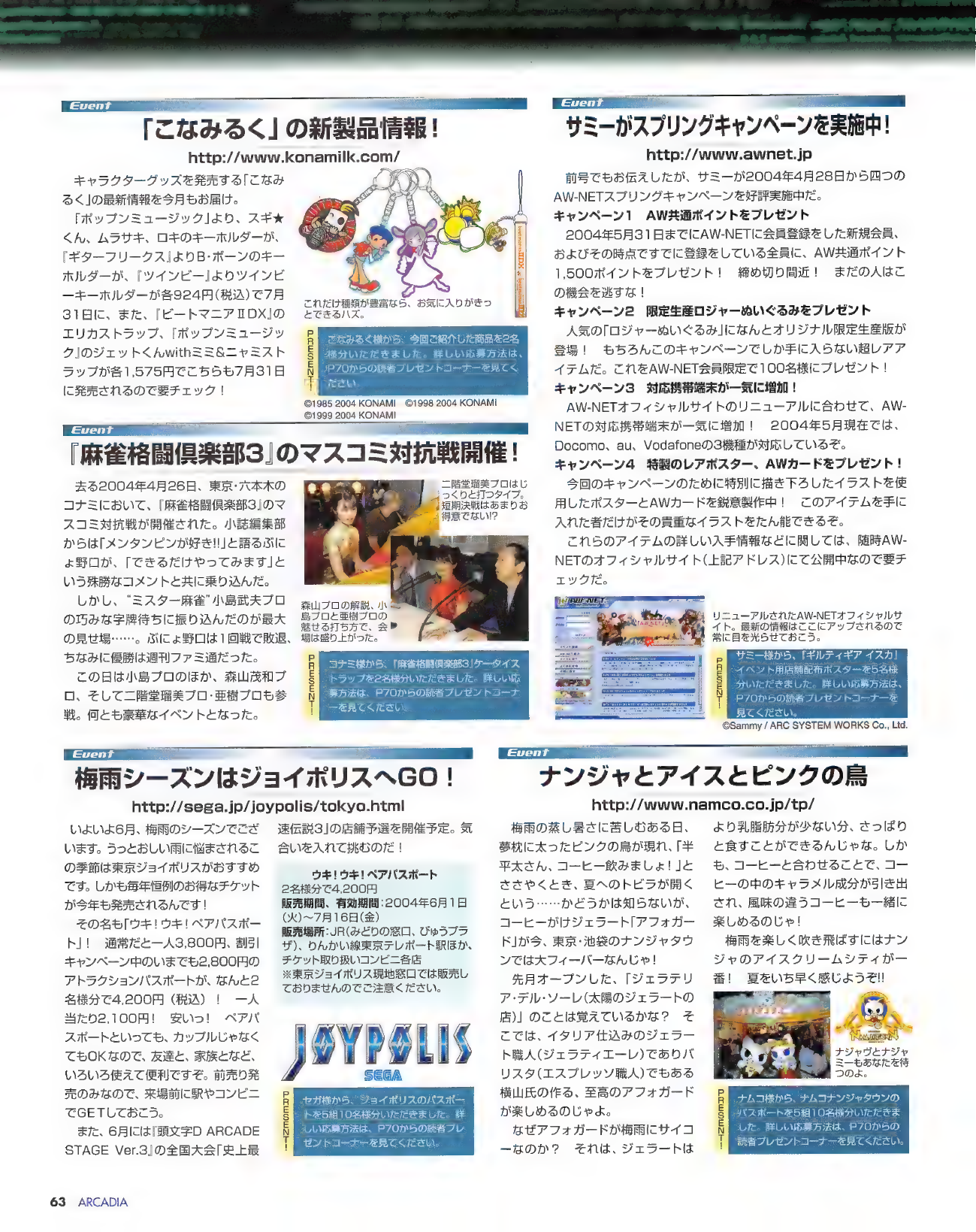
The handset paragraph says 3 models: Docomo, au, Vodafone, literally “the three models Docomo, au and Vodafone.” These are carriers, not an exhaustive list of three phone models; retain the article's imprecise wording rather than deriving a compatibility count. The drawing shows a redesigned AW-NET public homepage, not a member signup screenshot.
Shutdown and card limitations: December 2006, issue 79
Printed page 61, PDF page 63: original PDF · reading copy · public issue page.
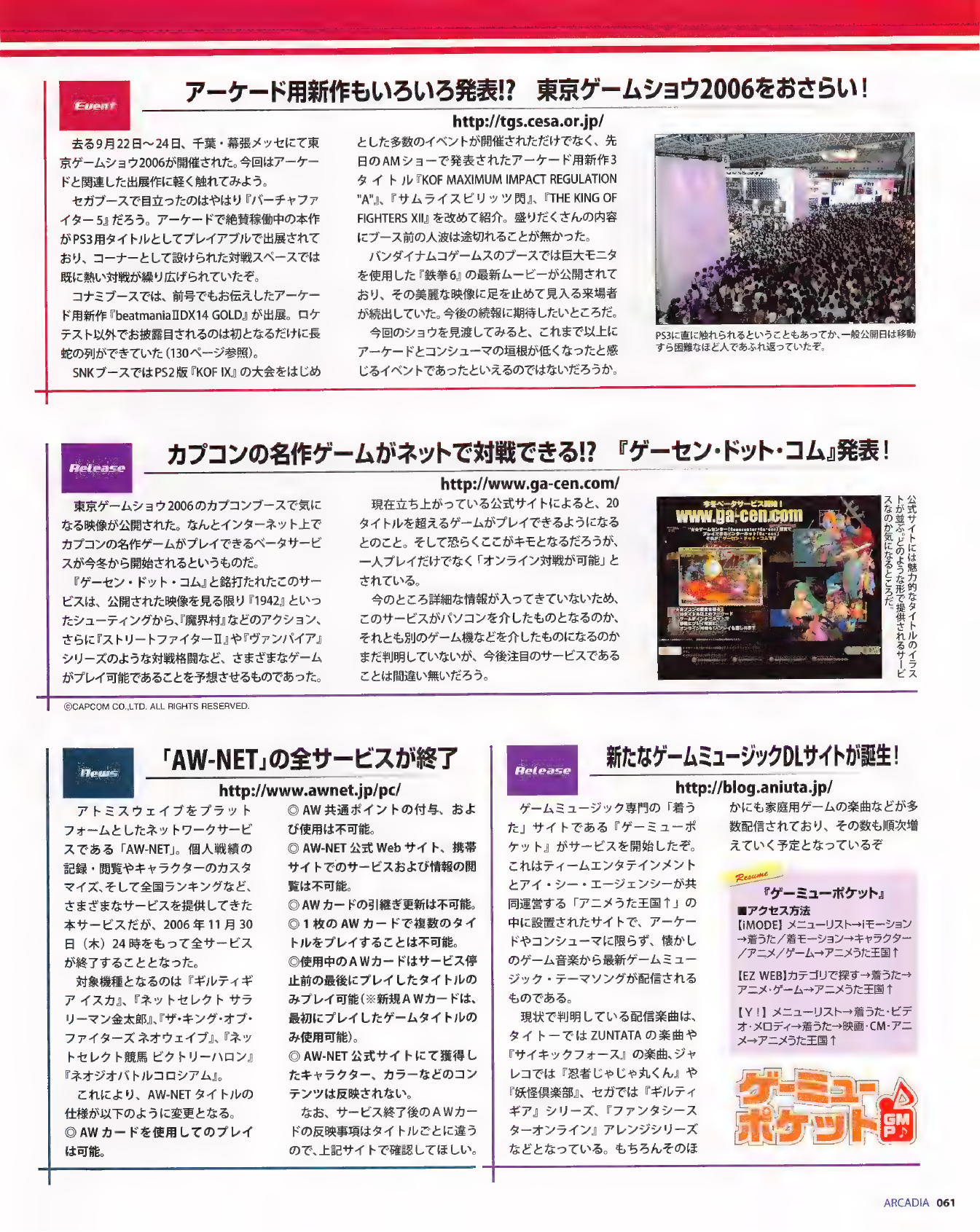
The news notice gives termination at 24: 00 on Thursday, 30 November 2006, and names exactly five affected games: Isuka, Kintaro, NEOWAVE, Victory Furlong and Battle Coliseum. Its stated post-closure behavior translates as follows:
- Play using an AW card remains possible.
- Shared AW points can no longer be awarded or used.
- AW-NET's web/mobile services and information can no longer be accessed.
- AW-card transfer/renewal is no longer possible.
- One card can no longer serve multiple games.
- An existing card works only with the last title played before shutdown; a new card works only with its first title.
- Characters, colours and other content obtained through the official site are no longer reflected/applied.
The notice adds that exactly which card information continues to appear differs by game and directs readers to the official site. This prevents a blanket conclusion that all cards became useless, all server entitlements survived, or all game-specific offline behavior was identical.
NEOWAVE account and team features: August 2004, issue 51
Printed page 14, PDF page 16: original PDF · reading copy · public scan.
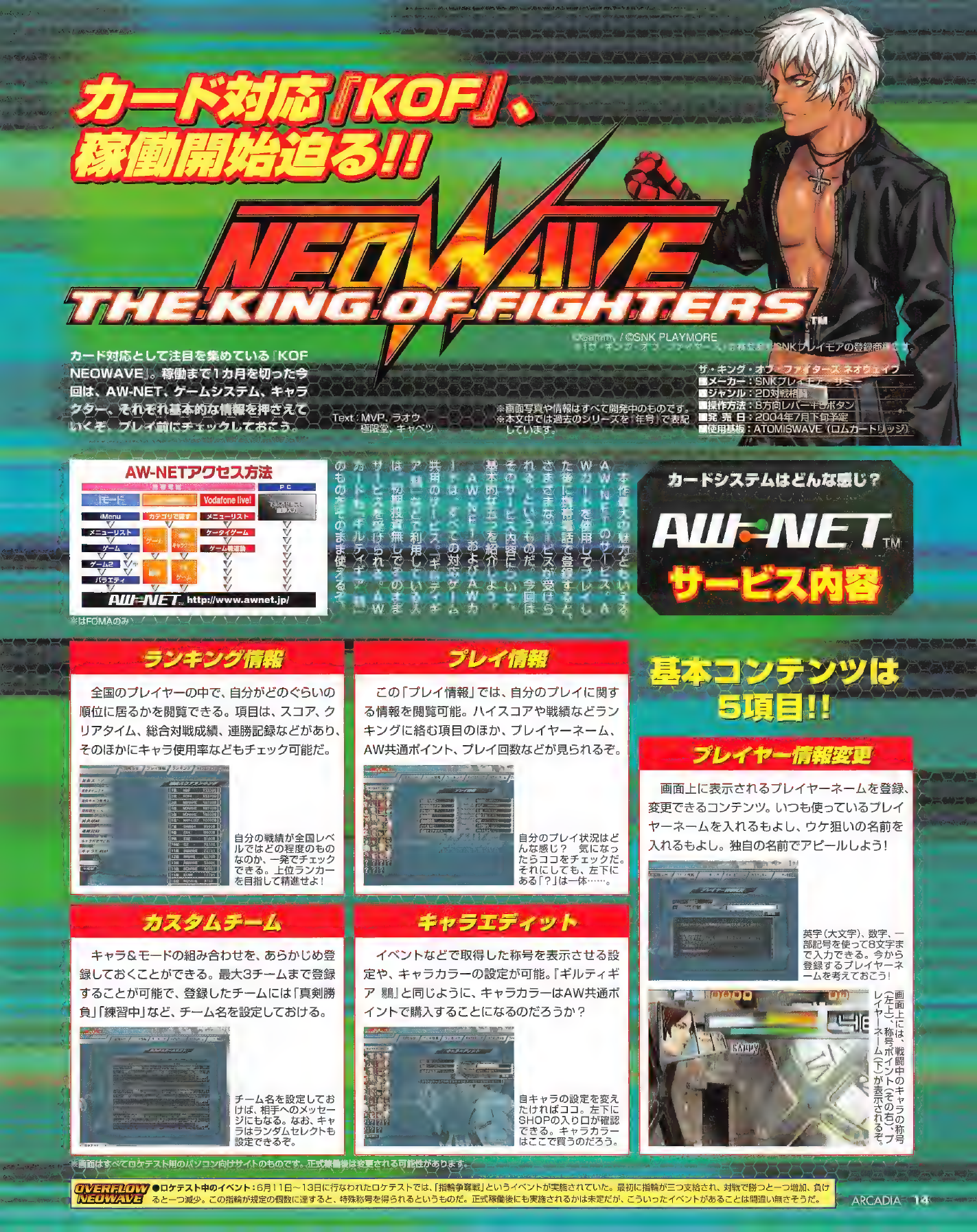
The feature lists five basic services: ranking information, play information, change player information, custom teams, character edit. Rankings include score, clear time, overall versus results, consecutive wins and character-use rates. Personal data includes name, shared AW points and play count. The nickname caption specifies up to eight characters, using uppercase Latin letters, digits and some symbols. That is a game player-name rule, not a PC AWID/password specification.
Custom teams store up to three character-plus-mode combinations. Team names such as serious match, and practicing, act as messages to opponents. Random character selection can also be stored. Character Edit supports displaying event-acquired titles and choosing colours; the article's colour purchase phrasing is still speculative.
The footer explicitly says the PC screenshots come from a location test and may differ from the released service. Its report of a June 11–13 test “title contest,” initially three title-point units and a special reward for reaching a threshold, is test evidence; do not transplant those figures into released ranking rules.
NEOWAVE palette grid and rank mechanics: October 2004, issue 53
Printed page 70, PDF page 72: original PDF · palette/rank reading copy · public scan.
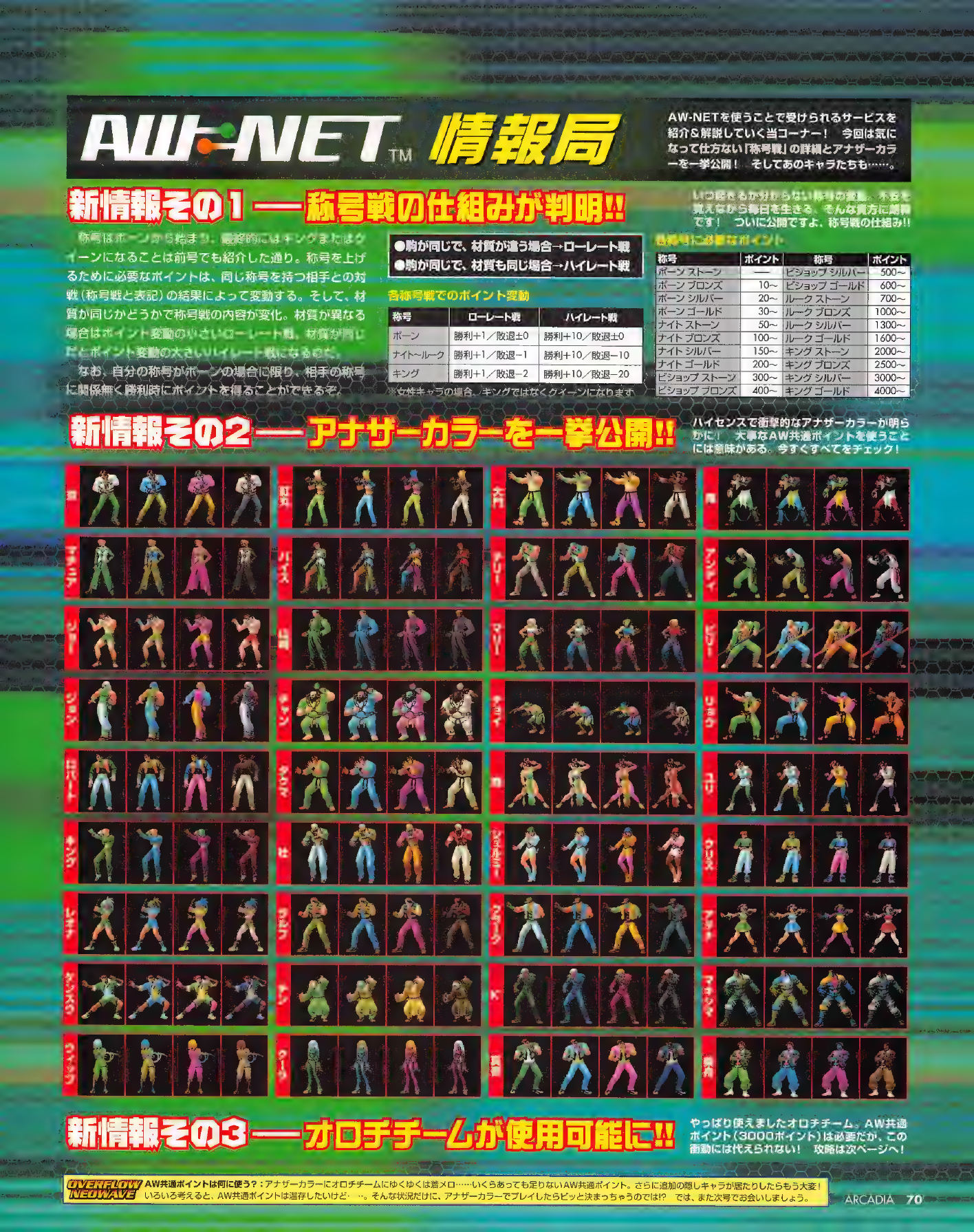
The page displays 36 labeled character groups, four alternate-colour sprites in each, a total of 144 pictured palette examples. It is substantially more complete than the four character examples in issue 52. The printed grid is a visual catalog for the characters shown; it does not recover individual sprite-download files, palette byte values, A/B/C/D activation mapping or a complete palette catalog for subsequently added characters.
The Orochi-team announcement on this page mentions 3, 000 shared AW points. It strengthens the period evidence for that team's purchase tariff, but the short sentence does not explicitly say whether that figure is per fighter or a bundled team. Keep the distinct “each” wording of issue 54's general additional-character table and the retrospective per-fighter account separately attributed.
The title-contest section explains that opponents with different material tiers use a low-rate match, while the same material tier uses a high-rate match. The table gives the following changes:
| Your rank group | Low-rate win / defeat | High-rate win / defeat |
|---|---|---|
| Pawn | +1 / 0 | +10 / 0 |
| Knight through Rook | +1 / −1 | +10 / −10 |
| King (Queen for female characters) | +1 / −2 | +10 / −20 |
It also says a Pawn gains points for a victory regardless of the opponent's title. These are title/rank points, not the spendable shared AW balance. Printed thresholds are:
| Title | Minimum rank points | Title | Minimum rank points |
|---|---|---|---|
| Stone Pawn | initial; no numeric threshold printed | Silver Bishop | 500 |
| Bronze Pawn | 10 | Gold Bishop | 600 |
| Silver Pawn | 20 | Stone Rook | 700 |
| Gold Pawn | 30 | Bronze Rook | 1, 000 |
| Stone Knight | 50 | Silver Rook | 1, 300 |
| Bronze Knight | 100 | Gold Rook | 1, 600 |
| Silver Knight | 150 | Stone King/Queen | 2, 000 |
| Gold Knight | 200 | Bronze King/Queen | 2, 500 |
| Stone Bishop | 300 | Silver King/Queen | 3, 000 |
| Bronze Bishop | 400 | Gold King/Queen | 4, 000 |
Do not turn these thresholds into shop prices or assume that defeating a CPU awards the same contest points. Fight Money and ring campaigns remain distinct mechanisms.
Battle Coliseum mobile-site preview: May 2005, issue 60
Printed page 52, PDF page 54: original PDF · mobile preview reading copy · public scan.
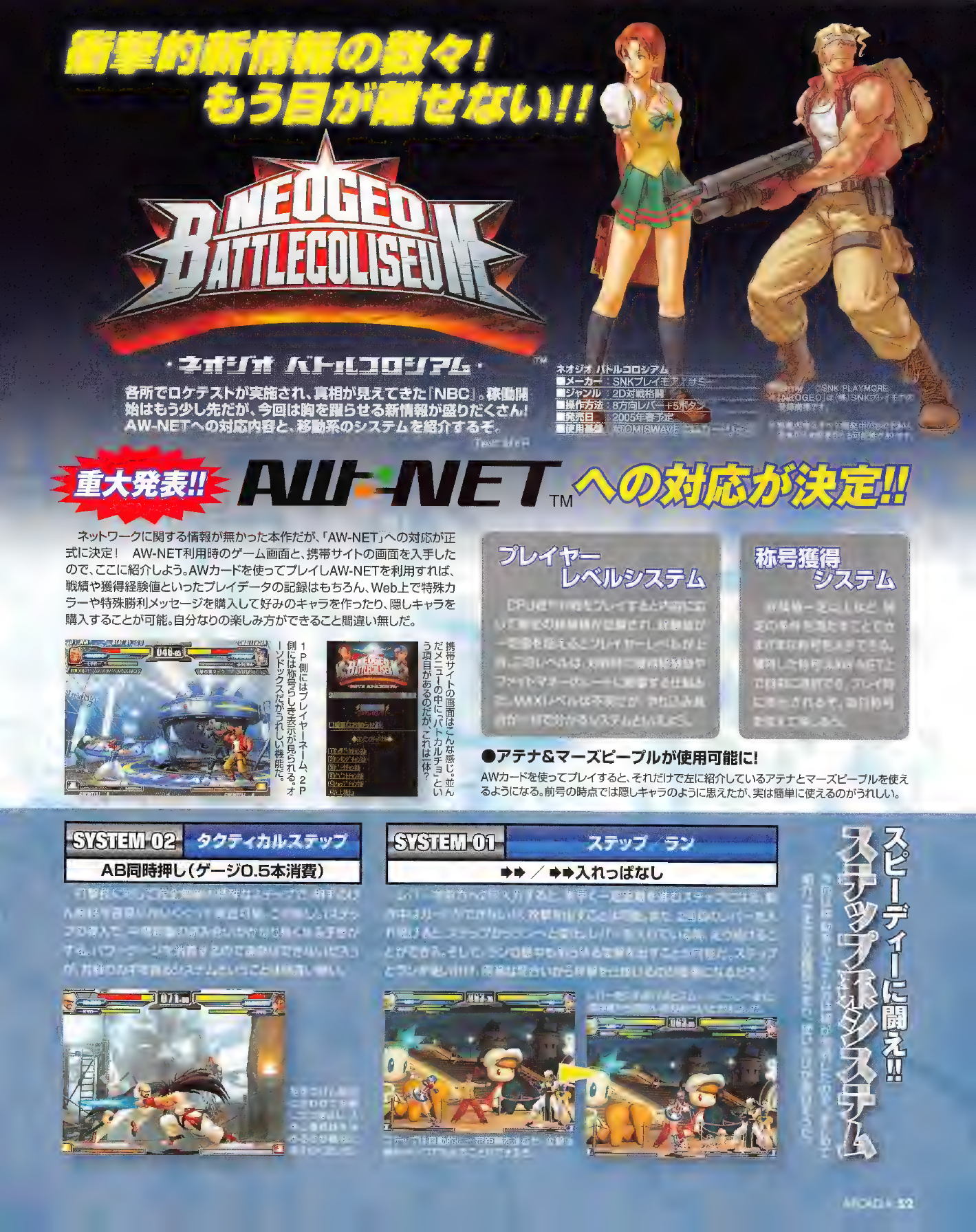
The announcement explicitly confirms planned AW-NET support. Its text says an AW card and AW-NET enable records of results/experience, purchases of special colours, special victory messages, and hidden characters through the web. This is period published evidence for victory-message customisation, stronger than anonymous forum recollections alone. The pictured mobile menu includes Bato Culture — Bato Culture. The printed caption explicitly calls attention to that menu entry and asks what it is; its content is not explained here. Its smaller menu labels are not sufficiently legible to reconstruct a complete mobile navigation tree or enrollment form.
The adjacent headings are Player-level system — Player-level system and Title acquisition system — Title-acquisition system. That level influences experience earned in versus play and the Fight Money rate; the maximum level was unknown to the writer. Specific conditions, including experience thresholds, award titles. Members can select an earned title through AW-NET for display during play. The in-game screenshot illustrates a player name and title display. The separate paragraph says using an AW card makes Athena and Mars People usable without a further hidden-character purchase described there. These remain preview rules rather than a recovered commercial experience formula.
This article predates commercial release. It is a preview after location tests, with the release timing still listed as under adjustment; it does not itself verify every commercial shop item, price, exact mobile screen or signup step. Keep its announced features beside later official notices and dated player purchases.
Isuka launch-era signup and initial colours: February 2004, issue 45
The illustrated three-step guide says to buy an AW card at the vending machine (standard price ¥500), use it in Isuka, then register through the phone site using the reverse-side serial number. It advertises ¥300 monthly excluding tax, and PC access after enrollment. Results can already carry over with the card before subscribing. This is not a photographed carrier billing or enrollment form.
The service list covers rankings, play information, viewing/changing personal information, and character settings/shop. Status text and player name can be changed. PC screenshots are explicitly identified as location-test screens. A grid shows 20 characters with three initial special colours each, labeled Color 1–3 left to right: 60 examples. The page does not price those colours or demonstrate that all were simultaneously sold in the released shop. It preserves a useful earlier visual set alongside the dated March addition.
Isuka EX price, setting path and rank courses: March 2004, issue 46
Printed page 70, scan leaf 71: original response · public scan.
The EX instructions explicitly give 1, 500 AW points per character, strengthening the later player guide's price with period publication evidence. The printed route is Web Garage → character-specific settings → SHOP → buy EX → change that character's setting → play an AW-NET-supported cabinet → press Start to display the medal at character selection → confirm. The article announces availability planned from late January, subject to change; the official site's January 31 update remains the better exact release date. EX versions change move properties and include EX-only moves; they are not additional palette files.
The rank diagram separates bounty-hunter and Holy Order paths. Play actions accumulate course-specific influence; the larger balance determines the path, with Holy Order winning a tie. Switching paths normally maps to the equivalent rank, but at higher ranks resets to bounty level 6 / senior member. Acting alone, partnering with different numbers/factions, surviving, and defeating the other faction affect this choice. These course points are distinct from spendable AW points. It also describes rare branches requiring conditions before promotion, and humiliating ranks obtained through repeated perfect losses at the first rank.
Isuka faction statistics, arcade list and planned rare items: May 2004, issue 48
Printed page 75, scan leaf 76: original response · public scan.
A new Faction Distribution page was scheduled for mid-April. It would show the Holy Order/bounty-hunter proportions, counts at each title, character usage, and character win rates. This is an announcement; preserved commercial pages elsewhere should determine the actual layout and availability.
The arcade-installation list and tournament information are described as being published from early March, with ongoing updates and submissions invited. The pictured page heading is an installation-location list. The Guilty Gong screenshot supplies a further visual reference for voting.
Rare physical items available only through AW-NET were still being planned; acquisition details would follow on AW-NET, Guiltygearx.com or in the magazine. This is not an inventory of released goods or proof of a specific point price. A separate column explains ranked CPU challengers after rare-rank branching; this is card progression/gameplay, not WAN opponent matchmaking.
Kintaro message packs and carrier menus: June–August 2004
Issue 49, unnumbered Sammy advertisement, scan leaf 5: original response · public scan.
The advertisement explicitly offers shared-point purchase of preset chat messages and free combination of those messages. Its Osaka dialect pack examples mean “Hello / thanks for your custom,” “Thank you,” and “Business going well?” The emoticon pack shows happy/celebratory faces and a kiss expression. No price appears. The adjoining Rumble Fish artwork is a separate advertisement; it does not establish AW-NET support for that game.
Issue 51, printed page 74, leaf 75: original response · public scan.
The article reports operation from late June 2004 and confirms reuse of an Isuka AW card. Company job positions are separate from game rank, and member benefits include rankings/items. Its phone access box adds dated carrier paths: i-mode through Game → Game 2 → Variety (FOMA gets a Variety shortcut); EZweb through category/game/general or image-character/TV-game; Vodafone live! through phone games → game-machine linkage. These are portal directions, not screenshots of paid enrollment. It illustrates a management promotion and named CPU opponents from the manga; it does not offer those CPU characters as purchasable fighters.
NEOWAVE Geese campaign and first ring-event preview: December 2004, issue 55
Printed page 95, leaf 96: original response · public scan.
The footer advertises 3, 500 shared AW points given to AW-NET members in conjunction with Geese's release, with joining by the end of November qualifying for the gift. This corroborates a promotional award; it is not a monthly recurring allowance or a quoted Geese shop price.
The ring-event column announces an early-November start after the late-October Fight Money event. Using a card during the event grants three rings initially. Two ring holders contest one ring; the winner gains one and the loser loses one. A player who loses every ring can regain one by clearing CPU play. Titles may be earned according to the ring count. This period preview agrees with the earlier one-ring replenishment rule; the later three-ring web/poster version remains a dated change, not an error to erase.
Two especially rare NEOWAVE card illustrations are pictured with gold detailing described in the prose. The monochrome scan cannot establish the exact printed gold colour.
Battle Coliseum Fight Money and Double Up preview: July 2005, issue 62
Printed page 42, leaf 43: original response · public scan.
This prelaunch page announces a limited Fight Money acquisition event for NeoGeo Battle Coliseum: versus play earns virtual money, totals are competed over, and special titles can be acquired. Its rate varies with player-level differences and play actions, including taunting with health as collateral to increase the prospective return.
The pictured DOUBLE UP CHALLENGE!! shows Yes/No decisions and a doubled monetary value. The caption and UI explain that choosing it cuts health to half while doubling the obtainable Fight Money. This is a distinct NeoGeo Battle Coliseum mechanic; do not copy NEOWAVE's initial 900/100/50 rules into it. No complete commercial earnings formula, event calendar or title thresholds appear here.
The CPU-boss feature speculates about future AW-NET availability for Mizuchi and Shishioh. Later publisher purchase notices, not this speculation, establish those releases.
Other inspected pages and exclusions
Issue 42 (November 2003), printed pages 10 and 14, supplies prelaunch phone-ringtone/wallpaper promises and an AW-NET data-center diagram; the artwork and character-colour example are explicitly developmental. Page 14 announces SNK's intended spring-2004 KOF AW-NET title, and shows the planned Kintaro nationwide table-game service. A diagram alone is not a measured network topology or proof that Isuka offered remote fighting.
Issue 51's leaf 61 is a PS 2 Isuka feature with RGB colour editing. It explicitly says the PS 2 edition lost the AW-NET-supported elements. Issue 56's page 154 instead describes Xbox Live Isuka multiplayer.
Issue 52, printed page 61, shows the NEOWAVE card album as one of three Arcadia reader prizes, separate from AW-NET's ID-redemption route. Issue 57, page 102, is a NEOWAVE player tier-list article, not a shop table. Issues 57 and 61, page 11, mention AW-NET rankings while discussing Tougeki contestants; the accompanying entrant/shop lists are not an AW-NET installation directory. Issue 67, page 53, contains a brief Victory Furlong online-racing description, NeoGeo Battle Coliseum support mention, and Tenkaichi listing; proximity does not establish Tenkaichi AW-NET support. These sources are classified in the gallery without treating unrelated material as new service features.
NeoGeo Battle Coliseum boss purchases: September 2005, issue 64
Printed page 64, scan leaf 65: unchanged page image · public facsimile.
The banner announces two boss characters through AW-NET. Its service paragraph translates: “Mizuchi and Shishioh will become available to purchase as player characters through AW-NET! Mizuchi is planned to appear about three weeks after operation begins, and Shishioh after five weeks.” The footer warns that the dates are planned and may change. No point prices appear here. This is the actual period-print announcement behind the July 31, 2005 reader diary, now preserved alongside the scan. It does not settle the first commercial availability dates or contradict a later revised schedule merely by being earlier.
The next page, printed 65, explains routes to CPU bosses Neo Dio and Goodman. CPU appearances are distinct from purchased playable characters. Pages 66–67 cover ordinary fighting mechanics. A neighboring advertisement announces Arcadia Extra volume 22, NeoGeo Battle Coliseum Master Guide, for mid-August 2005 at ¥1, 480 excluding tax; its advertised move, versus and CPU guides establish a useful additional publication lead.
April 2004 homepage and campaign: issue 49
Printed page 64, scan leaf 65: unchanged page image · public facsimile.
The article dates the PC homepage renewal to April 28, 2004. Its screenshot preserves the blue AW-NET header, AW-ID/password login, a Kintaro location-test banner, and navigation for event information, introduction, supported titles, FAQ and contact, with a membership-guide link. This is a public homepage containing login controls; it does not demonstrate PC enrollment.
Four campaign components are described: 1, 500 shared points for current members and people joining by May 31; a 100-winner Roger plush lottery; expanded handset support and release of previously undistributed EX colours; and newly drawn goods in production, comprising one poster design and three AW-card designs. Details for obtaining the latter goods were to follow. Issue 51's advertisement explicitly says the Spring Campaign was extended because of its popularity, without giving a new deadline on that page.
The separate Arcadia reader-prize quantities conflict within issue 49: page 64's PRESENT box says one Roger plush, one of each of three card designs, and five posters; page 72's reader-prize paragraph says five readers each. Preserve that discrepancy. The May 24 postmark deadline is the magazine draw, distinct from the AW-NET May 31 joining deadline. Prize illustrations are manufacturing/art examples, not proof that their images were phone rewards.
Kintaro design changes, card reuse and network chat
November/December 2003 advertisements explicitly include planned Tactics. The February 2004 left advertisement retains four-game developmental wording, while its facing page labels three-player mahjong, Daifugo, two-player Reversi and four-player Reversi: four modes across three game types. The January facing advertisement already shows that same four-mode inventory. Do not infer a February Tactics release from these mixed advertising versions. By the March 2004 advertisement, the list contains mahjong, Daifugo and Reversi, with a March release target; the April advertisement changes the target to spring. The June manufacturer column says location tests are continuing. An August advertisement still says summer-2004 planned release, while the same issue's feature reports operation from late June. These are successive dated plans, not four contradictory actual launch dates. The gallery preserves each advertisement and its qualification.
Issue 50, printed page 56, leaf 57: unchanged image. The preview explicitly promises matches between arcades with players nationwide, alongside matches within one arcade. Isuka cards can be reused. Saved results, grade and company job position, nationwide rankings and shared points are described. Preset chat examples mean “Hello,” “Nice to meet you,” and “Let's play again.” These are game-chat UI examples, not telephone text messages.
Issue 52, printed page 141, leaf 142: unchanged image. The Reversi column says Timan — one-on-one, describing it as the only one-on-one game among the included table games and discussing human opponents' thinking, mistakes and responses. An earlier working translation incorrectly read this as “real-time”; that reading has been corrected in the English notes. This column does not establish a network-timing distinction between Reversi, mahjong and Daifugo, nor asynchronous play in the other games.
Planned Force Five support and physical card memorabilia
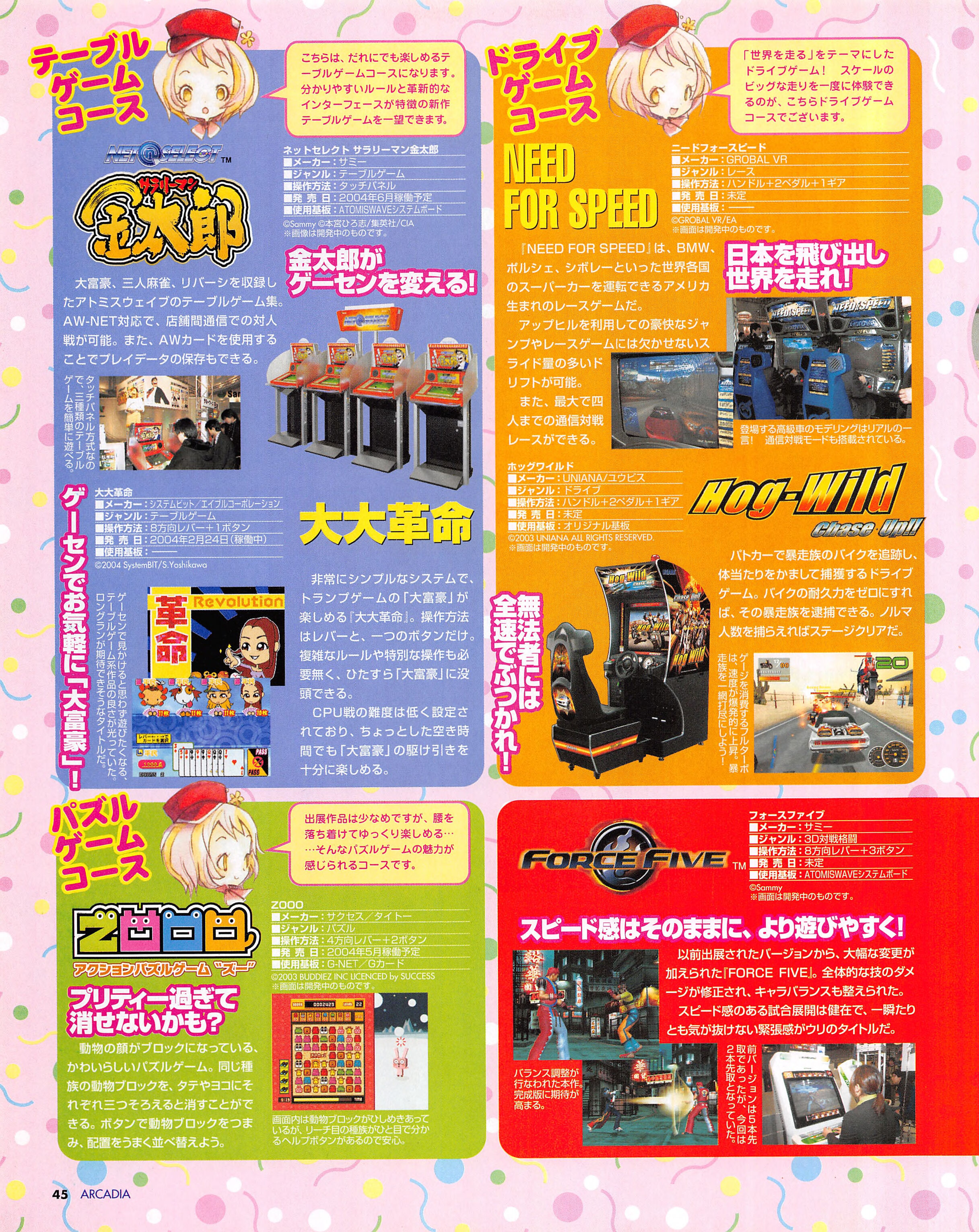
Issue 47, April 2004 advertisement, leaf 5: unchanged image. An AW-NET-supported badge is placed directly above Force Five, whose release date is undecided. This is explicit primary evidence of planned support; it does not add the unreleased game to the commercial five-title inventory.
Issue 42, printed page 64, leaf 65: unchanged image. Five AM Show limited AW cards are offered in an Arcadia postal reader draw. The photograph preserves a combined Isuka/Kintaro card and orange backing labeled “41 st AM Show attendance souvenir” and “limited-design AW card.” The October 24 postmark deadline belongs to this magazine giveaway. It is physical memorabilia, not an AW-NET point reward or a mobile signup form.
Other inspected physical-art sources include Sammy's 2004 New Year postcards, a September 2003 booth prize draw and a July 2004 local Isuka tournament listing an AW card as a planned prize. They are classified separately from the phone reward catalog. The generic awnet.jp footer on artwork does not independently prove that every pictured game supported AW-NET.
Victory Furlong progression and additional planned Kenju services
Issue 61, June 2005, printed page 82, leaf 83: unchanged full-resolution page, public facsimile. The game-information box gives 24 March 2005 as the release date and says the game is operating. The article distinguishes Rank points. — rank points from additional promotion conditions. CPU victories alone cannot satisfy required NET-race wins. This is not a shared AW-point price list.
| Grade | Rank points | Additional condition |
|---|---|---|
| 9-kyū | 5 | Win a race |
| 7-kyū | 95 | Win a NET race |
| 6-kyū | 220 | Win a G 1 race |
| 4-kyū | 730 | Win a NET G 1 race |
| 3-kyū | 1, 155 | Five G 1 victories |
| 2-kyū | 1, 720 | Thirty total victories |
| 1-kyū | 2, 445 | Ten G 1 victories |
| 1-dan | 3, 370 | Become a Triple Crown horse |
| 2-dan | 4, 535 | Thirty NET-race victories |
| 3-dan | 5, 980 | Ten NET G 1 victories |
| 4-dan | 7, 745 | Thirty G 1 victories |
| 5-dan | 9, 870 | One hundred total victories |
The article describes an August shop item Passport — Passport that changes the training assistant to a woman. With that assistant and at least five NET G 1 wins, February brings Hire you — Hire you: the female shop attendant can become the assistant, and the previous assistant becomes the attendant. The months appear to refer to the game's calendar; the passage does not provide real-world content-release dates, prices, a shared-point cost or phone redemption. Training, horse weight and instruction skills elsewhere on the page are ordinary game mechanics. The two preceding inspected leaves contain Raiden III strategy and are excluded from AW-NET features.
Issue 54, November 2004, printed page 139, leaf 140: unchanged page. The AM Show report explicitly plans win/loss recording, rankings and character customisation via AW-NET for Kenju. Its release is undecided. This is primary evidence of proposed support, not a released sixth member-service game. The adjacent provisional Net Select racing preview describes weekly horse raising; it does not give a completed mobile service.
Issue 50, printed page 71, leaf 72: unchanged page. The reader drawing offers fifteen each of a Kintaro promotional poster, an Isuka arcade event poster, and a Rumble Fish telephone card, with a 28 June 2004 postmark deadline. They are physical magazine prizes, not AW-point rewards. The other follow-up leaves add a Kintaro manufacturer mention and a reader-survey listing; neither is a signup form.
Coverage and remaining print work
Machine OCR currently identifies dozens of candidate leaves across the service years. Counts in catalogue.json, reviewed_pages.json and image_gallery.json are regenerated as review progresses. Reviewed pages include repeated advertisements, contents pages, unrelated card mentions, coverage of other Atomiswave games, and genuine AW-NET feature columns; a reviewed page is not necessarily a new independent witness or a fully translated article.
The September 2005 Mizuchi/Shishioh purchase announcement has now been located on printed page 64 and translated above. The adjoining Neo Dio/Goodman route guide remains separate gameplay evidence. This does not mean all 10, 040 scan leaves were inspected visually or that OCR found every relevant page. Contents, release lists, editorial pages and false positives retain their separate scope in the per-page English notes.
Additional broader-search findings
The January 2004 Force Five advertisement, leaf 6 bears an AW-NET-compatible badge and a planned February launch. Its real-time ranking/inter-store competition text describes the platform; it does not prove a released remote-fighting feature in Force Five. The game remained unreleased.
The February 2004 Kintaro advertisement, leaf 6 shows four mode labels: three-player mahjong, Daihugo, two-player reversi and four-player reversi. These are four modes across three table-game types, not evidence that the early proposed Tactics game launched. The May 2004 AOU report, printed page 45 describes Kintaro human competition between arcade locations, AW-card data saves and a touch panel, with June then planned.
The August 2004 private-show report, printed page 62 identifies Sammy’s 21 May Tokyo event: Kintaro and Force Five were exhibited, while the horse game appeared as reference video. Separate clear-file, signed-board and telephone-card drawings in nearby magazine pages are physical reader prizes, not AW-point shop merchandise.
The June 2005 income table, printed page 47 lists Victory Furlong at rank 17 with an income index of 38. 1 for 1–31 March. The August table, printed page 51 lists rank 20/index 29. 1 for 1–31 May, publisher Sega. These are magazine income statistics, not player AW points. Both have red first-entry annotations despite the earlier appearance; retain the printed inconsistency rather than inventing a release sequence. Survey arcade lists are not AW-NET installation rosters.
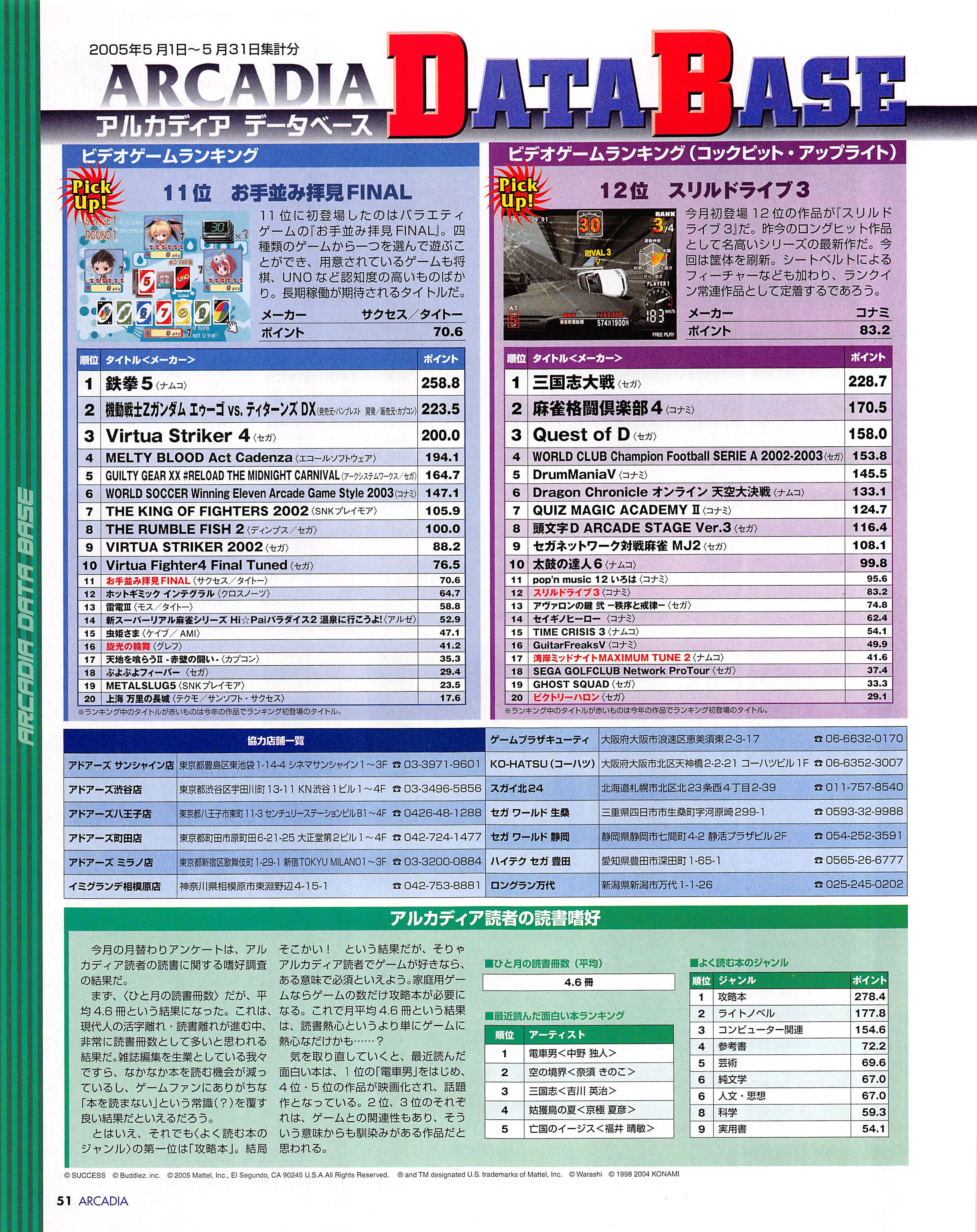
Outstanding work includes additional signup illustrations, full point/character/colour tables, reward/music catalogs, operator bulletins, Victory Furlong network details and shutdown coverage.
Additional commercial-period Victory Furlong evidence
Visual review confirms the game box's 24 March 2005 (operating) date. The article describes nationwide network competition for up to ten horses/players in one race, using AW-card-raised horses. Its race-list screenshot identifies the blue band as the network-race area.
The bottom Victory Stable feature explains Net Stakes — Net Stakes: a player creates a race, specifies its name, distance and entry conditions, and other players join. A password can limit participants, permitting arcade-organized or friends-only races. This is a new commercial-period witness beyond the November 2004 location-test material. The article does not supply network protocol, latency, every matchmaking condition, or proof every field contained ten humans.
Selected accompanying labels: Registration — Registration/entry, Training — Training, Care — Care, Feed — Feed, Raising mode — Raising mode, Challenge mode — Challenge mode. The printed raising flow is create horse → weekly training/care/race → retirement/breeding. Five attributes are speed, stamina, power, mentality and start. Parent varieties can be expanded through shop purchases or race wins. Neither this paragraph nor the pictured AP display supplies shared AW-point prices. These are gameplay screens, not mobile billing forms or wallpaper previews. Further selected English notes accompany the full-resolution original in the gallery.
Separate 2006 Guilty Gear mobile advertisement
The main advertisement is for PSP Guilty Gear Judgment, sale 24 August 2006, with ad-hoc two-player communication. The bottom strip advertises Guilty Gear Club — Guilty Gear Club, at http://gm-guilty.handybitway.com: apps, mini-games, ringtones and original standby/wallpaper illustrations. Its footnote says i-mode only. It does not name AW-NET, AW cards, shared AW-point prices or a balance transfer. Its relationship to the earlier AW GGX Mobile service remains unproven. No commercial AW-NET reward filename was recovered here.
That is a result for this query, not proof no private or unindexed copy exists.
The additional normalized phone/racing OCR pass generated 117 previously unreviewed candidate leaves. The other 111 remain OCR-only triage judgments, mostly other mobile services, unrelated game strategy or the ordinary Japanese verb “wait.” They are not 111 verified AW-NET sources. A further title/racing variant pass produced four OCR snippets explicitly about DOC Online or StarHorse. Original 85 keyword/45 broader candidate completion remains separate. Additional pass coverage, candidate snippets, racing variants.
Phone-reward false positives resolved visually
These clarify attribution without adding AW-point redemption evidence.
AOU News operator bulletin
A separate bulletin collection preserves 24 complete 2003–2004 issues and 38 individual historical 2005–2006 pages: 62 original PDF responses / 200 pages, not 62 complete issues. All pages received modern Japanese OCR and a reduced-resolution visual discovery survey; twelve selected full-page renderings have separate English context notes. The August 2004 page-six NEOWAVE advertisement carries an AW-NET badge and the claim “The series’ first network-compatible title.” Its summer-2004 planned-release copy is retained without overriding commercial release evidence. OCR missed the service logo/game title, demonstrating why keyword absence cannot prove absence. Other selected pages concern generic networks, retail loyalty, electronic money or physical phone accessories; none supplies a successful paid enrollment screen or reward-file catalog. Historical issue indexes and explicit PDF-link failures are preserved separately.
Visual advertisement-zone survey, October 2003–July 2004
All sixty modern contact sheets were visually screened. This is not an interior-page or full-issue audit. Twelve additional full-resolution pages were reviewed with separate English readings; one additional January Force Five response was already preserved and reviewed, so it does not increase the review count.
The October 2003 two-page Isuka/Atomiswave teaser advertises the September 11–13 AM Show and a secret item for September 13 visitors who bring the magazine. The item is an in-person promotion, not an identified AW-point phone reward. The November and December Isuka advertisement promises detailed AW-NET results analysis and editing; its simultaneous four-player team feature does not specify remote internet fighting. Force Five receives an AW-NET badge as an early-spring-2004 proposal.
The January Kintaro advertisement supplies four explicit mode icons: three-player mahjong, Daifugo, two-player Reversi and four-player Reversi. Its target is February 2004. These mode icons are separate from the earlier Tactics proposal. March–June adjacent advertisements reinforce nationwide matches, national rankings, touch-panel play and AW-card recording. Mixed Rumble Fish/Kintaro spreads carry central AW-NET branding but do not establish Rumble Fish compatibility.
The July facing campaign advertisement illustrates more than twenty AW-card designs including rare cards, unspecified planned NEOWAVE member services, and the first spring-campaign round: shared points plus a Roger plush lottery for 100 members, ending May 31. The overall campaign is advertised through June 30. The plush is a physical prize, not a downloadable phone background.
Second visual advertisement-zone survey, August 2004–May 2005
Across both passes, twenty issues now have 720 selected front/rear leaves screened in 120 sheets.
The September and October NEOWAVE blue/group and portrait-grid advertisements retain summer-2004 planned-release wording; cover dates alone do not establish actual release chronology. The November yellow portrait page says the game is operating to favorable reception and repeats in December. These facing illustrations add graphics but no registration form. The October Kenju preview, printed page 14, identifies an Atomiswave development exhibit with controls/release undecided, without an AW-NET compatibility claim.
The February 2005 NeoGeo Battle Coliseum website article, printed page 18, supplies two small desktop screenshots and names Q&A STATION, MUSEUM and a PREMIUM GALLERY planned for December. It does not attach an AW login, point price or phone download to those public-site features. Following its publisher lead recovered the public gallery and museum roots plus 36 gallery character pages from SNK’s current historical-site host. These are related publisher-site graphics, not recovered AW-NET phone-reward files. See the separate public gallery.
Other selected zones include Tekken.NET, D.NET, VS.NET, SNK WORLD mobile services, Sega Golfclub and ordinary home/gameplay coverage; attribution is recorded per issue in screening notes. Magazine postal ballots and local high-score submission forms are distinct from AW enrollment.
Their existing English notes/review records were reused. They are now included in the standalone gallery, which contains 161 reviewed JPEG responses. The combined review total remains 169, with eight reviews using other facsimiles. This corrects catalogue coverage; it is not six new historical findings. Confirmation audit.
Third visual advertisement-zone survey, June 2005–March 2006
A further 360 selected leaves were visually screened across sixty modern contact sheets, bringing the completed advertisement-zone survey to 1, 080 leaves in thirty issues. The full fallback image, March 2006 leaf 14 / printed page 13, was separately reviewed: ordinary Fist of the North Star strategy, with selected headings translated. It supplies no additional AW-NET service function. The original JPEG gallery now holds 162 reviewed responses, and the full page-review register 170 entries including other facsimiles.
Commercial-period NeoGeo Battle Coliseum promotion, Tougeki events, console editions and other companies’ networks were distinguished in the thirty issue-screen notes. No additional service-bearing full-page candidate was selected in this batch. The remaining eighteen monthly advertisement zones were subsequently completed in the follow-up below. The July 2004 appendix and interior visual discovery remain accessible. Thumbnails cannot establish small-print absence; they are discovery aids, not full translations.
Completed 2003–2006 advertisement-zone survey
The final eighteen monthly issues complete all 48 issues / 1, 728 selected leaves / 288 visually screened sheets. These are the first 24 and last 12 leaves of each issue, not complete issue interiors.
The January advertisement schedules Dolphin Blue, Maximum Speed and Sports Shooting USA for spring 2003. March/April Sushi Bar advertisements retain proposed release dates. The April AOU table, printed page 11, lists Premier Eleven among proposed 2003 software and identifies Guilty Gear X Ver. 1. 5 as an overseas Atomiswave product with domestic sale undecided. Neither appearance establishes AW-NET support. The May five-title platform advertisement is distinct from the five commercially supported AW-NET titles.
July Dolphin Blue/Demolish Fist advertising says summer planned release; the August variant specifies early August for Dolphin Blue and end of June for Demolish Fist. The September Dolphin Blue advertisement still prints an early-August plan. Preserve this advertising chronology without treating cover dates or proposals as actual launch confirmations. No AW-NET logo, shared-point shop or phone registration is shown on these eight pages.
The April–December 2006 selected zones contain other network systems, home-console editions and magazine reader questionnaires asking about handsets/mobile subscriptions. Those questionnaires are not AW-NET enrollment. All 48 issue contexts are recorded in the English screen notes. Magazine interiors, the July 2004 appendix, operator installation documents and successful paid phone enrollment remain open.
December 2003 interior discovery
These screens are discovery aids; unrelated small print has not been fully translated. Three selected full-resolution scans have separate English readings.
Printed page 54, scan leaf 55, offers physical Isuka plush straps/hand fans, Roger BIG plush, and a poster/clear-folder set through a postal magazine questionnaire. Its entry deadline is November 25, 2003, postmark valid. GGXX drinking glasses are a separate numbered prize. This is neither the later AW-NET Roger campaign nor an AW-point download.
Printed page 153, scan leaf 154, documents Isuka goods sold at September’s Tokyo Game Show in Makuhari. Captions identify Ky’s rosary Ver. 2 and the Isuka Zippo lighter; Roger plush merchandise is pictured. The bottom margin invites readers to submit proposed character colours as illustrations in an original-coloring contest, deadline November 20, postmark valid. It references choosing character colours in Isuka but supplies no shop price or editor instructions; it cannot establish unrestricted RGB customisation. This is a magazine reader-art call, distinct from official palette purchases and Guilty Gong voting.
Printed page 182, scan leaf 183, contains a Sammy staff joke about hoping for revenge against a colleague’s Millia when Isuka becomes four-player. No remote network play is specified. Konami’s nationwide Winning Eleven matches and Amusement Vision’s Internet F-ZERO rankings in other boxes belong to those companies’ games.
The interior gallery and selected English screening notes retain the discovery scope. The other 47 monthly interiors and July 2004 appendix remain accessible leads; successful paid registration and original phone reward files are still missing.
July 2004 general-catalogue appendix visual frontier
The new material comprises three Isuka/NEOWAVE cover-art reproductions and eight bibliography/context pages, including adjacent pages used to resolve rotated small-text attribution. These are not eleven new AW-NET feature witnesses. The current full-page review register is 192 entries / 184 unchanged reviewed JPEG responses.
The Isuka index, printed page 10, identifies introductions in issues 42–44 (November 2003–January 2004) and strategy in issues 45–48 (February–May 2004). It provides no page numbers or promise of service material. This strengthens source selection for the remaining interiors without establishing new gameplay/network features. GGXX and GGXX Reload entries on adjacent pages are separate titles.
Three preserved artwork pages translate printed publication captions: Isuka issue 43, December 2003 cover, released October 30, 2003, illustration by Hiroaki; Isuka issue 45, February 2004 cover, released December 27, 2003, illustration by Daisuke Ishiwatari; NEOWAVE issue 50, July 2004 cover, released May 29, 2004, illustration by Hiroaki. These dates describe magazine sale dates, not game or AW-NET launch dates. Artwork is reproduced in the later appendix, not an identified original AW-NET website asset or phone reward.
A small network feature initially suspected in the reduced preview was corrected from the full page 40: it is VF.NET and mobile phones, indexed in September 2001. A separate pre-monthly arcade-network essay likewise does not name AW-NET. Bibliographic references alone are insufficient service evidence. Full attribution corrections are retained in the English sidecars and sheet notes.
The selected December 2003 monthly interior and this entire appendix total 240 visually screened leaves / 41 sheets, separately from 1, 728 monthly advertisement-zone leaves.
January 2004 interior discovery completed
Together with December 2003 and the July 2004 appendix, the interior collection has 410 screened leaves / 70 sheets. The current full-page review register is 196 entries / 188 unchanged reviewed JPEG responses. Four added full-resolution readings establish context and correct preview attributions; they are not four new AW-NET feature witnesses.
The Isuka multiplayer page, printed 27, describes simultaneous matches of up to four people, team/individual combinations, shared team souls, manual facing and two combat lanes. It supplies no remote opponent transport or AW-point requirement. Printed page 35 contains Christmas reader art, anticipation of Isuka and a physical signed drama-CD giveaway. A suspected colour-contest continuation was not established from the full original.
The postal prize page, printed 54, closes December 25, 2003, with that day's postmark valid. Relevant prizes include CAPCOM/SNK/Sammy collectible figures, Sammy rabbit mugs, signed GGXX Drama CD BLACK and A.S.H concert tickets. The small preview initially suggested T-shirts; the full scan corrects it to figures and mugs. Readers applied through the magazine questionnaire by post. These prizes are distinct from AW-NET point redemption, mobile enrollment and the later Roger campaign. The Sammy publisher comment, printed 182, promotes upcoming Seven Spirits without an AW-NET service announcement.
Other screened pages discuss e-AMUSEMENT, BG 3 Garage, VF 4 items, eeMALL, mobile game columns, magazine coupons and editorial high scores. Their customisation, points and network functions belong to their respective services. The preserved signup/Web Garage material on leaves 25–27 and October developer interview on 53–54 were already reviewed. No additional successful paid enrollment or original phone download was recovered.
February 2004 interior discovery completed
All 186 selected interior leaves (24–209) of ARCADIA February 2004, issue 45, received a reduced-image visual screen across 31 contact sheets. Combined with December, January and the July catalogue appendix, the interior survey now has 596 actually screened leaves / 101 sheets. This is a discovery screen; it is not a full translation of every article.
A new unchanged full-resolution printed page 32 / scan leaf 33 presents an Isuka Original Color Contest reader-art showcase. The selected English reading identifies its card-system/colour introduction and selected recolor captions, while distinguishing proposals from proven shop inventory or phone rewards. No submission URL, editor controls, adoption rules or price appears in that panel. English note and scope. The nearby ¥3, 200 two-disc Korean-version #Reload soundtrack is a commercial CD, not an AW-point ringtone pack.
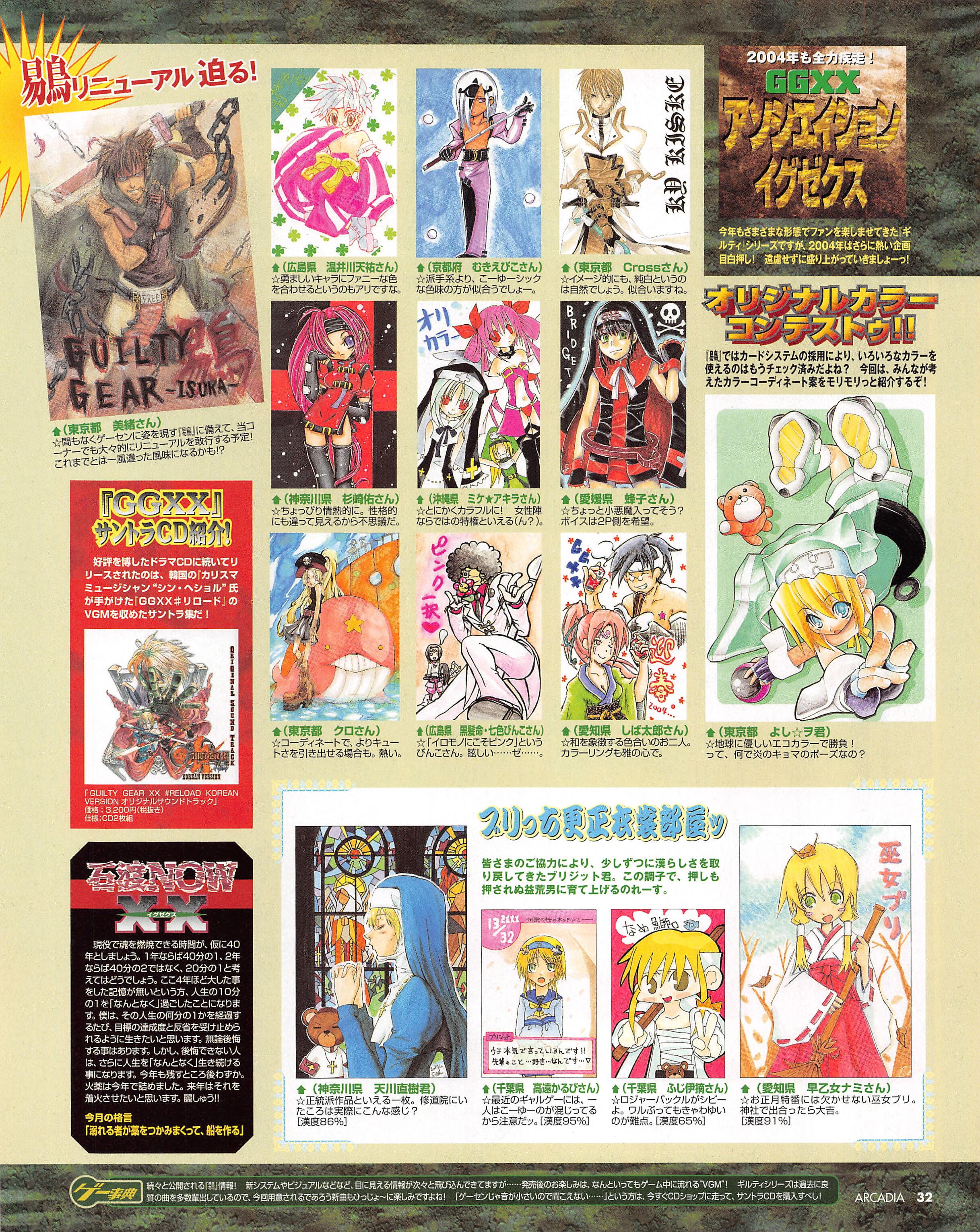
The other interiors cover KOF 2003, Wartran/e-AMUSEMENT, Battle Gear, WCCF/Avalon, Monster Gate Online, physical prizes, publisher New Year artwork, reader correspondence and printed score tables. Their cards, nationwide lists, rankings, coupons, illustrations and music are not additional AW-NET functions. Existing full reviews of leaves 24, 149, 156 and 199 remain reused.
March 2004 interior responses are being retrieved next.
March 2004 interior discovery completed
All 170 selected interior leaves (24–193) of ARCADIA March 2004, issue 46, received a reduced-image visual screen across 29 contact sheets. The December–March monthly interiors and July catalogue appendix now total 766 actually screened leaves / 130 sheets. Selected full readings are linked from the facsimile gallery, with originals unchanged and English notes separate.
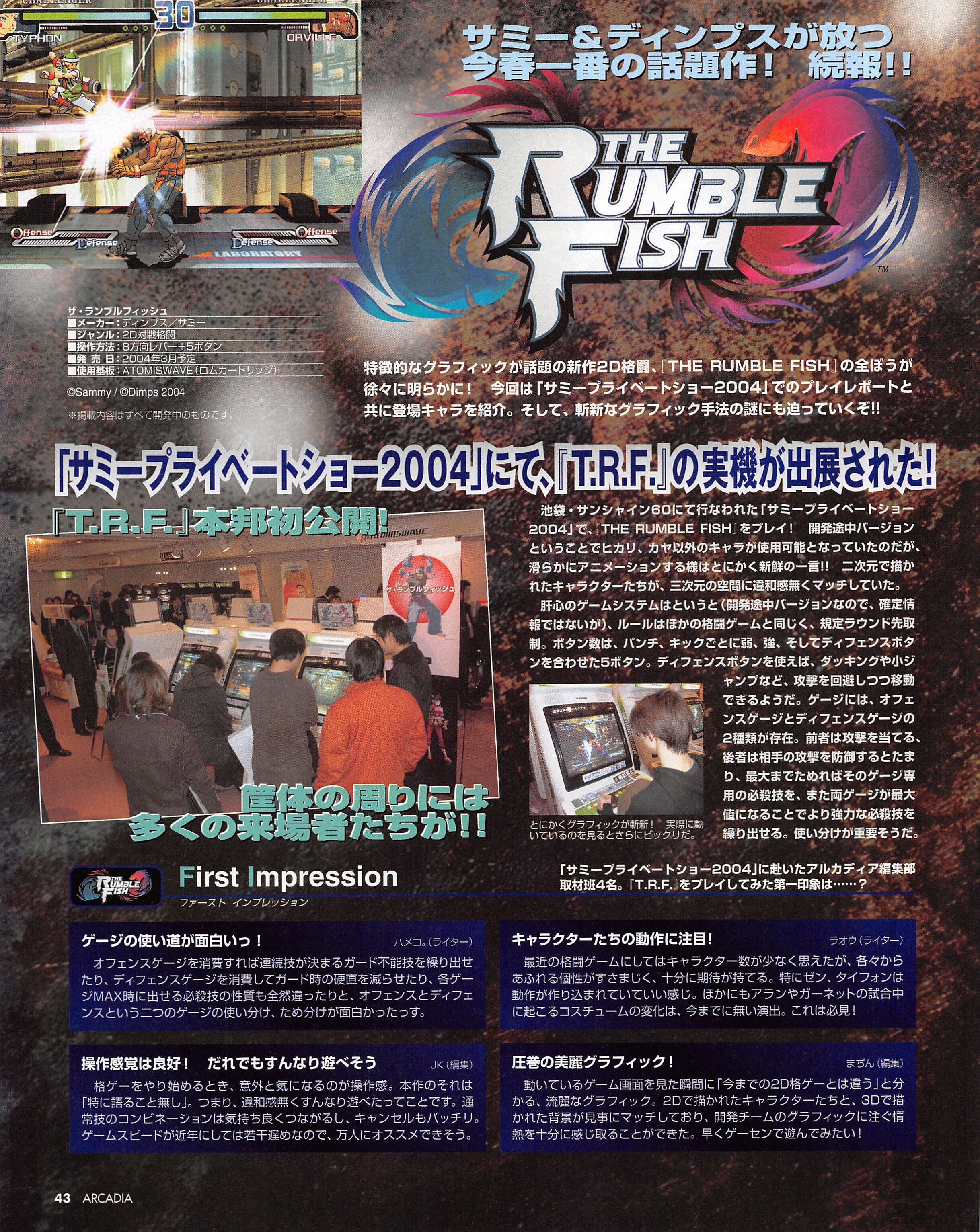
Four full context checks add scope corrections, rather than four new AW-NET feature witnesses. Leaves 44 and 46 introduce The Rumble Fish and its normal gameplay: the WINNER display is a match-result screen, not an AW card, and the printed development information supplies no AW-NET enrollment or palette shop. Leaf 72 contains Isuka reader art and concert commentary; “Bring it on, even three against one,” not a March 1 service announcement. Leaf 186 confirms the recommended fan-site list concerns Tekken, correcting a tentative Isuka attribution from a reduced preview.
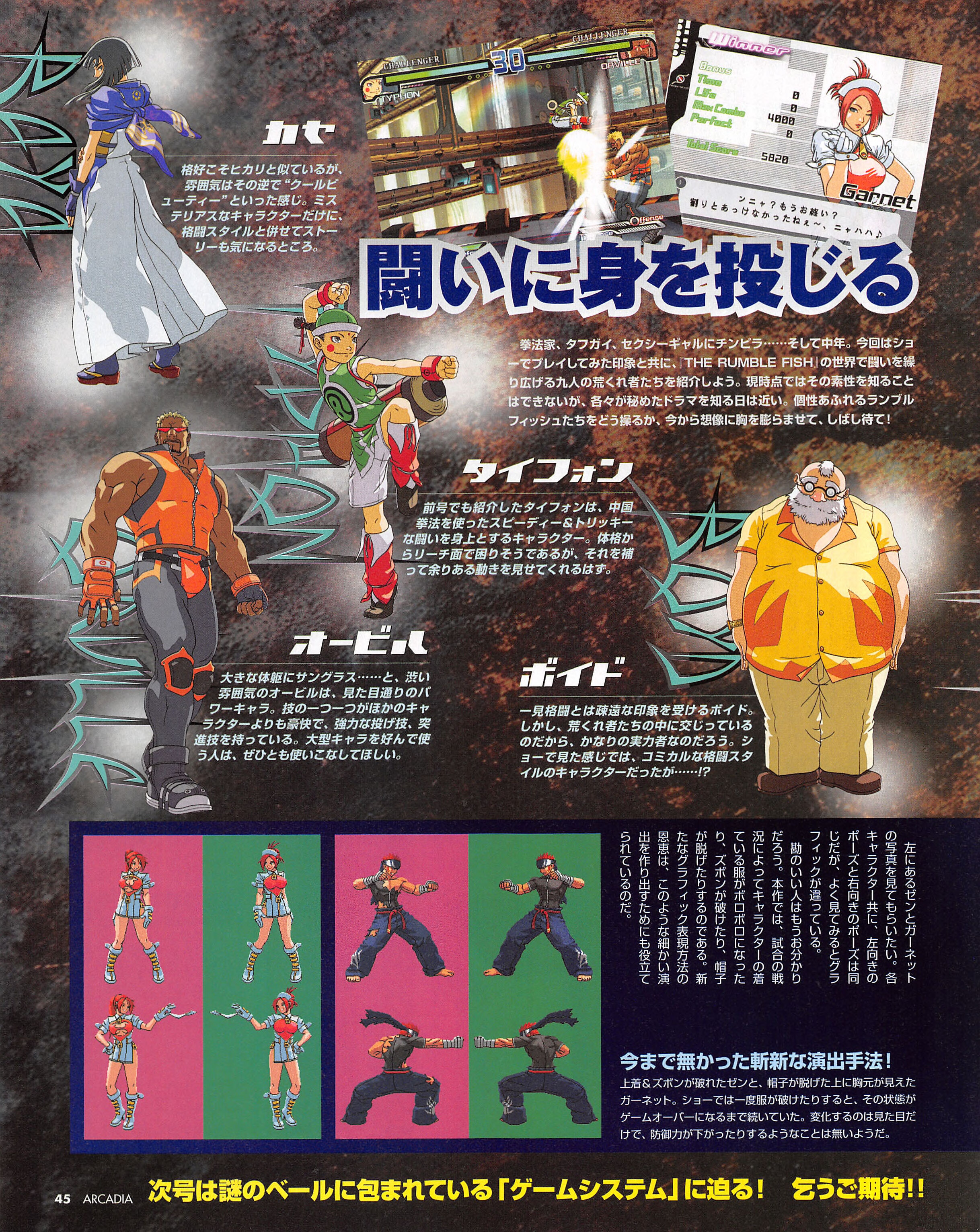
Nearby pictured phone ringtone/wallpaper menus belong to Konami eeMALL. Zoids NESYS, Dragon Chronicle, Battle Gear, Initial D, Xbox Live and other networks have distinct cards, stores and registration paths. Magazine physical prizes, Puyo Puyo concept art, original-colour reader submissions and editorial high scores are not authenticated AW-point phone downloads or AW-NET online rankings. Existing Isuka EX/class pages remain previously reviewed evidence.
The review register now contains 201 entries / 193 unchanged reviewed JPEG files. April 2004 retrieval is underway.
April 2004 interior discovery completed
All 188 selected interior leaves (24–211) of ARCADIA April 2004, issue 47, were preserved and screened across 32 contact sheets. Five monthly interiors plus the July catalogue appendix now total 954 actually screened leaves / 162 sheets. Full-page English context readings are in the separate sidecar and unchanged facsimile gallery.
Leaf 49 / printed 48 concerns physical Sammy’s Street arcades, including Motoyawata and Hamamatsu openings on February 11. The magazine promotion offered 100 physical medals to readers bringing the issue for a stamp during March 1–30. It is not an AW-point or phone offer. Leaf 50 / printed 49 reports the first official Isuka Strongest Tag Tournament on February 11 at Sammy Street 156 Sagamiono: 42 teams, winner Mana-o/Kurage, Arc System guests and physical signed-folder/poster reader prizes. It supplies no server-hosted tournament bracket or mobile registration screen.
Leaf 168 / printed 165 requests two-to-four-person Isuka team fan art and shows Sol/Dizzy/Bridget physical background figures planned for December 2004. These illustrations are not authenticated mobile wallpapers. Leaf 201 / printed 198 is a Sammy publisher’s Rumble Fish naming joke, not an AW service announcement. Existing full checks of point tables/EX pages remain reused. Other discovered phone/card interfaces belong to Konami and other named services; reader coupons, school adverts, game concept artwork and printed high scores are separately classified.
May 2004 interior discovery completed
All 170 selected leaves of ARCADIA issue 48 (May 2004), scan leaves 24–193, were preserved and actually screened across 29 contact sheets. This brings the interior/appendix survey to 1, 124 leaves /191 viewed sheets.
Printed pages 48/50 distinguish Xbox Live Guilty Gear XX #Reload remote fighting and voice chat from SegaMEDALiD/SegaMoba simulated medal games, eMEDAL and physical venue coupons. Their phone/network features are separately attributed and do not establish AW-NET capabilities or the benefits of its later 2006 Thanks Campaign. Printed page 152 shows magazine reader art, an Ishiwatari column-mascot naming call and a separate wish for a physical phone strap. None is an authenticated AW-point wallpaper or ringtone release.
Six production-reference pages (printed 170–175) provide Isuka storyboards and key-animation drawings. Selected printed captions are translated; tiny handwritten instructions remain partly illegible. Printed 183–184 advertise the physical Isuka soundtrack KDSD-00036 for April 21 at¥2, 940 including tax and interview Ishiwatari/Suzuki about its production. Track 3 is Exceptional Routine Work, also the later Guilty Gong selection’s title.
The July 2004 general-catalogue appendix and all 48 front/rear advertisement zones have separate completed coverage. June 2004 interiors are the next discovery pass.
June 2004 interior discovery completed
All 170 selected interior leaves of ARCADIA issue 49, scan leaves 24–193, were preserved and actually screened across 29 contact sheets. Five new full-resolution English readings supplement the twelve June pages already reviewed.
Printed page 176 / leaf 177 explicitly defines Isuka alternate characters as adjusted versions of home #Reload EX characters. It says they can be bought on the web by spending points accumulated through the card system; default characters are called normal. The article provides no price or successful purchase screen. Its guard balance, attack level, Soul and other combat gauges should not be confused with shared AW points.
Printed page 177 / leaf 178 says one AW-NET enrollment provides services across compatible games, including saved player/battle data and play/result-linked shared points usable for content. At that time Isuka alone is operating; Kintaro is in location tests, Force Five is expected and NEOWAVE is announced as compatible. This is dated operating/test/development evidence, not proof that Force Five eventually shipped.
Printed page 152 / leaf 153 distinguishes Isuka team reader art and a caption about customizing a character colour from the PS 2 announcement: a July release was planned, price undecided, with home-only GG Boost mode, a new character and multitap four-player support. These are home-product features. The mascot naming call is for the Angel Eyes XX column.
Printed page 169 / leaf 170 lists fourteen Roboky/#Reload fan sites and four related ring/union directories, covering fiction, illustrations, comics, boards and fan circles. Eighteen manually transcribed URL leads retain source and transcription limits; retrieval outcomes govern later use. Printed page 179 / leaf 180 wishes for NeoGeo game revivals and jokes about four-player baseball on an Isuka cabinet. It announces no additional compatible title.
Other screened network systems and rewards remain separately attributed: Battle Climaxx/e-AMUSEMENT, Dragon Chronicle, Avalon, WCCF, Battle Gear, Xbox Live, Venus Online/Cats-net and Sega medal products. The already preserved April 28 AW-NET renewal/campaign report and Kintaro location-test publisher comment are reused. No successful paid phone enrollment or original purchased ringtone/wallpaper file was recovered.
July 2004 interior discovery completed
Existing full readings of the Kintaro nationwide match/preset-message article, NEOWAVE preview and spring campaign were reused. Two additional unchanged full scans and scoped English readings distinguish Namco’s prospective Tekken 5 network features from AW-NET and identify the magazine’s Angel Eyes XX mascot as Chimaki. The naming prizes were specially drawn autograph boards, not phone downloads or AW-point purchases. Reader art, home Xbox features, D.NET/Zoid Base/Konami mobile services, physical coupons and printed high scores remain separately attributed. The magazine register now has 223 reviews / 215 preserved original-response JPEGs; the interior/appendix survey covers 1, 472 leaves / 250 sheets, all screened. Paid mobile enrollment screens and actual reward files remain unrecovered.
August 2004 interior discovery completed
All 162 selected interior leaves 24–185 were preserved and actually screened across 27 contact sheets. One additional full Kintaro rules/withdrawal page, printed 75, and a scoped English reading add an in-match withdrawal button shared by its games: exiting counts as loss or bottom place. Daifugo sets have three rounds/up to four players; Reversi has one round; mahjong uses the three-player rules shown. The local magazine/Sammy demonstration photographs do not independently establish remote transport. Existing August full readings for carrier menus, NEOWAVE customisation, home PS 2 colour editing, physical prizes, local Isuka tournaments and horse-video previews were reused. Separately named TekkenNet/ALL.Net, Zoid Base/NESYS, Mahjong Fight Club, medal entry cards, publisher phone services and printed score tables remain separately attributed.
September 2004 interior discovery completed
All 170 selected interior leaves (24–193) were preserved and actually screened across 29 contact sheets. Existing full readings of NEOWAVE’s colour/rank/melody article and the card-album ID wallpaper campaign were reused. One additional unchanged full page and scoped English reading record Sammy Plaza’s July 2 opening in Osaka and a prospective home Rumble Fish release. This publisher box does not establish AW-NET support. NEOWAVE roster/design art, other services’ mobile accounts, fan illustrations and the generic summer questionnaire retain separate attribution. Paid mobile enrollment and original purchased reward files remain unrecovered.
Interior follow-up: presets, records and attribution
All 170 interior leaves (24–193) were visually screened across 29 sheets. Five unchanged full-resolution responses have selected English readings and appear in the original-page gallery.
Printed page 155 explicitly describes alternate NEOWAVE colours bought with shared AW points, including changes to skin colour, and invites reader illustrations. This is evidence for purchased palettes, not a free RGB editor or fan drawings sold as phone rewards. A separate 25-reader physical phone-screen cleaner giveaway is not a wallpaper download. Unchanged page. Printed page 133 confirms AW-NET play-information viewing and character editing beside local tournament schedules; these schedules do not demonstrate remote fighting. Unchanged page.
Printed page 60 covers Geese as a boss and Orochi characters purchasable through AW-NET. It mentions checking win rates and rankings between fights; it gives no Geese purchase procedure or price. Unchanged page.
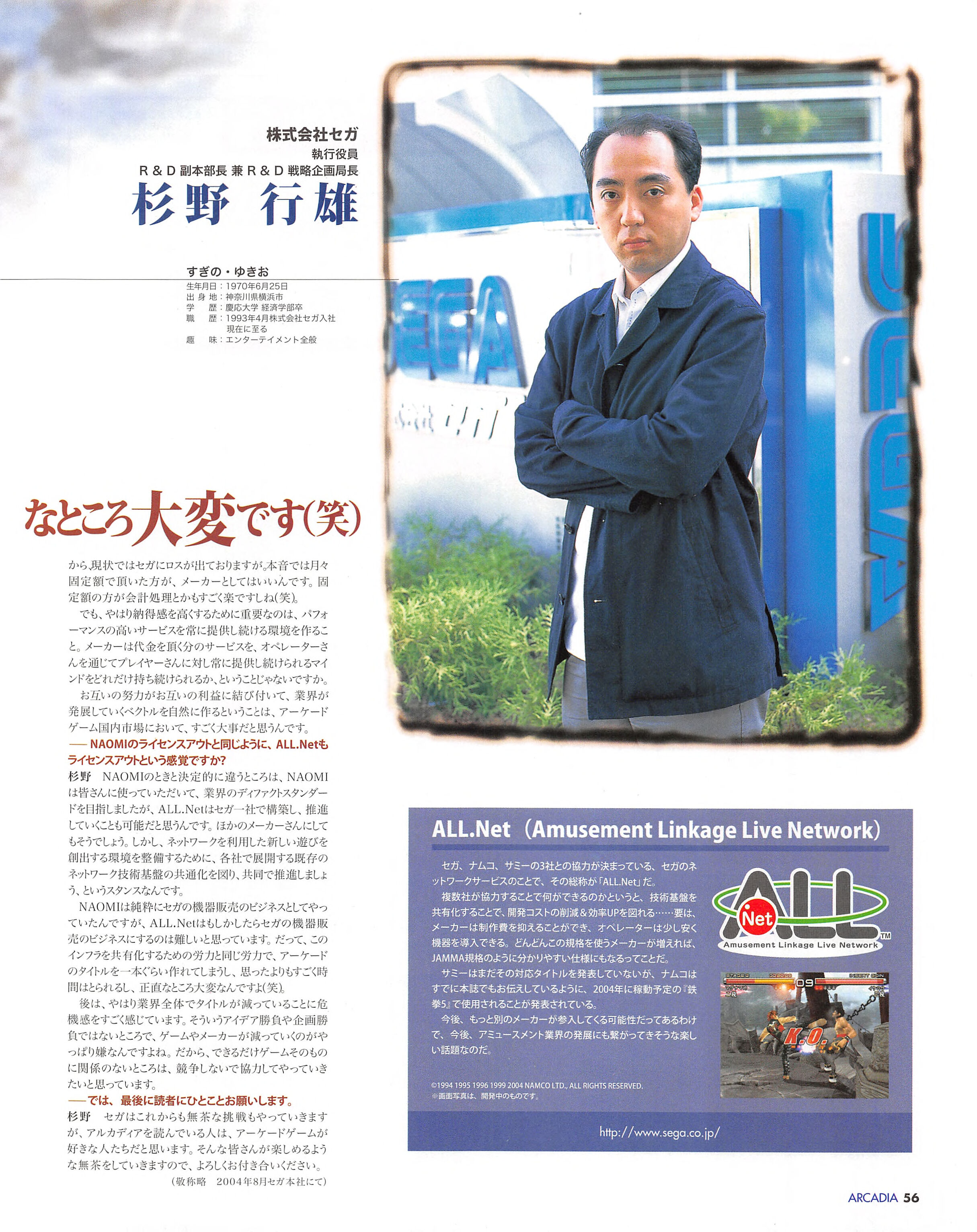
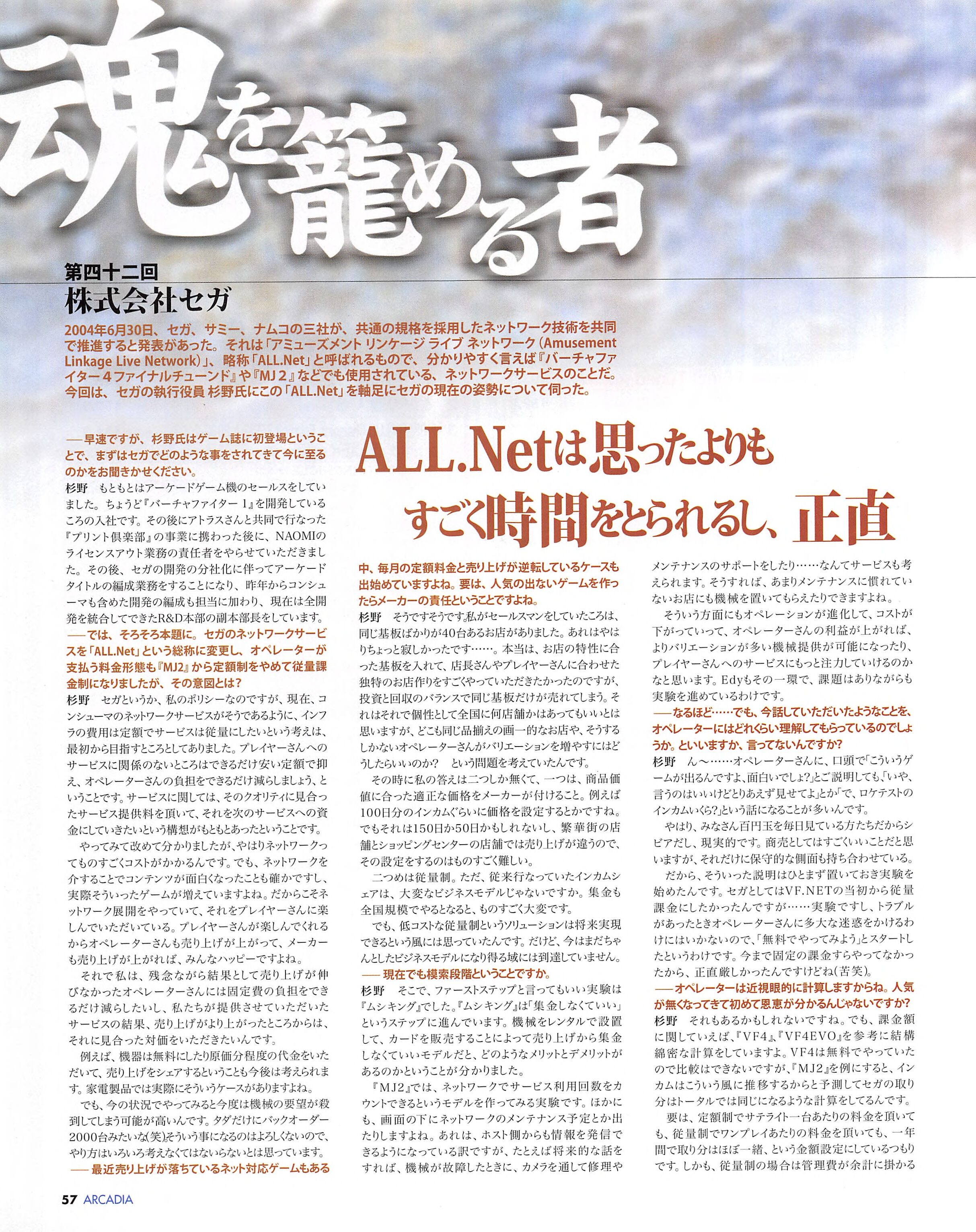
Printed pages 56–57 contain a Sega interview and the separate June 30, 2004 ALL.Net announcement. Common infrastructure and operator billing are discussed; hypothetical arcade per-play fees and MJ 2 billing do not establish AW-NET user fees or account migration. Page 56, page 57.
November 2004 interior follow-up: extra-character palettes and card context
All 170 interior leaves/29 sheets were actually viewed. Printed page 87 shows 24 palette references: Ramon, Vanessa and Kim each have four button colours and Alternate 1–4. The preceding AW-NET column supplies the palette price; these sprite references are not phone reward files. Unchanged palette page.
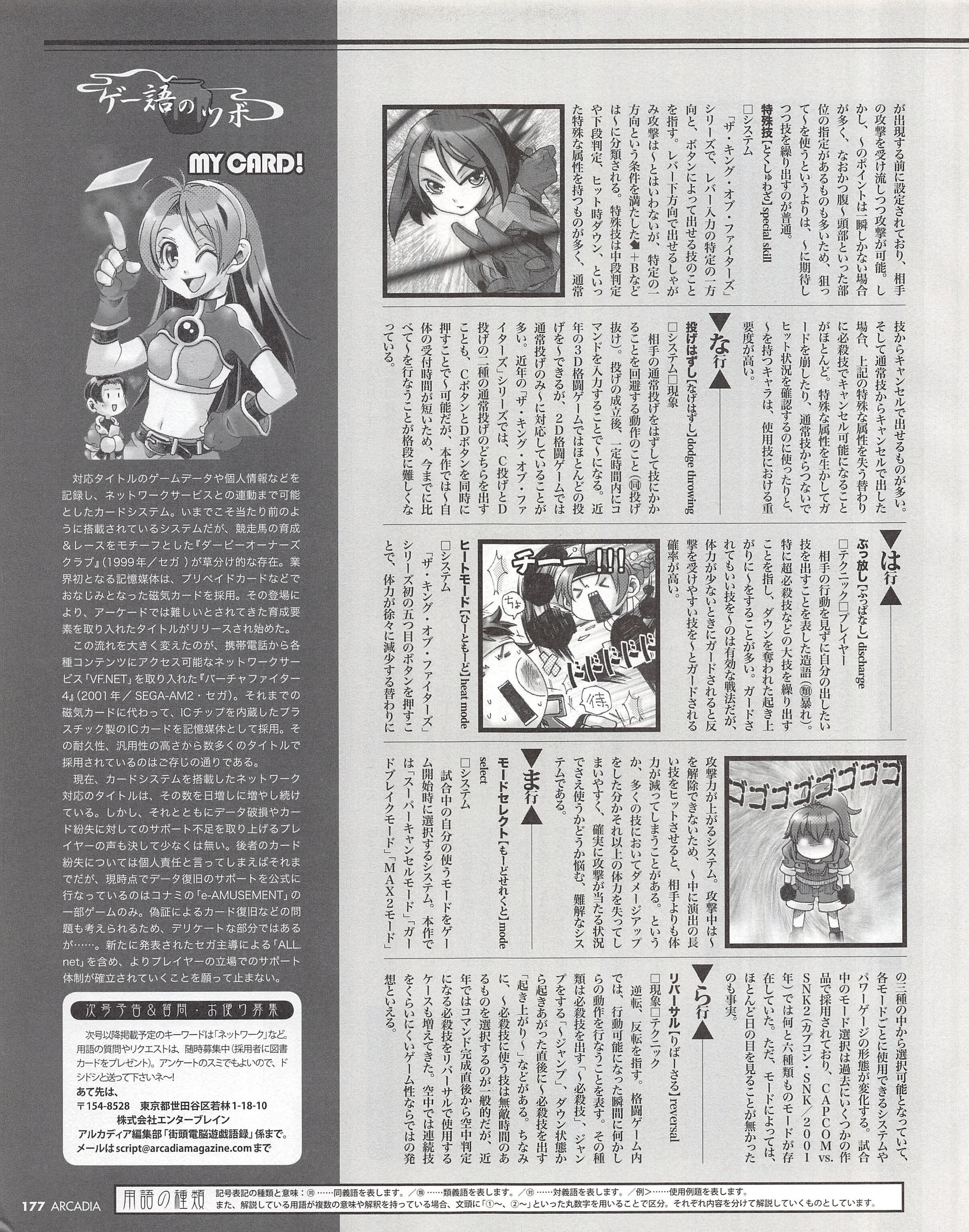
Printed page 176 explicitly describes network/card records and new-character purchases, followed by ordinary combat definitions. Unchanged glossary introduction. The adjacent MY CARD editorial distinguishes Derby Owners Club magnetic cards, VF 4/VF.NET IC cards and general card-data recovery concerns; these descriptions do not identify AW-card technology or AW-NET recovery policy. Its next-issue keyword is network, providing a December 2004 lead; the subsequently viewed December issue instead uses an arcade-TCG theme, as recorded below. Unchanged editorial.
December 2004 interior follow-up: Geese price and glossary attribution
All 172 selected interior leaves in issue 55 were actually viewed across 29 contact sheets. Combined interior/appendix coverage is 2,316 leaves across 393 viewed sheets; this reduced discovery survey does not represent a full translation of unrelated articles.
Printed page 91, leaf 92: Geese purchase notice and profile independently gives 3,500 AW points and planned early-November 2004 AW-NET availability, describing different properties from the CPU boss. The page warns that unlock plans may change. This does not replace player reports of purchases on 25 October with a later inferred first release date. The already reviewed printed page 95 advertises a separate 3,500-shared-point membership gift through November; the equal amounts are not proof of a recurring allowance. No purchase form is shown.
Printed page 28, leaf 29: NeoGeo Battle Coliseum system preview describes planned 2-on-2, one-round battles, partner changes and Double Assault, with a 2005 release planned and development material subject to change. The two characters are a player’s fighting-game team; this page does not establish remote AW-NET PvP or four simultaneous human players.
Printed pages 178–179, leaves 179–180: glossary opening and continuation use the actual theme arcade TCG, discussing WCCF, Quest of D, Key of Avalon, physical card rarity/trading and starter kits. November had advertised “network” as the next keyword, but the actual December issue does not deliver that theme. IC-card starter sets, card-dispensing percentages and real-money physical-card trading are not AW-NET registration, AW point rules or phone rewards. Its next-keyword box names Capcom Fighting Jam and Tekken 5 among planned topics.
Other surveyed pages include separately named MJ.NET registration, VF.NET, Xbox Live Isuka, Idolmaster customisation, reader-created colour illustrations and physical prizes. They are recorded with their product attribution. Paid mobile enrollment and original phone download files remain unresolved.
January 2005 interior follow-up: eight NEOWAVE event titles
All 170 selected interior leaves in issue 56 were actually viewed in 29 contact sheets. Printed page 110, unchanged full scan gives the complete eight-row title-condition table: カリスマ/豪腕 for $5,000/$10,000 Fight Money; 鬼人/拳客 for 30/70 rings; 心眼 for $5,000 and 30; 巧 for $10,000 and 70; 達人 for $15,000 and 100; 超人 for $20,000 and 120. Both thresholds apply where printed together. These earned-title conditions are separate from shared-point shop costs; the wording does not define accounting period or current-versus-cumulative acquisition. Japanese labels and scoped English reading. A possible year-end/New Year event is explicitly a rumor.
Existing Xbox Live Isuka and CAVE mobile readings remain separately attributed. The Metal Slug fan directory on leaf 169 is an additional discovery lead, not AW-NET support evidence. No paid registration or original phone-download file was recovered.
February 2005 interior follow-up: publisher artwork and NeoGeo Battle Coliseum public-site channels
All 186 selected interior leaves in issue 57 were preserved and actually screened in 31 contact sheets. Three additional unchanged full scans and English readings bring the magazine review register to 241 records / 233 standalone JPEGs. Existing NEOWAVE combat-tier, Victory Furlong development-list and NeoGeo Battle Coliseum preview readings are reused.
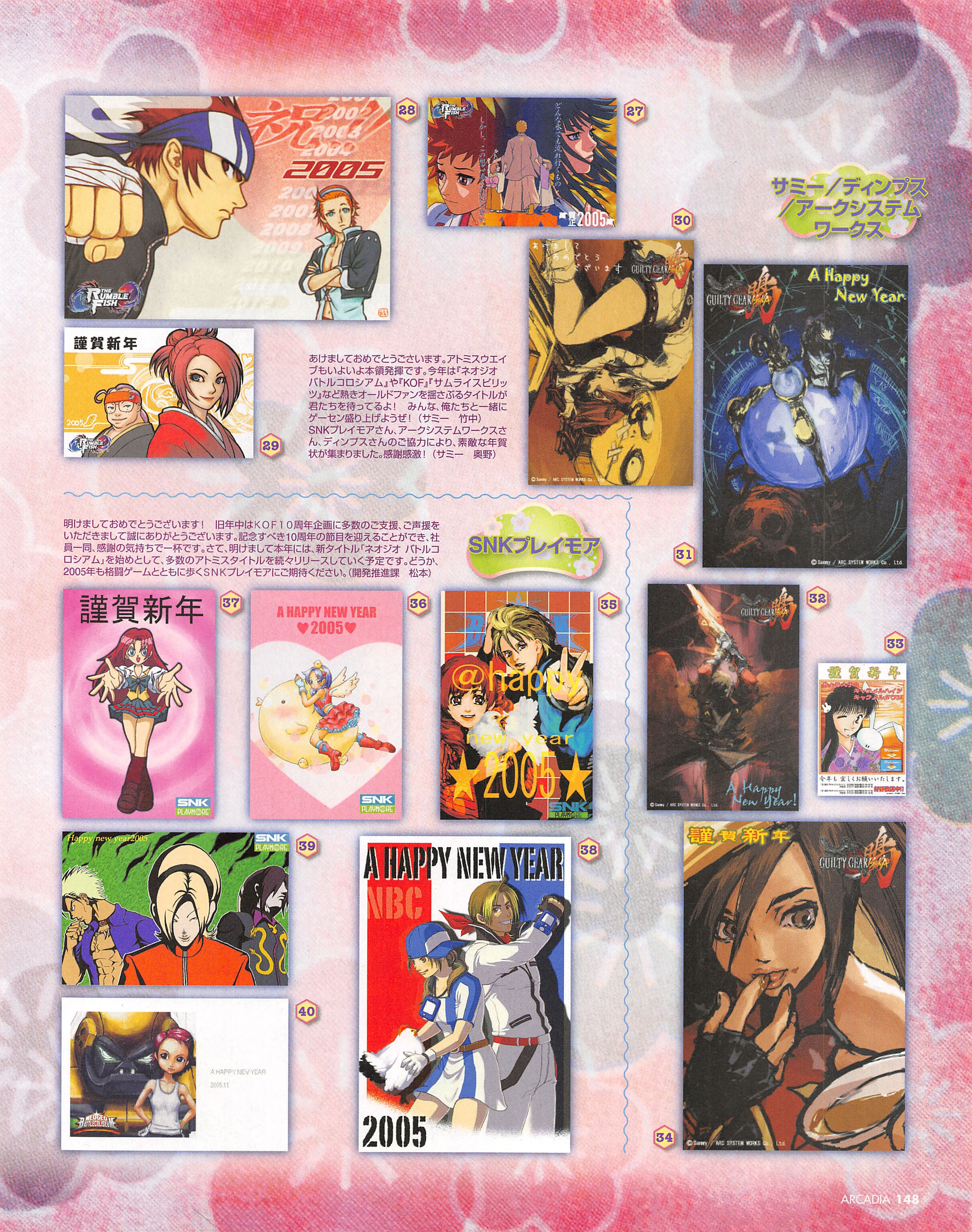
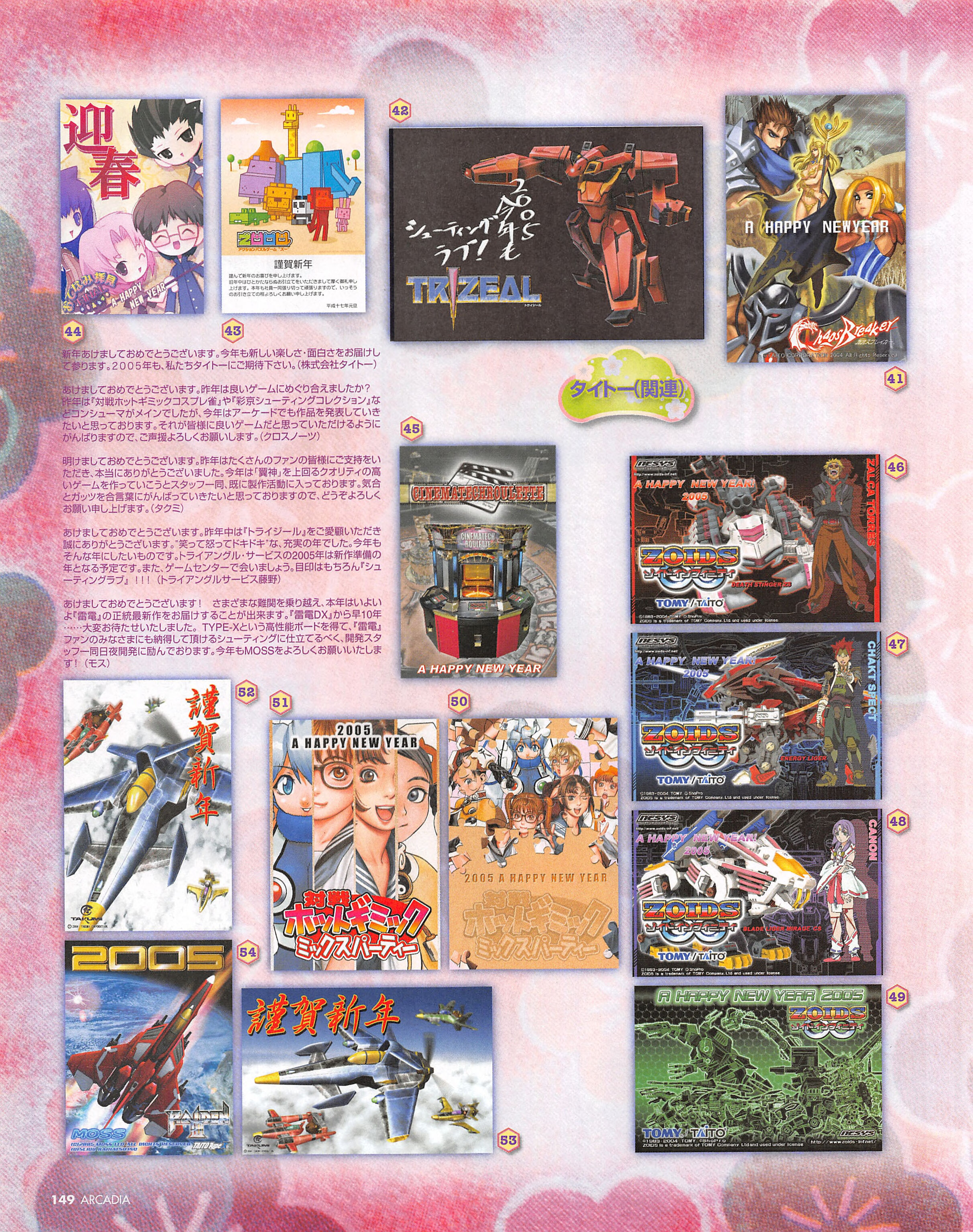
Printed page 148 reproduces manufacturer New Year artwork for NeoGeo Battle Coliseum (number 38), NEOWAVE (39) and four Isuka illustrations (30–32, 34). Japanese greetings are translated separately. Sammy/SNK comments anticipate further 2005 Atomiswave titles, without establishing AW-NET support for every named release. Printed page 149 verifies the neighboring Taito-related artwork attribution.
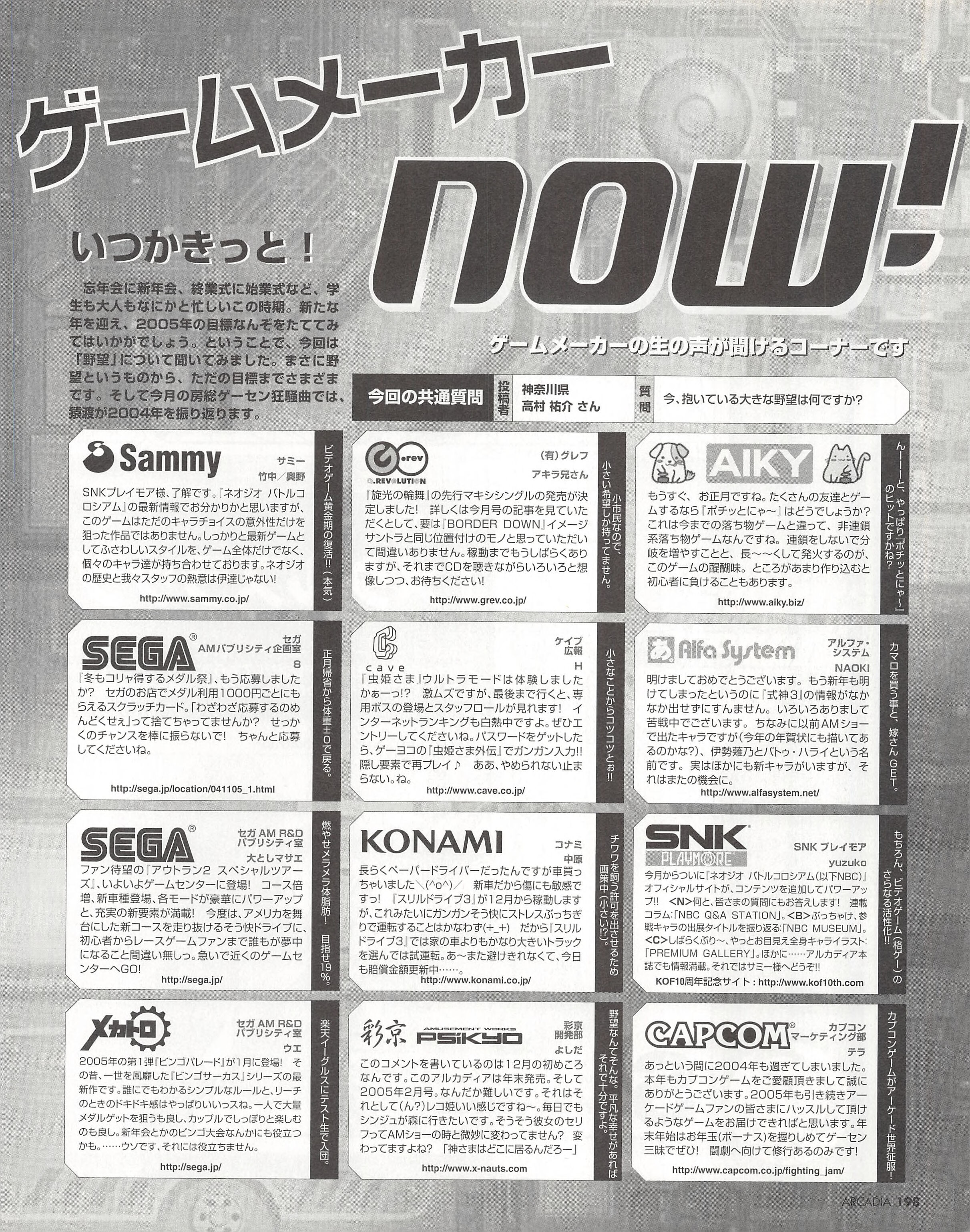
Printed page 198 announces three NeoGeo Battle Coliseum publisher-site additions: Q&A Station answers reader questions, Museum reviews participating characters’ source games, and Premium Gallery presents full-body illustrations. Its February cover month is not an exact channel launch date: a comment on the same page identifies writing in early December and year-end sale. These public publisher channels are separate from the AW-NET member shop and registration flow.
Cumulative completed interior/appendix coverage is 2,672 leaves / 453 viewed sheets.
March 2005 interior follow-up: NeoGeo Battle Coliseum preview artwork and publisher context
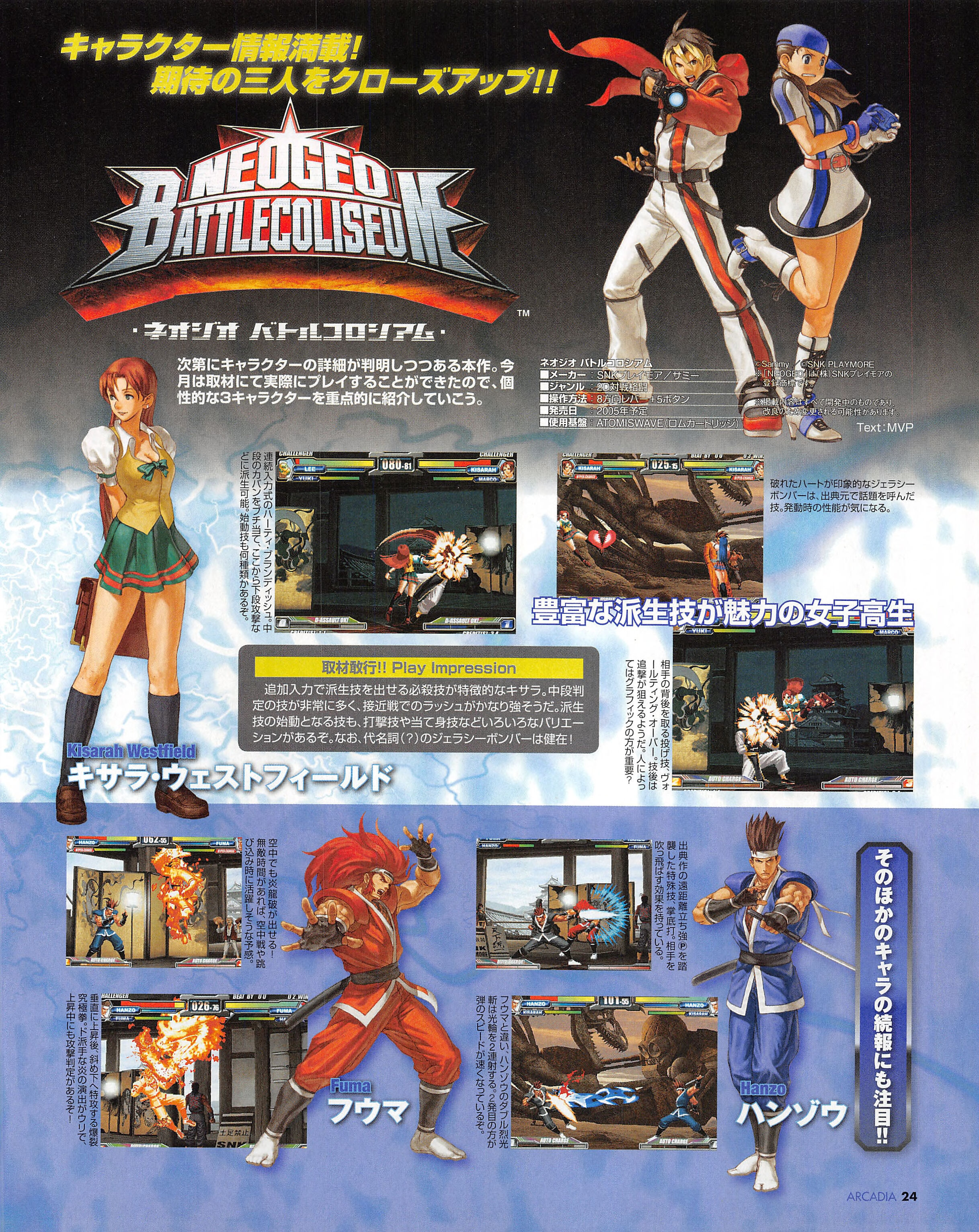
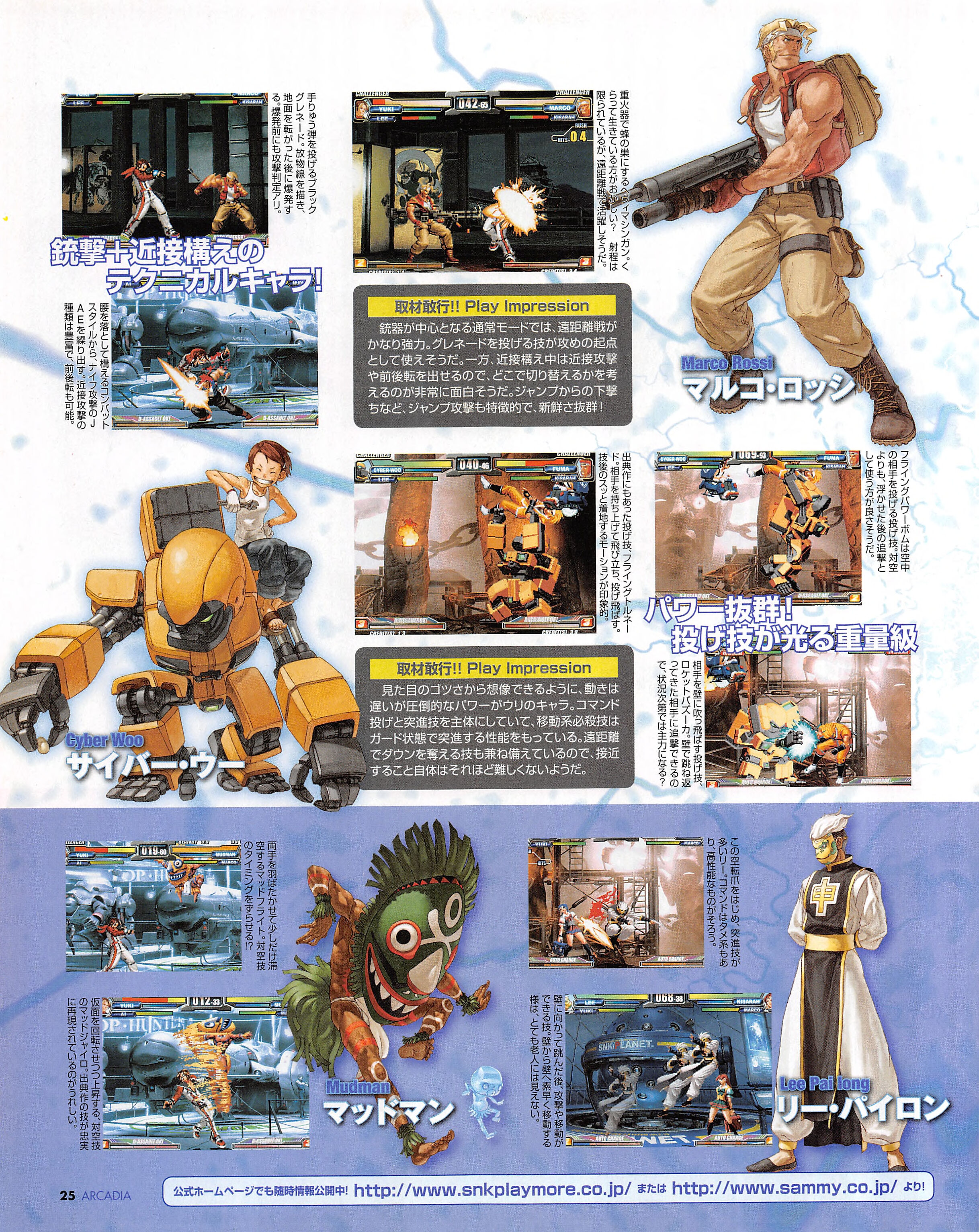
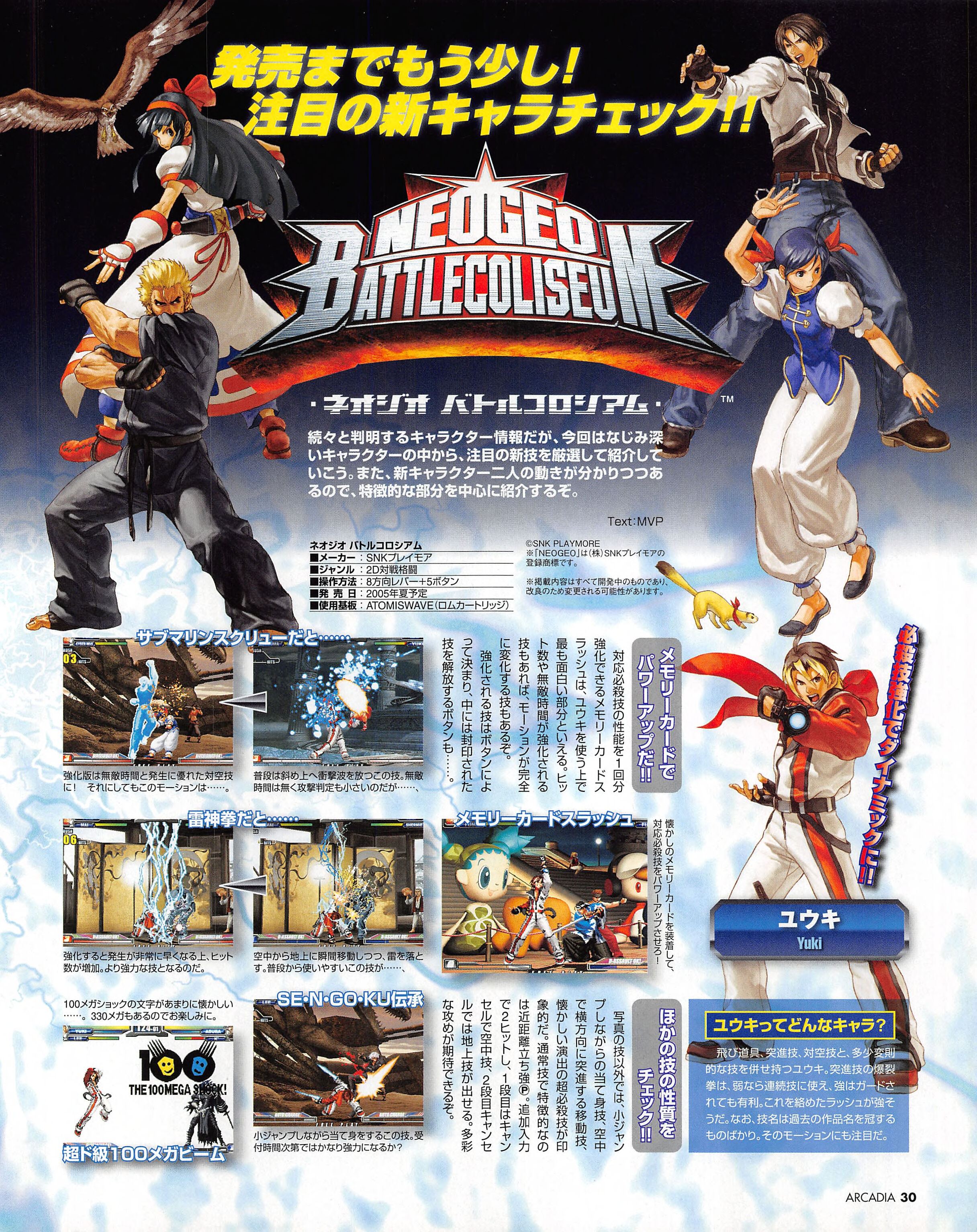
All 162 selected interior leaves in issue 58 were preserved and actually screened across 27 sheets. Printed page 24 and page 25 reproduce NeoGeo Battle Coliseum character art and 17 development gameplay screenshots: Kisarah, Fuuma, Hanzo, Marco, CyberWoo, Mudman and Lee Pai Long, with Yuki/Ai header art. Their ordinary move previews and public publisher links are distinct from AW-NET paid unlocks, phone downloads and member screens. The article explicitly warns that development material may change.
Printed page 174 has Sammy asking upcoming AOU visitors to play NeoGeo Battle Coliseum and submit impressions, and SNK recalling the crowded NeoGeo Battle Coliseum movie screening at the KOF tenth-anniversary celebration. Neither comment gives signup steps, point awards or shop additions. Neighboring CAVE phone content belongs to CAVE. The March cover date is not an exact event or service-launch date.
The QMA fan directory on leaf 161 remains a lower-priority discovery lead with separate game attribution. Other viewed mobile/customisation/card screens belong to named Tekken, Konami, VS.NET, Tetris, golf, Cobra and Idolmaster systems. No new paid enrollment screen or original phone reward file was recovered.
April–June 2005 interior
All selected April, May and June interiors were actually screened: 188/170/170 leaves across 32/29/29 sheets.
April readings preserve NeoGeo Battle Coliseum character art and 16 development gameplay/CPU screenshots. Its Athena/Mars People caption asks whether players can use them; it is speculation at that date, not a verified unlock rule. May readings explicitly announce web purchases of special colours, victory messages and hidden characters; describe player-name/title display and experience; and identify card-triggered Athena/Mars People. All retain the development caveat. Printed page 52’s mobile entry is Bato Culture — Bato Culture. The side caption asks what the item is without explaining its contents.
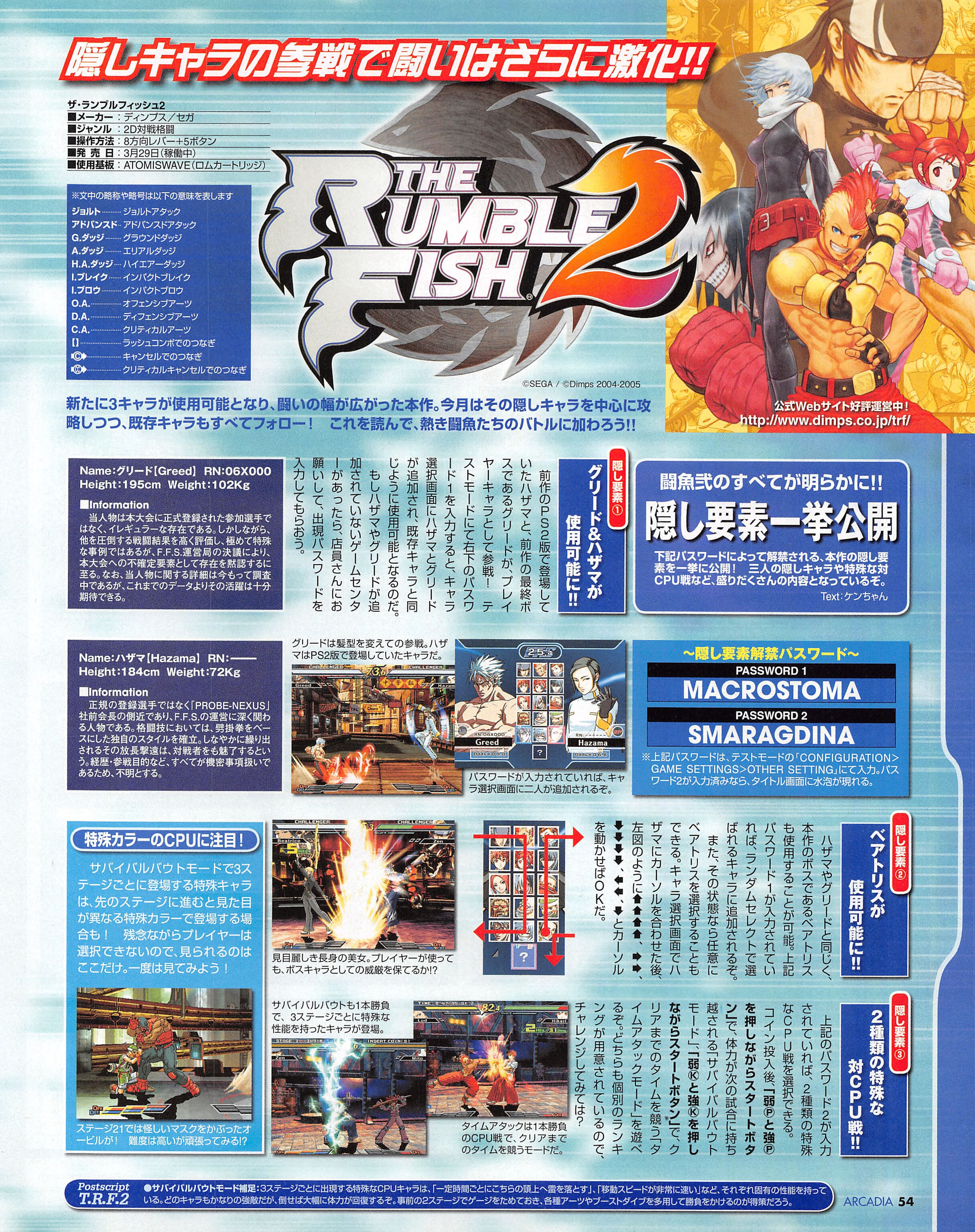
June printed page 31 explicitly labels the palette/message currency shared AW points — shared AW points, supplies eight sample sprites (four Kyo, four Iori), and illustrates the victory line Remember this every time you look at the moon! — Remember whenever you look at the moon! It does not give purchase prices or enrollment forms. Yuki’s “Memory Card Slash” on printed page 30 is an ordinary gameplay move, not the physical AW card or a member function. Rumble Fish2 printed page 54 gives local operator passwords MACROSTOMA/SMARAGDINA via test-mode settings. These are not evidenced AW-NET web purchases; its CPU-exclusive colours are not a member palette catalog.
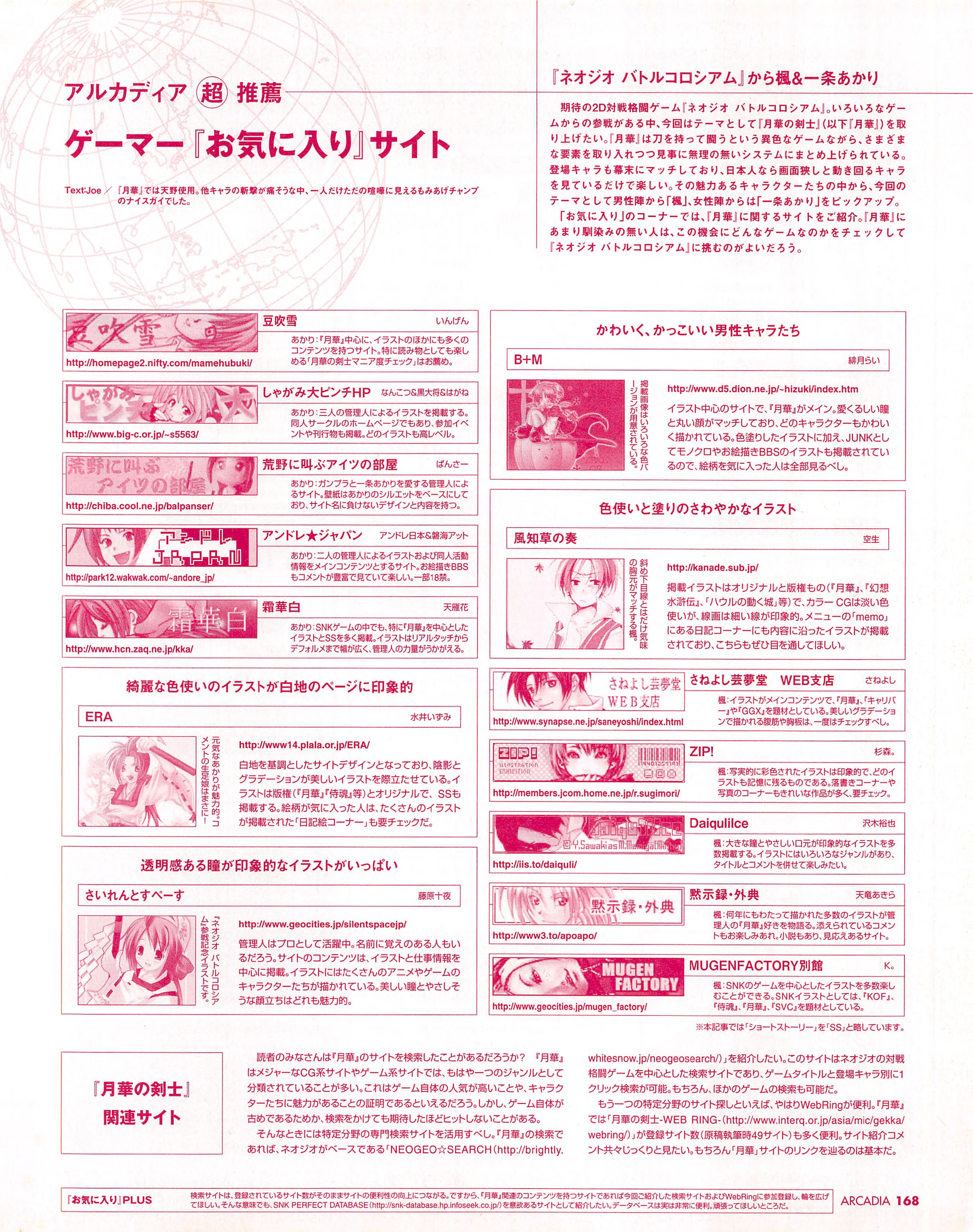
May’s Last Blade fan directory supplies 17 manually transcribed Japanese URLs. The separate fan-source readings distinguish archived entrances, fan music/art, host advertisements and personal credentials from AW registration and rewards. The newly recovered August 6, 2005 Shagami Daipinchi diary reports buying all Akari colours, some lines, some CyberWoo colours and the title ガン待ち. It is a firsthand commercial purchase report without exact prices or phone screens.
July 2005 interior review
All170 selected leaves across29 sheets were actually viewed, bringing the completed interior/appendix survey to 3,532 leaves /599 sheets, with20 monthly issues plus one appendix. Three full readings recheck the existing NeoGeo Battle Coliseum event page and add two unchanged full-page sources. Printed page 42 preserves a prelaunch Fight Money acquisition event, accumulated-total competition, special titles, level-dependent rates and Double Up YES/NO panels; boss playability remains speculative here. Printed page 157 identifies its online tournaments/voice chat as XboxLive KOFMI MANIAX and its extra NEOWAVE characters as the PS2 version. Reader Dress Room clothing/colour illustrations are not AW shop stock. Printed page 182 supplies qualified SNK location-test feedback rather than registration or an exact launch date. The SpectralVsGeneration fan directory at leaf169 remains a lower-priority separately attributed lead.
August–November 2005 interior review
All688 selected interior leaves in these four issues were actually screened across117 modern contact sheets. Combined completed interior/appendix coverage now reaches 4,220 leaves /716 viewed sheets,24 monthly issues plus the July 2004 appendix. These are scoped service readings, not complete translations of unrelated articles.
August full readings give NeoGeo Battle Coliseum prelaunch move previews, the printed KOF fan directory and qualified publisher commentary. RumbleFish2 hidden mechanics/ending appearances are ordinary gameplay; its apparent “card” caption reads guard, not AW card. Twenty-one directory leads and10 actually read response notes preserve their dates, resolved captures and remaining work.
September printed64 announces boss purchases with explicitly tentative timing: Mizuchi about three weeks after operation, Shin Shishioh five weeks. The neighboring CPU encounter/ending table governs which CPU boss appears and when character endings are shown; it is not a shop-unlock table. Exact conditions and caveats are in the scoped English readings. The publisher’s KOF Mobile/Volleyball FOMA offerings on SNK WORLD-i are separately named products, not AW point exchanges.
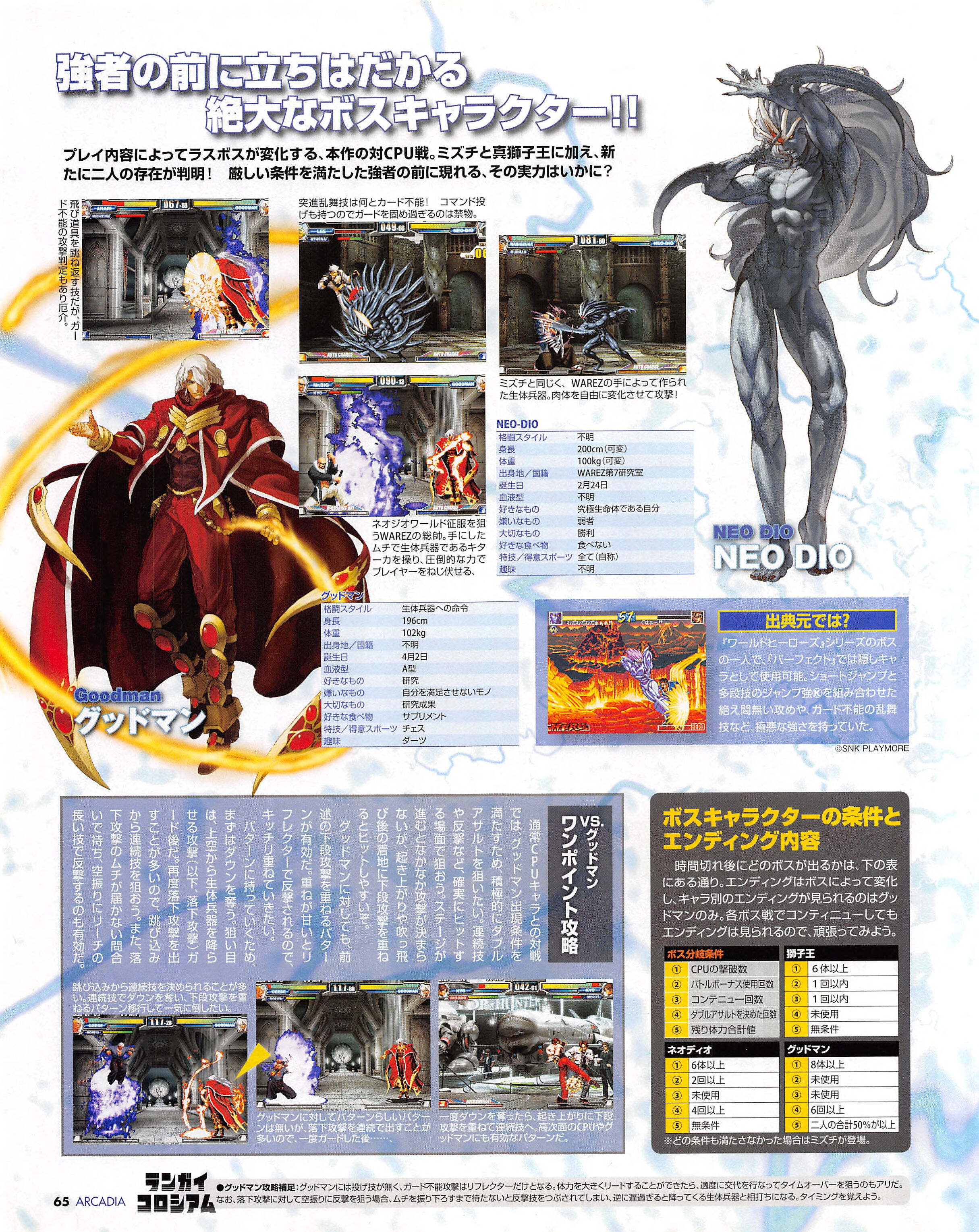
October printed66 says Mizuchi was released on August 7, and Shin Shishioh and Neo-Dio were planned for mid-September. It tells players to use an AW card, accumulate shared AW points and obtain bosses. Usable bosses have adjusted properties and some CPU-only moves remain unavailable. Printed67 continues their command/strategy guides; in-battle power gauges are not AW shop prices. Full English readings keep the article’s released/planned distinction, the SNK balance-correction comment and the unrelated paper high-score rules.
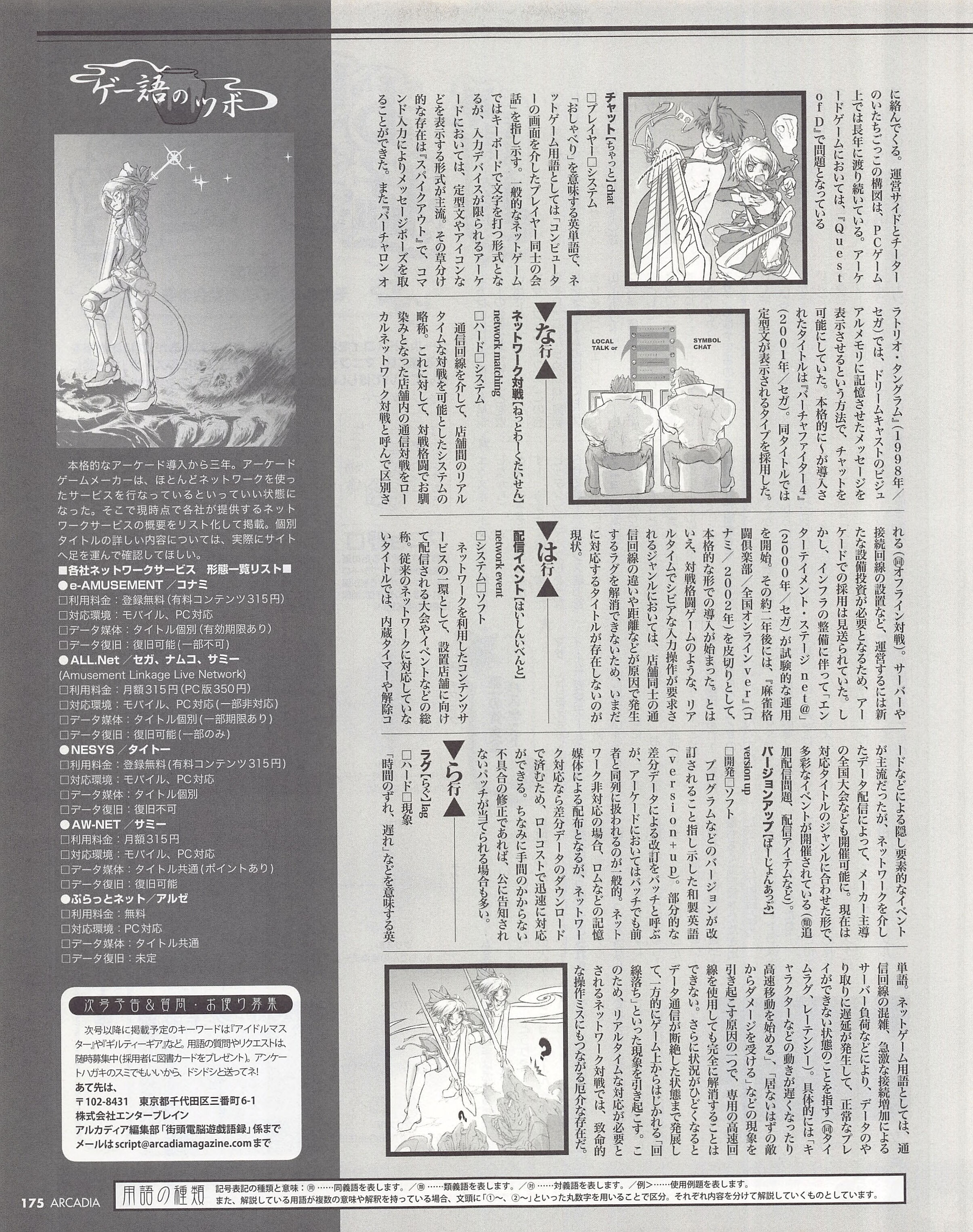
November printed175, in a network-game terminology feature, lists AW-NET/Sammy as ¥315/month, mobile and PC supported, data medium shared across titles, including points, and data recovery possible. This corroborates service-level functions but supplies no recovery steps/eligibility rules and is not a universal entitlement promise. Its separate listings for ALL.Net, e-AMUSEMENT and NESYS retain their own attribution. Generic network-match definitions do not prove remote fighting matches in AW-NET titles. Full readings also explain MetalSlug6’s Ralf/Clark, Weapon Stock and Rush Blaster features without asserting AW-NET support; KOFXI’s CPU Adelheid preview merely hopes he might become playable. Neither article announces an AW character purchase or phone reward.
December 2005–February 2006 interior review
All536selected leaves in these three issues were preserved and actually viewed across90contact sheets. Completed interior/appendix coverage reaches 4,756leaves /806viewed sheets,27monthly issues plus the July 2004appendix. The next chronological service-period issue is March 2006(arcadia0070). Discovery notes identify article contexts, not full translations of unrelated material.
December readings document KOFXI's twelve ordinary button-selected colours and Tenka's purple Nakoruru local cabinet code. NeoGeo Battle Coliseum's Mr.BIG character tier is combat strength, not an AW player ranking. Publisher announcements and a separate fan site's P900i standby pictures do not establish AW phone reward stock.
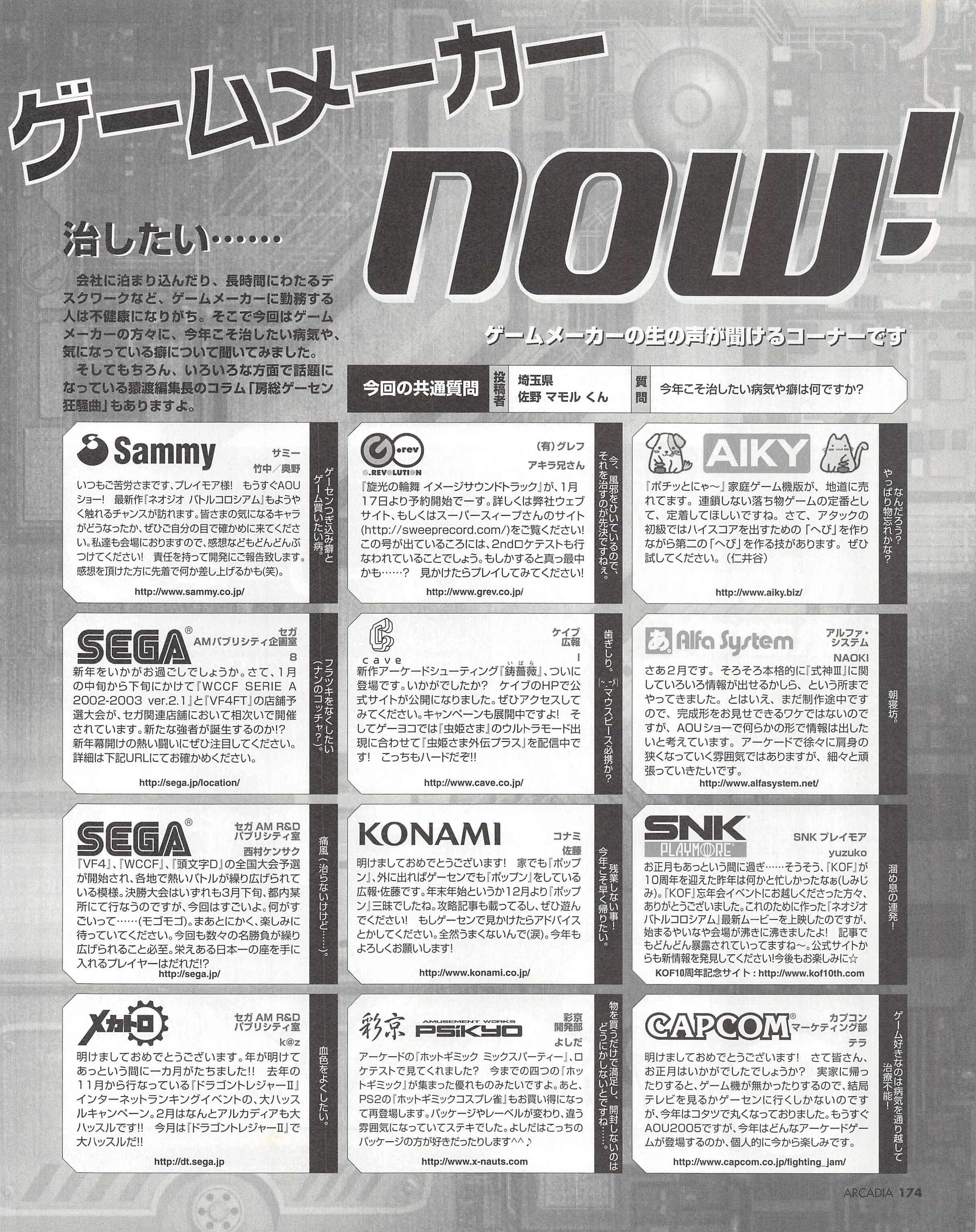
January readings preserve KOFXI CPU-intruder conditions separately from playable-character unlocks, identify the magazine's reader/carrier survey, and distinguish the final Game Maker NOW column from an AW-NET closure announcement. SNK's KOF anime via ShowTime and physical year-end event are separately attributed.
February readings specify playable Gai and Silber time releases after960/1,200powered-on board hours, explicitly warning that dates vary by arcade. These are not calendar deadlines, CPU encounter conditions, or AW web purchases. The NeoGeo Battle Coliseum combat article identifies39characters and the PS2 release, without a new AW service rule. Named TEKKEN-NET, BEMANI, Cave mobile, Gundam, Idolmaster and other card/phone systems in the discovery survey retain their own identities.
March 2006 interior review and separate phone-reward attribution
All 162 selected interior leaves were preserved and actually viewed across 27 sheets. Coverage is now 4,918 leaves /833 viewed sheets,28 monthly issues plus the July 2004 appendix. April 2006(arcadia 0071) is next in the service-period sequence.
Printed 76, leaf 77 explicitly calls Jazu a KOFXI time-release character and requires cabinet board power-on time exceeding 1,200 hours. Its footnote warns that dates differ by arcade. This adds Jazu to the separately verified Gai/Silber cabinet unlocks; none is an AW-NET purchase. Full scoped English reading. Printed 122, leaf 123 gives NeoGeo Battle Coliseum normal-throw combat statistics, with no new AW shop rule.
Printed 136, leaf 137 provides particularly explicit phone standby-image/ringtone rewards, but labels them GuitarFreaksV 2/DrumManiaV 2 and GITADOCHANKO, by Konami. It says those separate reward types alternate every 3 matches and are downloaded from their games’ mobile sites. Hidden songs and ENCORE/PREMIUM TICKETs are additional categories. These details are preserved for attribution, not imported into AW-NET. Cave mobile games, FamitsuDX, QMA records, ordinary MetalSlug 6 game features, physical illustration prizes and local tournament schedules likewise retain their separate identities. Reduced discovery images are not full article translations.
April–June 2006 interior review
All 496 selected leaves /83 contact sheets were preserved and actually viewed. Completed interior/appendix totals are 5,414 leaves /916 viewed sheets across31 monthly issues plus one appendix.
April’s four readings identify Hayate’s KOFXI time release at more than1,200 board-powered-on hours, NeoGeo Battle Coliseum guard-cancel-tag combat meter rules, a distinct Konami home-game serial/ringtone campaign and a school postal-request form. May’s two readings add the explicit AW-NET purchased-character NeoGeo Battle Coliseum heading for a March 18 Tokyo qualifier and separately attribute TEKKEN-NET/ShikigamiIII content. June’s two readings preserve NeoGeo Battle Coliseum tournament-use statistics and the separately named Sangokushi Taisen.NET mobile panel, with phone-screen labels and wallpaper/voice/card-reissue plans. No new commercially supported AW title, remote fighting feature, paid AW registration confirmation or original handset reward binary is established.
July–August 2006 interior review
All 324 selected leaves /54 sheets were preserved and actually viewed. Completed interior/appendix coverage totals 5,738 leaves /970 viewed sheets across33 monthly issues plus one appendix.
July printed 58, scan leaf 59 is an NeoGeo Battle Coliseum Tougeki champion interview and physical tournament report. Scoped English reading identifies KEE-ROC@SMK, Kim/Hotaru and preparation against Kim’s throw offense. Mizuchi/NEO-DIO are reported player choices, without additional AW shop claims. The heading’s ‘card’ refers to a matchup, not an AW membership card. July also explicitly separates Sangokushi Taisen.NET, NESYS Camp and VS.NET panels.
August discovery notes cover VF5 character additions, DDR’s e-AMUSEMENT PASS, Popn NET battle customisation, Card Builder revisions, shooter secret modes and physical-event/DVD/fan-art material. No new AW-NET signup screen, point tariff, shutdown notice or phone reward menu was identified at contact-sheet scale. No unrelated page was promoted to full-resolution AW evidence merely to increase the image count.
September–December 2006 interior survey
All 650 selected interior leaves /109 sheets were preserved and actually viewed, completing all 2004–2006 monthly interiors plus December 2003. Cumulative interior/appendix coverage is 6,388 leaves /1,079 sheets,37 monthlies plus the July 2004 appendix. Coarse discovery notes are separate from readable full-page translations.
October NeoGeo Battle Coliseum readings cover the physical Tougeki tournament, champion KEE-ROC@SMK and MAXPLAZA Zentsuji. The semifinal heading and prose disagree about one character pairing; the English reading preserves that discrepancy. These reports do not establish remote online versus play or a new AW feature.
December's closure panel, printed61, was already viewed in the preserved PDF earlier. It is corroboration/retrieval improvement, not a new historical discovery or an additional unique reviewed page. It retains the five-game list, last-title/first-title card restrictions, point and website entitlement loss, and title-specific caveat. Neighboring Game Music Pocket is separate from AW-NET.
Launch-era magazine follow-up and external storage
August–November 2003 interiors are now actually screened:706 leaves/120 sheets. Together with the completed2004–2006 issues and December 2003, interior/appendix visual discovery totals 7,094 leaves/1,199 sheets,41 monthly issues plus the July 2004 appendix. June/July's340 reduced source responses and58 contact sheets are preserved but have not yet been viewed. Selected source preservation now totals7,434 leaves across43 monthlies plus one appendix. A discovery screen is not a full translation of every small-type or unrelated article.
August 2003 Playmore interview readings add two unchanged full-resolution images. Katsunori Fujimoto's interview is expressly dated June 2003 in Esaka: network games were contemplated without concrete progress; at that time Playmore reported no plans for other makers' arcade hardware, and no concrete NeoGeo2 project. Neither AW-NET nor Atomiswave is named in that Q&A. This is dated pre-partnership context, not a description of the later service. SNKWORLD's free community/art/chat/minigame functions retain separate attribution. September's GGX preview and November's already-preserved AM Show report are not counted as new service discoveries.
Eight additional BatoCulture/phone/manual/alias queries rediscovered known Japanese news/forum sources or unrelated modern matches. No authenticated enrollment confirmation or original phone reward binary was recovered. The three guidebooks' remaining visual screen, January–July 2003 interiors, selected failed archive inventories and literal fan-site leads still require work. No global or private-collection exhaustion is claimed.
January, June and July 2003 reviewed
January, June and July 2003 add 510 actually viewed interior leaves /87 contact sheets. Interior/appendix discovery now covers 7,604 viewed leaves /1,286 sheets,44 monthly issues plus the July 2004 appendix. All 8,312 selected reduced source responses are preserved, with1,406 contact sheets built.
The selected Sammy manufacturer comments for January, June and July now have unchanged full-resolution JPEGs and separate, explicitly scoped English readings. January announces the home PS2 GGXX release; June and July contain staff/personal anecdotes. None supplies AW-NET enrollment or an additional service entitlement. Neighboring Cave phone rewards and Arika/Konami/Sega network functions retain separate attribution. The coarse discovery survey does not translate every small-print article.
Paid carrier enrollment confirmation, authenticated phone reward files, BatoCulture contents, Japanese network installer/manual interiors, remaining guidebook visual screening and selected literal Japanese fan-site/archive leads remain open. No global research exhaustion is claimed.
All selected monthly interiors screened
February–May 2003 add 708 actually screened leaves / 120 contact sheets. The selected 2003–2006 monthly interior survey and July 2004 appendix now have 8,312 preserved and visually screened leaves / 1,406 viewed sheets, covering all 48 monthly issues plus one appendix. This completes coarse visual discovery for this selection; it is not a full translation of every article or proof that all relevant small text was detected.
The magazine register now has 307 review records / 299 standalone JPEG responses, all standalone JPEGs actually viewed. The count difference includes earlier PDF-based readings. February readings preserve Sammy's New Year promise of more Atomiswave games; March confirms Atomiswave at its forthcoming AOU booth. April hints at undisclosed news without naming AW-NET or Atomiswave. May preserves the AOU show report and Sammy's venue comment.
The May AOU report, scan leaf 146 / printed page 145, says six Atomiswave titles were exhibited and describes four pictured games: Dolphin Blue, Guilty Gear X Ver.1.5, Demolish Fist and Toretore! Sushi. It does not establish AW-NET support for these games. Sammy's original announcement, recovered from a February 8, 2003 archive capture, confirms the six-title list and also names Sports Shooting USA and Maximum Speed; the new search record retains the failed live-URL attempt and successful archive recovery.
The remaining meaningful avenues include a complete visual screen of the three guidebooks' 660 scan leaves, literal Japanese fan/venue links in printed directories, selected failed archive inventories, paid carrier enrollment confirmation, original phone reward binaries, Bato Culture contents and Japanese network installer/manual interiors. The guidebooks' 59 OCR candidates and 134 selected page images are already reviewed, but the remaining leaves have not had a complete visual pass. Research remains active; global exhaustion is not claimed.
A new AOU 2003 publisher/press gallery preserves Sammy's archived announcement, the contemporary press response, separate English readings and three original GGX Ver.1.5 gameplay GIFs. This addition is Atomiswave launch context, with no AW-NET enrollment or phone reward claim.
The current Japanese-source catalogue contains 956 preserved response IDs / 575 unresolved document URLs / 232 unchanged image responses.
Early 2003 printed operator URLs
The February–April 2003 WWW directory pages supplied nine literal arcade-operator URLs. Two additional unchanged full-resolution pages were preserved and actually viewed; the February page was already preserved. Selected Japanese headings/operator descriptions and URLs now have separate English readings. The unrelated fan-art/fiction portions are summarized rather than fully translated.
The operator reading gallery has 36 actually read response records: four modern responses and32 historical responses, including prelaunch wrappers. Twenty-two exact URLs were queried, including explicit frame/venue children and the NeoGeo Battle Coliseum image/inventory leads. A selection of dated landing/inner pages was preserved; the191 indexed revisions were not all retrieved. This is not a full crawl of the operators.
POWER STICK's September 8, 2005 page links NeoGeo Battle Coliseum and says the promoted SNK title is running at the venue. Its explicitly linked bcolo1.jpg graphic has zero exact successful index rows and returned404 at the containing page's replay date; no new graphic was preserved. Venue game listings do not establish AW-NET connectivity. Local tournament points, arcade mobile pages, Nihon Unica's mobile/Edy payment systems and other-game card functions are translated/scoped separately and do not fill AW-NET's missing paid registration flow.
The remaining explicit-link register retains seven deeper frame children, the UCO operator alias and a player-site link. These are meaningful next leads with relevance still to establish.