
Company and trade documents
These are research notes, written to keep track of evidence. They're precise but dense. The AW-NET and game pages tell the same story in plainer language.
Detailed research notes. Quoted source text may be machine-translated.
Notes on company reports, trade-journal pages and other documents that mention Atomiswave or AW-NET. Only the relevant passages are translated.
Sammy card-network applications filed in late 2003
The separate English reading gallery preserves JP2005143969A, JP2005144078A and JP2005177164A: 57 original PDF pages in total, three reviewed cover pages, six reviewed figure sheets and 62 selected translated labels. The applicant is サミー株式会社, with inventors 川村 正広 and 村瀬 廣晃.
These published applications concern offline-history upload, printed-code registration/authentication and exhausted-card renewal. None explicitly identifies AW-NET or Atomiswave. Their proposed offline shared-point accumulation and PC code-based access differ from recovered commercial instructions. No actual card byte layout, server command set or signup form has been recovered. See the gallery's per-document figure/paragraph references, English summaries and scope qualifications before using any proposed design in a reconstruction.
Sammy annual report 2004: Japanese and official English
Sources: Japanese original, official English original.
Both editions' PDF page 24 / printed page 22 discuss arcade equipment. The Japanese passage says that Sammy launched Atomiswave domestically and overseas, and released dedicated software including Isuka compatible with AW-NET. It describes AW-NET as enabling online connections among amusement facilities nationwide and integration with mobile content. The official English edition corroborates this description; no unofficial full translation is needed to obtain an original English source.
The Japanese report gives arcade-equipment segment sales of ¥7,780 million, up 23.6%, and an operating loss of ¥1,651 million, attributed to increased research and development mainly for Atomiswave-specific software. The official English prose rounds these to ¥7.8 billion and ¥1.7 billion. These are segment figures, not AW-NET-only financial results. The page includes an Atomiswave cabinet image whose screen depicts Isuka.
Fiscal 2004 earnings reports
Sources: Japanese original, official English original.
The management strategy discusses expanding Atomiswave through full-scale AW-NET operations and alliances with major software companies. This is the company's contemporary strategy and expectation, not evidence that AW-NET achieved a dominant market position. Segment accounting does not provide an isolated subscriber count or operator installation total.
Interim presentation for the year ending March 2005
Source: Japanese original.
Despite some search-result titles suggesting fiscal 2004, the document itself labels the period Interim period for the year ending March 2005. The relevant slide reports advance development investment centered on AW-NET-compatible software, with amusement arcade equipment segment research expenses of ¥3.3 billion versus ¥1.1 billion in the preceding comparable period. It anticipates development efficiency from the Sega integration.
Additional fiscal 2004 business reports and April–September 2004 interim report
The Japanese Business Report 2004 and official English companion are separate from the previously preserved annual report.
Printed page 9 describes Atomiswave sales in Japan and overseas and Isuka's AW-NET connection to mobile content. It reports amusement arcade equipment sales of ¥6,536 million, up 27.5%, in this business-report section. Do not substitute that figure for the separate annual report's ¥7,780 million segment figure or call either number AW-NET-only revenue. Printed page 11 describes the intention to expand Atomiswave through full-scale AW-NET operation and partnerships with influential Japanese software developers. Its future market-position language is corporate expectation, not demonstrated adoption.
Printed page 37 explicitly labels Atomiswave as released in April 2003, and says AW-NET began in December 2003. The official English edition supplies the same month labels. Other contemporary sources describe late-June 2003 platform rollout; preserve this discrepancy with source attribution rather than silently choosing one date. Neither hardware month displaces AW-NET's independently documented 17 December 2003 service launch. The page includes a cabinet photograph and Isuka screenshot, not a registration screen or phone wallpaper. Unrelated pachislot, pachinko and home-game product descriptions are excluded from this selected reading; the official English PDF preserves their original English text.
The interim business report covers 1 April–30 September 2004, despite the fiscal-2005 filename. The arcade-equipment paragraph reports sales of ¥5,681 million, up 73.3%, and an operating loss of ¥1,999 million. It attributes the loss in part to increased research/development of AW-NET-compatible software while trying to expand Atomiswave through varied game genres. These figures encompass the arcade-equipment business; the document does not isolate the cost, profit or revenue of AW-NET itself. Its adjacent mobile-content discussion concerns Sammy 777 Town and ringtone services generally, not a recovered AW-NET subscriber count or shared-point reward catalogue. This is a partial English reading of the relevant paragraph, not a translation of all 28 PDF pages. Page 16 was also rendered for discovery but is not recorded as reviewed.
Atomiswave SD cabinet manual: Japanese, not English
Source: Hard--Candy mirrored PDF.
The saved filename atomiswave-sd-manual-en.pdf originated from an initial language assumption. The scan carries the mirror's watermark; original scan processing and exact printing date are not verified.
On PDF page 3 / printed page 1, the introduction explains that the manual addresses owners, managers and operators and covers safe installation, operation, maintenance, inspection and transport. It identifies Sammy as distributor/service contact and Taito as manufacturer, with listed contact information current as of October 2003. Follow-up visual review of PDF page 62, the colophon, confirms First edition, 1 October 2003, and Edited and published by Sammy Corporation — Edited and published by Sammy Corporation. PDF page 63 is the rear Sammy cover, not the colophon. This cabinet-manual date does not change AW-NET's later commercial launch date.
The listed cabinet specifications are width 750 mm, depth 903 mm, height 1,765 mm (1,450 mm without the instruction panel), mass 110 kg, AC 100 V at 50/60 Hz, rated 140 W, maximum 2.0 A, and a noncondensing operating range of 10–30°C / 30–70% humidity.
On PDF page 29 / printed page 27, AW multiplayer system connection translates as Connecting the AW multiplayer system. The passage says:
One AW multiplayer system can connect four JAMMA-compatible cabinets with a dedicated harness so that games can be played.
Its warning instructs operators to disconnect each cabinet's switching-power-supply connector when using that system. The diagram labels Dedicated harness — Dedicated harness and AW multiplayer system — AW multiplayer system. The final instruction refers operators to the separate manual supplied with the multiplayer system for the connection procedure.
This is a local four-cabinet harness system, not a demonstration of WAN fighting or an AW-NET registration guide. The separate multiplayer manual remains an identified lead.
Isuka arcade manual: English
Source: mirrored original PDF.
This twelve-page PDF contains the cover, contents, introduction, operation precautions, specifications, game overview, rules, screen description, system menu and game settings. It describes local four-player play and Soul/team behavior. PDF page 8 / printed page 6 gives default coin settings including four-player mode and one coin per credit/continue, which operators could change.
It does not provide a successful AW-NET enrollment walkthrough. Its system-menu section refers readers to the separate system-board manual. The absence of a registration chapter in this regional English game manual does not establish that Japanese AW-NET functions were absent.
The preservation database's second manual link, saved as hfs-isuka-manual-2.pdf, is byte-identical to this manual. Treat it as an additional surviving mirror, not a separate manual edition.
Additional Isuka box artwork
Source: preservation database PDF.
A one-page English box-cover layout uses character art, screenshots and Atomiswave branding. The database labels it Box 2. It is reference artwork, not proof of a phone wallpaper or an AW-NET shop reward.
Atomiswave motherboard manual: English
Source: original scan rehost, linked by the DIY Retro Arcade manual directory. Saved as atomiswave-motherboard-supaturbo.pdf, 27 PDF pages. The scan credits daddelkingz.de and supaTurbo. Its printing date and regional applicability to individual Japanese games are unverified.
The screen includes NETWORK START1–4 counters, described as tournament-mode play counts for up to four registered tournaments. These generic counters do not identify a shipped Japanese AW-NET tournament feature or prove Internet fighting-game matches.
Service/test switches select settings; CANCEL & EXIT discards changes and SAVE & EXIT stores them. Changing NETWORK from OFF to ON, or opening the menu after a connection error, causes a connection attempt when returning to the attract loop. The manual expressly says this option has no effect on a game without network support. No member enrollment, carrier billing, AW-point shop or Japanese supported-game list appears on these reviewed pages.
Consult hardware follow-up notes for the separate modern MAME observations and unresolved card-storage testimony.
Period magazine facsimiles
Museum page 109 corresponds to printed page 105; page 247 corresponds to printed page 241; page 107 corresponds to printed page 103. Page 19 is a colour advertising spread with no printed number located. The differing winter-2003/spring-2004 plans are retained as development dates.
English notes and originals keep local multiplayer arrangements, operator prices and neighboring games' fees separate from AW-NET membership. All eight museum PDFs appear in the discovery gallery.
Originals remain in this directory; page previews and English interpretation are in the magazine evidence guide. These are scans of Japanese print, not operator manuals. The guide supplies both printed page and PDF page numbers and preserves prelaunch/commercial distinctions.
Additional operator documents recovered and visually checked
English; 27 PDF pages. Colophon gives first edition 1 December 2002, with a separate ©Sammy 2003 line. Printed 11/PDF 13 shows the system menu’s Network Settings; printed 23/PDF 25 explains saving/cancelling, enabling networking, and retrying connection during the attract loop after initial failure or an error. It explicitly says this option has no effect with a game lacking network support. Printed 24 is blank with show-through, not a missing recovered network screen. This is early platform documentation, not the separate Japanese AW-NET operator/card-reader manual or proof a specific service shipped in 2002.
Fourteen PDF pages. Printed 1 says its contact information was current in July 2004. It describes ordinary controls, 36 starting characters, three modes, operator settings and JAMMA wiring. Printed 12/PDF 13 has a 16-character A–Z/0–9 operator password for extending game functions. That is not the card’s numeric USER ACCESS CODE or PC AWID. No specific unlock password or AW-NET shop entitlement is supplied there. The last JAMMA diagram and key settings differ in button numbering; retain the original diagrams rather than silently reconciling them. This public English scan does not recover Japanese network/card-reader installation or the mobile registration flow.
Lists main PCB, game cartridge, Spanish instruction sheet/banners and export manual. Its communication item is a plastic cover, not proof that an AW-NET modem, reader or Japanese subscription was included. It reproduces export-manual cover artwork distinct from the User Manual scan above; do not assume they are the same edition.
Validation details: operator_manual_validation.json. The separate Japanese multiplayer/network/card-reader documentation remains an open lead.
Sammy-to-Sega sales and division transfer: two separate dates
Two unchanged publisher PDFs clarify the later trade report's shorthand about Atomiswave changing publisher in January 2005. These notices concern the broader Japanese arcade business; neither names AW-NET or establishes a change to its subscription, servers or account ownership.
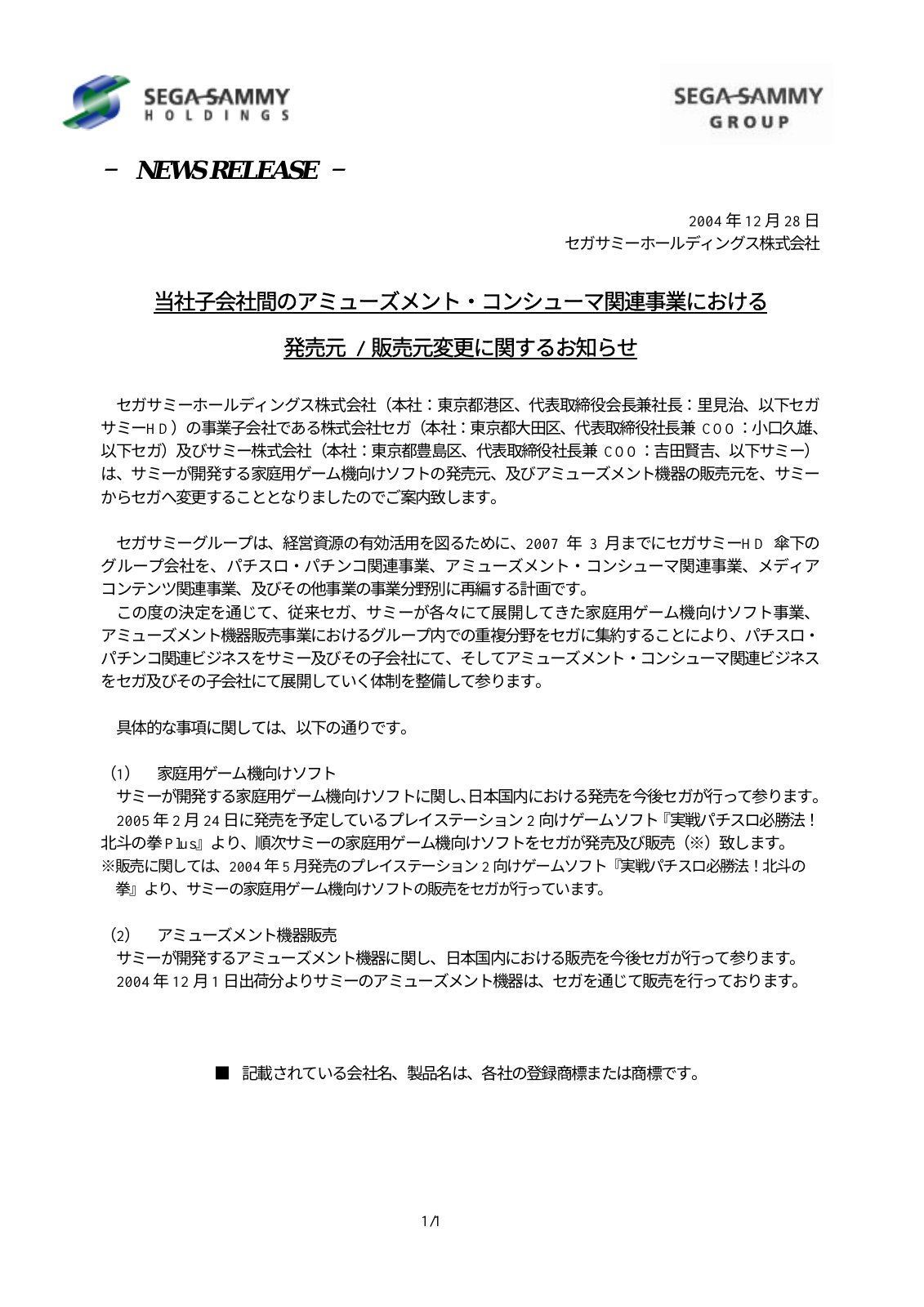
28 December 2004 — publisher/seller changes: publisher original, preserved PDF, Japanese text extraction, reviewed modern page rendering. The one-page notice says Sega would publish Sammy-developed home software in Japan, beginning with the planned 24 February 2005 PS2 release Jissen Pachislo Hisshoho! Hokuto no Ken Plus. Sega had already distributed Sammy home software since the May 2004 predecessor. For arcade equipment, Sammy-developed products had been sold through Sega beginning with shipments on 1 December 2004. The group planned its business reorganization through March 2007. This English reading covers the substantive notice, excluding company-address boilerplate and the trademark footer; it is not an AW-NET registration document.
24 December 2004 — proposed legal division transfer: publisher original, preserved PDF, Japanese text extraction. The board decided on 24 December that Sega would assume Sammy's amusement-related businesses in the AM sales, production and media-development divisions through a company split planned for 1 April 2005. Contract approval/signing was dated 24 December; shareholder approval was planned for 8 February, and the effective date/registration for 1 April. Preserve the document's prospective wording: this announcement alone does not certify later completion.
Page 2 says Sega would inherit the AM business's assets, liabilities, associated rights/obligations and contractual positions. The split involved no share allocation, capital increase, cash split payment or newly appointed officers from Sammy. September 2004 book values were assets of ¥13,985 million and liabilities of ¥1,643 million; these are division-wide figures, not AW-NET revenue, server costs or subscriber balances. The holding company's particulars and announced consolidated forecast would not change. Page 3 compares the companies' profiles, using September 2004 figures and separately identified October 2004 ownership information. The table is context, not a member demographic or network inventory. These are selected English readings, not a line-by-line translation of the corporate profile table.
Maxell reader-family documentation
Three public FCC-filed original PDF responses were preserved: ME-MA21/MR21 user manual, external photographs 1 and external photographs 2. English originals require no Japanese translation. Modern page renderings appear in the catalogue. Hardware findings and scope explain the model link and post-shutdown filing date. This material does not recover the missing Japanese AW-NET operator manual.
Six preview pages were generated, but only those three are recorded as reviewed. The two external-photo pages were also inspected.
July 2004 N900iS carrier reference
The official DoCoMo/NEC Application-volume manual is a 500-page generic carrier document. The handset is present in AW-NET's January 2005 compatibility roster, which does not establish July 2004 compatibility. This is not an original AW-NET paid signup, fee agreement, successful enrollment response or member page.