
Game features & shared points
These are research notes, written to keep track of evidence. They're precise but dense. The AW-NET and game pages tell the same story in plainer language.
Detailed research notes. Quoted source text may be machine-translated.
What AW-NET added to each game and what AW points bought, with sources for each detail. The shop lists that survive are incomplete.
Network play and account features
AW-NET combined card identity, server records, web/mobile account functions, a shared points economy, and game-specific services. A game being connected did not automatically mean internet fighting-game matches. The clearest nationwide human-versus-human implementation was Net Select: Salaryman Kintaro. Victory Furlong had network race facilities, including entry-and-replay tournaments. For Isuka, NEOWAVE and Battle Coliseum, the recovered evidence establishes records, purchases and events; it does not establish remote internet fighting matches. Launch description, Kintaro introduction, horse FAQ
Five released AW-NET titles are documented in the collection:
| Game | Network gameplay established | Content AW-NET added or enabled | Website/mobile functions |
|---|---|---|---|
| Guilty Gear Isuka | Recorded local arcade play; remote fighting not established | Purchased EX move-set variants and extra colours | Web Garage, character records, ranks/rankings, faction distribution, phone rewards, Guilty Gong voting |
| Net Select: Salaryman Kintaro | Nationwide three-player mahjong, daifugō and reversi | Purchased preset message packs and displayed titles | Detailed records, rival searches, promotion simulation, aggregate statistics, rankings |
| The King of Fighters NEOWAVE | Recorded arcade play and network-linked events; remote fighting not established | Seven purchasable additional fighters, extra colours, special titles | Character/player editing, records/rankings, shop, Fight Money and ring events |
| Net Select Horse Racing Victory Furlong | Official test material describes real-time Net Stakes; commercial-period print describes nationwide races for up to ten horses/players and password-controlled player-created Net Stakes; separate entry/replay tournaments | Item purchases and mobile lottery rewards usable in the arcade game | Stable/horse data and diary, real-name horse list, rival search, breeding simulation, expanded rankings |
| NeoGeo Battle Coliseum | Recorded arcade play; remote fighting not established | Card-triggered Athena/Mars People; three shop bosses; eight purchased palettes and four purchased victory texts per fighter; monthly ranking titles and glow effect | My Data, Data, Shop, nine ranking views, events, venues and Flash video presentation |
The recovered January 16, 2004 Sammy private-show report explicitly says Rumble Fish AW-NET/card support was undecided, while announcing planned Force Five AW-NET support. Archived Japanese article and selected English reading.
BigJoy’s period location-test log lists Force Five, March 5–14,2004, as a Sammy fighting game. It documents a venue test and supplies no network or card function; planned AW-NET support remains evidenced separately by the publisher/show sources. Original operator log and English reading.
The detailed sources below qualify each row. Atomiswave hardware compatibility alone is insufficient to add another game to this list. Force Five and Kenju had proposed network features in show coverage, but those proposals do not establish released AW-NET services. The November 2004 Arcadia AM-show report explicitly plans AW-NET win/loss recording, rankings and character customisation for Kenju, whose release remains undecided. September 2004 show report, primary Kenju print evidence
Recovered official Kenju test notices from October 2004 and January 2005 explicitly say the product does not support AW-NET. Original notices and English reading.
The April 2004 Arcadia issue 47 advertisement explicitly places an AW-NET-supported badge above Force Five, with its release date undecided. This strengthens planned Force Five support with primary print evidence; it remains outside the commercially released five-game list. Original advertisement and translation
Metal Slug 6 also had an early expression of interest: at AOU 2004, SNK's Hirata said the development team was interested in AW-NET and wanted to use the system. The report names no actual network function, card feature or point purchase. This is development intent, not a confirmed release plan or shipped sixth AW-NET service. 20 February 2004 report, preserved Japanese text.
Member campaign at shutdown: Sega Moba lead
AM-net’s 18 September 2006 log reports AW-NET’s November 30, 24: 00 closure and a Thanks Campaign planned for October 2. Its 2 October entry says the campaign began that day for AW-NET members in conjunction with Sega Moba. Preserved Japanese paragraphs and English notes.
The recovered notices do not state a reward, point conversion, eligibility beyond membership, registration steps or redemption deadline. This is a separate campaign lead; it cannot yet be added to the established 15-point wallpaper / 30-point ringtone catalogue or described as migration of AW points to Sega Moba.
Which functions required the network
The March 5, 2005 general FAQ response provides explicit offline restrictions for three games. The earlier five preserved FAQ files lack this detailed block, so its capture date accompanies the rules. Offline card play could retain selected local data for reflection on the server after the next online play, but offline play earned no shared AW points. March 2005 FAQ, dated source audit
| Game | Data the FAQ says was recorded offline | Features unavailable or restricted offline |
|---|---|---|
| Isuka | Total wins/losses/draws; total plays; high score/experience; highest survival level; consecutive wins; class; team wins/losses | EX colours and EX characters cannot be used |
| Kintaro | Job position; overall performance; each game's performance; each game's wins/losses; each game's dan rank | Cannot compete against another arcade; some normally displayed play data is absent |
| NEOWAVE | Total match count; overall wins/losses only; consecutive wins | Alternate colours/characters cannot be used; ring contests and Fight Money ranking do not occur |
The FAQ also specifies visible status checks: Isuka and NEOWAVE display green ONLINE at the lower right; red OFFLINE, or no such display, means offline. Kintaro uses the AW-NET logo at the very bottom: a white glow means online, a dark logo means offline. These are source-supported status indicators, not evidence of remote fighter matchmaking. The page does not supply equivalent offline tables for NeoGeo Battle Coliseum or Victory Furlong. March 2005 FAQ
The March response qualifies server-backed recovery as a member-only service: it will not guarantee or repair nonmembers' or former members' data. This does not establish a deletion deadline, cancellation workflow or precise retention period. The readable physical AW-card reverse separately warns about stored-data damage and describes exhausted-card renewal.
Guilty Gear Isuka
A Japanese venue’s June 2004 game list describes Isuka as four-player simultaneous fighting and explicitly names AW-NET. Its separate nationwide-match statements concern Winning Eleven and Mahjong Fight Club; the Isuka entry does not specify remote human opponents. Original venue inventory and English reading.
EX characters were gameplay variants
The official news history dates the addition to 31 January 2004 and describes EX versions for all 20 characters, with new moves or changed move properties. Purchase took place in the Web Garage's Shop. Players then enabled the EX version in Web Garage and used Start at character selection to display the emblem. EX versions and purchased colours could be combined. To use an EX version with its ordinary colour, the site instructed players to restore the colour setting to Normal. These were separate character and palette settings. Official update history, early front page
An additional recovered Isuka news page dates the full EX-colour addition to April 28, 2004, sold through the character-settings Shop. Its March 26 entry dates the addition of faction distribution. Dated news and captured statistics.
The same history records two additional colours per character on 8 March 2004. That is a dated addition, not proof that only two alternate colours ever existed. The newly recovered Outlive Encyclopedia says 13 EX colours were prepared per character and added successively. Its commercial point prices are 1, 500 per EX character and 300 per EX colour. The original illustrated EX use guide is preserved and translated in the gallery. Guidebook findings, unchanged palette plates and English notes.
The guide's character pages confirm that EX purchases can change moves, commands, chaining routes, movement and numerical attributes. Examples include EX I-No's ground-running dash and EX Zappa's soul-funded possession selector. Selected notes for all twenty fighters are in the guidebook gallery; this is not a complete translated moveset database.
Starting survival level and ranked CPU challengers
The commercial guide establishes a 1, 000-shared-point purchase of starting-level control. Once bought, it is reusable and adjustable separately for each character in one-level increments, up to 999. It also says ordinary survival without AW-NET caps at level 100; the purchased setting permits higher levels and changes Leopaldon's encounter frequency above 100. Leopaldon remains CPU-only. The guide describes occasional ranked CPU challengers associated with rare-rank progression, identified by rank icons and SP MATCH. These are game benefits beyond palettes, with no implication of remote human fighting. Original screens, conditions and source limits.
Records and community functions
Isuka's FAQ describes character-by-character results and use. Its ranking help covers versus wins, streaks, clear times, handicap wins, team results and experience, with eligibility thresholds. Clear-time submissions could take four to five hours to appear. Isuka FAQ, ranking help
Ranks branched into Bounty — Wanted/Bounty and Holy Knights — Holy Order courses. A faction-distribution page aggregated the sides. These are supported interfaces for a reconstruction, rather than an inferred modern matchmaking ladder. Rank help, distribution
Phone rewards and voting
The FAQ explicitly lists ringtone melodies, standby wallpapers, character colours and EX characters as point purchases, and says points could also be used in Guilty Gong — Guilty Gong. The early home page says Gong's second round concerned phone wallpapers, and separately announces new ringtone melodies in GGX Mobile. Isuka FAQ, early home page
Launch reporting explains the voting concept: earned points could become votes, and popular ringtone/wallpaper choices would become downloadable content. The first Gong winner is now identified: the Outlive Encyclopedia explicitly names “Exceptional Routine Work”, distributed as a ringtone through GGX Mobile. Complete ballots, vote-to-point rate, wallpaper winner and download filenames remain missing. Launch report, printed Gong article and English notes.
The 2003 presentation also showed purchasable starting-level selection. Its photographs are prelaunch concepts, now supplemented by the commercial guide's price and rules above. The book's 20-member rare AW-card giveaway using Bridget artwork was a reader postcard contest; no point purchase is stated. Physical goods and giveaways should retain their campaign context. 2003 demonstration, goods page, original prize page and deadline conflict.
A newly verified June 2004 Isuka glossary explicitly says alternate characters can be bought on the web using points accumulated through the card system. The adjacent service column says a single enrollment covers compatible games, while identifying Isuka as the only operating title at that time; Kintaro was testing and Force Five/NEOWAVE were still forthcoming. These dated statements corroborate web purchases without adding Force Five to the released roster. Original pages and selected English readings.
Net Select: Salaryman Kintaro
A September 11, 2003 report additionally proposes chat during Kintaro online matches, editing features and four table games including Tactics. It does not define unrestricted typed chat; later preset-message evidence remains more concrete for the shipped interface. Archived report and English reading.
Kintaro's network contribution went beyond account statistics: its public introduction advertises competition against players nationwide in three-player mahjong, daifugō and reversi. Earlier 2003 development coverage also listed Tactics; the three-game public service should not inherit that fourth proposed game. Commercial visitor introduction, 2003 show coverage
The newly recovered 2003 Sammy advertisement and trade-show product entry independently name Tactics in the proposed four-game selection. The product entry expressly describes real-time network-versus play through AW-NET. Their winter-2003 and spring-2004 targets differ; a later February report describes three games with March release planned. This strengthens the dated development record without establishing Tactics as a commercial service feature. Period-publication follow-up.
The February 2004 AOU report observed three games at about 70% development and described play against other show machines. It also reports the idea of earning points with accessible table games. Show-floor networking is useful development evidence, distinct from proving nationwide commercial operation on that date. Firsthand AOU report
Member functions included name/region editing, detailed per-game records, a rival search by name and region, another player's results and the prospective reward for beating them, a promotion forecast, and aggregate data. Company positions provided progression alongside game ranks. Personal records, Data Bank
The Shop sold preset message packs and titles replacing the displayed job label, using shared points. This is the best concrete description of Kintaro's purchasable customisation; no complete message/title inventory or tariff survives in the collected pages. Preset communication should not be converted into unrestricted text chat. Shop introduction
The original Kintaro chat-text reading preserves24 contiguous built-in phrases, with separate English translations. The pool includes greetings, self-descriptions, winning/losing-streak remarks and match-start prompts. Original pointer literals and256-byte indexing are checked. This supplies native communication vocabulary; it does not identify paid pack groupings, shared-point tariffs, bonus messages or unrestricted player-written chat. The purchased-pack inventory remains incomplete.
The card-transition notice also promises a special pre-game chat message automatically unlocked for test participants who transferred to production cards. It announces an advance version for June 23, 2004 and partial member data transfer from June 24; it does not reproduce the bonus message or settle the full national shipment date. Original notice and English reading.
A commercial-period magazine account documents a shared withdrawal button usable even during a game: leaving counts as a loss or bottom place. It also describes Daifugo sets of three rounds/up to four players, one-round Reversi and three-player mahjong. August 2004 original page and English reading.
Rankings covered overall/job/area/monthly results and game-specific categories, including yakuman/dora, revolutions and stone/perfect/black/white results. Ranking introduction
The King of Fighters NEOWAVE
AW-NET's own retained launch notice dates NEOWAVE's network service to August 5, 2004 at 10: 00, separately from the game's July arcade release. It explicitly advertises shared-point additions, rankings, character-use rates, alternate colours and phone standby-image downloads. Original notice and English reading.
A period AOU News advertisement also labels NEOWAVE the series’ first network-compatible title and prints the AW-NET logo/site address. It supplies branding corroboration, with no remote human fighting promise or shop tariff. Unchanged bulletin and selected English reading.
A preserved Japanese venue page supplies a concrete operating example: Fantasista advertised two NEOWAVE setups with online card support, with NEOWAVE listed at ¥50 per play in its October 12, 2004 capture. The card-support banner remains in December 2004 and February 2005 captures. Its August 4 capture also preserves a July 29 game-arrival update; that arrival notice does not move the official August 5 network-service launch date. The venue statement documents advertised card support, not a connectivity test or remote human fighting. Original venue response and English reading.
Fantasista’s preserved calendar advertises local NEOWAVE tournaments on August 14, November 21 and December 25, 2004, with a standing ¥100 tournament-entry charge. These are scheduled venue events; the charge is distinct from arcade credits, AW-NET membership and shared AW points. Period calendar and English reading.
Additional fighters
The documented AW-NET purchase roster is:
| Japanese identification | English identification |
|---|---|
| 乾いた大地の社 | Orochi Yashiro |
| 荒れ狂う稲光のシェルミー | Orochi Shermie |
| 炎のさだめのクリス | Orochi Chris |
| キム | Kim |
| ヴァネッサ | Vanessa |
| ラモン | Ramon |
| ギース・ハワード | Geese Howard |
SNK's surviving site identifies Geese as the third additional-character wave and links the member Character Edit help. Its 2 December 2004 news lists seven profile additions; that date should not be assigned to every fighter's shop release. The player-maintained Gore guide separately marks these seven as AW-NET point purchases and notes operator-unlocked exceptions. SNK site, Gore guide
A Japanese arcade writer’s November 8, 2005 entry reports that a command had apparently been discovered to unlock NEOWAVE’s hidden characters, with the arcade operator needing to set it. It criticizes buying formerly available fighters with points earned by playing, but supplies no command sequence or exact first-discovery date. This is a dated blog claim preserved through a current response, not an independently captured 2005 version. A revised 2021/2026 recollection separately describes playing hundreds of matches and says the service was not ready on release day; the original AW-NET notice remains the stronger witness for the August 5 network launch. Dated entry, retrospective, preserved originals and English readings.
The preserved original Geese command sheet gives 3, 500 shared points, membership and card requirements, and the Start/K′ selection instruction. The printed-material translation guide records the relevant labels. Geese's price is substantially better evidenced than most shop tariffs.
Arcadia’s December 2004 issue adds an independent 3,500-point Geese price and says he was scheduled to become purchasable through AW-NET in early November. It expressly warns that unlock schedules may change and says the playable version differs from the CPU boss. This announcement does not override the preserved player reports of purchases on 25 October 2004 or establish the first actual availability date. The nearby 3,500-point membership gift is a separate promotion. Original page with English reading
Arcadia issue 52 (September 2004), printed page 39, announces four purchasable alternate colours and illustrates example palettes. Issue 54 (November 2004), printed page 85, gives 600 shared points per colour and 3, 000 per additional character, alongside Kim, Vanessa and Ramon coverage. This is period print evidence; full character-by-character stock and authenticated shop screens remain incomplete. A retrospective personal account gives all six non-Geese extras as 3, 000 each, but that broader six-item claim is not an original shop inventory. Verified magazine scans and translations, retrospective player account, period complaint thread
The Gore guide describes a card-enabled time-attack start using C+D. This instruction comes from a fan guide; no surviving official help screen confirms it. Console unlock conditions are separate from the arcade shop. Gore guide
Arcadia issue 51's location-test screenshots show three saved custom teams, character/mode combinations and random selection, plus player names limited to eight uppercase letters/digits/some symbols in that preview. They also show rankings, play records and Character Edit. Issue 53 supplies a much larger visual palette reference: 36 groups of four alternate-colour sprites, 144 pictured examples, alongside a full rank-point threshold/change table. These rank points are separate from shared AW points; the guide retains the test/commercial distinctions. Verified screenshots, palette grid and English rank tables
Events had separate balances
Fight Money tracked a virtual event balance: the first rules award 900 initially, 100 at game start, and 50 per CPU-team win. Versus stakes used 20% of the poorer player's balance with a 100 minimum. A 5, 000 balance qualified members for special titles. These were event rules, not the shared-point earning formula. First event rules
Ring competition transferred a ring between eligible card-using opponents according to the match result; 30 rings qualified members for titles. Surviving versions disagree about empty-balance CPU-clear awards: the first web rules say one, while the later poster/third event say three. Preserve those dated versions. Both event types ranked recorded arcade results; neither proves WAN fighting-game matchmaking. First ring rules, third rules, event poster
The November 17, 2004 first-round web revision also expressly awards three rings after an empty holder clears CPU play, changing the earlier November 10 one-ring wording. The second-round results acknowledge a December 18 system incident and a December 28 recount. Dated rules and result-page translations.
The January 2005 ARCADIA issue supplies the complete printed eight-title event award table. These English names are translations of the Japanese labels, not established official localizations. Conditions use “earn/acquire”; this page does not define the accounting period or current-versus-cumulative balance.
| Japanese title | English gloss | Fight Money earned | Rings acquired |
|---|---|---|---|
| カリスマ | Charisma | At least $5,000 | — |
| 豪腕 | Mighty Arm | At least $10,000 | — |
| 鬼人 | Demon | — | At least 30 |
| 拳客 | Fist Expert | — | At least 70 |
| 心眼 | Mind’s Eye | At least $5,000 | At least 30 |
| 巧 | Skill | At least $10,000 | At least 70 |
| 達人 | Master | At least $15,000 | At least 100 |
| 超人 | Superhuman | At least $20,000 | At least 120 |
Where both columns have a threshold, both conditions apply. These are earned-title requirements, not prices paid from shared AW points. The same panel mentions a rumored year-end/New Year event; it does not confirm that event’s release or rules. Structured transcription and translation.
Net Select Horse Racing Victory Furlong
The May 2005 Arcadia commercial-period article, printed page 146, now confirms an operating-game release date of 24 March 2005, nationwide races for up to ten horses/players, and player-created Net Stakes. The host can set the race name, distance and entry conditions; passwords can restrict entry for an arcade tournament or friends-only race. It does not document the protocol, latency or every matchmaking condition. Unchanged scan, selected English translation
A 28 March 2005 contemporary arcade fan report explicitly describes real-time competition with nationwide players and records four stations at Isesaki Namco Land. This adds evidence for racing beyond saved-horse entry/replay tournaments, while leaving individual modes and networking details unresolved. The blog identifies itself as a fan site. Its local ¥200 start/¥100 continue prices are not a nationwide tariff. The official April sitemap also lists stable diaries, owned real-name horse lists and useful tips. See further findings.
The newly recovered official November 2004 test overview explicitly defines Net Stakes as real-time network competition, using player-set conditions and a hosting ticket. It separately describes tournament-result viewing. This corroborates a specific real-time mode while retaining the test/commercial distinction. Original capture and English reading.
Victory Furlong's member introduction advertises stable and horse records, rival-stable searches, leisurely web item shopping using shared points, and a breeding simulator whose precision affected the point charge. Rankings were expanded for members, including horse top-100 browsing. Its phone race lottery — race lottery could be played once a day, with no blank prize; rewards were items usable inside the arcade game. This was distinct from downloading a wallpaper to the phone. Member introduction
Network play included Net Stakes, with host-defined entry conditions and password/private races, and operator-organized network tournaments, where saved horses entered and results could be viewed as VTR/replays after registration closed. It is unsafe to describe every network race as synchronous global human matchmaking. Commercial FAQ
The card retained the stable and last selected horse, while the server retained the wider horse collection. Offline access lacked the other server-stored horses and network races. Items bought through the website became effective at a subsequent online cabinet session. Commercial FAQ, usage guide
The preserved member introduction was captured during late-2004 testing; the April 2005 FAQ is commercial-era evidence. The December test's access-code login and transfer restrictions should not become the standard paid AWID registration workflow. Test news
The June 2005 Arcadia feature identifies 24 March 2005 as Victory Furlong's release date and gives rank-point thresholds requiring NET-race wins for certain promotions. It also describes two assistant-changing game-shop items: Passport and Hire you, the latter conditional on a female assistant and at least five NET G 1 victories. These are additional documented game features; the passage supplies no shared AW-point price or phone redemption. Original page and translated factual table
The original cartridge item-data reading now supplies45 Japanese names and34 descriptions across51 indexed slots. Both local stock program variants agree on all preserved excerpts. The native menu includes care passes, supplements, treasure chests, special grooming tools, four animal suits, weather charms, bits and whips, stable/silks changes, Passport and Hire you. Six slots have empty labels. These are client-side names and actions; the native numeric getter values do not establish shared AW-point prices, web availability or phone lottery odds.
NeoGeo Battle Coliseum
Two different paths to extra characters
SNK's launch release says Athena and Mars People became selectable by inserting an AW card, distinct from subscribing to member services. The April location-test FAQ also documents those two, but its no-points/test-card rules cannot be applied to commercial play. Publisher launch release, test FAQ
SNK's notices date later member purchases to Mizuchi: 25 August 2005; Shishioh: 1 September; NEO DIO: 15 September. These are dated publisher purchase announcements. An anonymous Mizuchi thread discusses a 1, 000-point price on 19 August and whether to buy on 22 August, before the publisher’s 25 August notice. This leaves the first effective availability date unresolved; the earlier posts could reflect advance information or earlier access. Earlier player discussion A boss biography appearing on the site is not evidence that the boss was a purchasable fighter; this matters for a forum-referenced Goodman profile. Publisher notices
Arcadia issue 64, September 2005, printed page 64 explicitly announces purchasable Mizuchi and Shishioh, planned approximately three and five weeks after operation begins, respectively; its footer says the plans may change. This recovered primary announcement explains the July 31 reader diary, but supplies neither prices nor confirmed first commercial dates. Original scan and English translation
Colors, messages and account functions
A 30 July 2005 player diary reports buying Washizuka's Shinsengumi Zero Division palette and Jin Chonrei's Jin Chonshu-inspired palette. This supplies named examples from launch week, but no price. Period diary
The alternate-colour discussion records numbered palettes, effects/projectile colour changes, Shishioh's eighth alternate and purchased alternate victory messages. The subsequently recovered Neo Geo Battle Coliseum Master Guide, first edition 2 September 2005, supplies primary commercial prices and illustrated references: 39 character plates × eight purchased colours = 312 palette examples, separate from four default colours per fighter. Its victory-text tables provide four E+A–D slots for each of the 39 selectable fighters. The CPU-only True Shishioh and Goodman tables do not establish additional shop characters. Color discussion, original guide and English findings, structured palette reference.
The guide prices the three bosses at Mizuchi 1, 000, Shishioh 1, 500 and NEO-DIO 2, 000 common AW points. Each additional victory text costs 300; seven additional colours cost 100 each, with the eighth special colour 500. Purchased palettes use E+A/B/C/D and Start+A/B/C/D. Purchased victory text is selected by holding E+A–D during the music before the victory-message screen. These are game-screen messages, not downloaded phone ringtones. The guide's lower-right special-colour example matches Start+D on the character plates; applying that 500-point mapping across all fighters is a layout inference, explicitly labeled in the structured reference.
The guide prints 34 purchasable title examples at prices from 100 to 8, 000 points, expressly stating that others exist. Month-end top-ten monthly-versus-win players receive special titles and Proof of Prowess, a fighter-body glow. The nine ranking views and complete printed title-price table are translated in the NeoGeo Battle Coliseum findings. Fighting Level experience, event fight money and shared AW points have separate rules.
Arcadia issue 60 (May 2005), printed page 52, explicitly announces web purchases of special colours, special victory messages and hidden characters and includes a mobile Bato Culture — Bato Culture screenshot. It also describes card-triggered Athena/Mars People. This supplies period print evidence for the announced customisation categories; it remains a prelaunch preview, while later player purchases support commercial use. Original scan and English explanation
The July 27, 2005 publisher launch release expressly says Athena and Mars People become selectable upon buying and inserting an AW card. It describes membership services separately, without stating a shared-point charge for these two. Earlier developer Q&A promises extra card-linked colours while network content was still being planned. Original sources and English notes
The commercial navigation preserves member-only My Data, Data and Shop, plus public rankings, events and venues. The September master guide also documents Game Introduction and Game System channels, limits nonmember rankings to the top ten cumulative versus wins, and illustrates the Flash video presentation. My Data supports player/ranking names, title and prefecture settings, character purchases and records. Its per-character completion reaches 100% with eight colours and four victory texts. The printed July example dates are illustrative captures in a September publication, not proof of actual service operation on those dates. Commercial menu, May demonstration, printed interface and limits.
Shared points: newly recovered exact rules
A later official FAQ, captured 5 March 2005, adds a points table missing from the earlier FAQ used in the history overview. Original later FAQ · preserved Japanese text
The additional October 16, 2004 FAQ capture already contains this detailed table and the same NEOWAVE CPU inconsistency. That establishes an earlier surviving revision, without dating the table's initial introduction. Original earlier revision and English notes.
| Game/mode | Award stated by the March 2005 FAQ |
|---|---|
| Isuka CPU | Start/continue +10; each +10 survival levels +1, capped +5; all-clear +5; stated range 10–20 |
| Isuka individual free-for-all | Start +10; win +5 × enemy count; 10–25 |
| Isuka 2 v 1 / 2 v 2 | Start +10; winning pair +5, winning solo +10; 10–20 |
| Isuka 2 v 1 v 1 | Start +10; winning pair +5, winning solo +15; 10–25 |
| Kintaro | Start +10; match win +10; 10–20 |
| NEOWAVE CPU | Start +15; continue +20; the same block nevertheless states min/max 15 |
| NEOWAVE versus | Start/challenger +15; win +5, capped +20 through fourth consecutive win; 15–35 |
The NEOWAVE CPU block is internally inconsistent. Retain its +20 continuation statement and conflicting 15-point limit as unresolved source data. Isuka's older title FAQ gives a rough 10–30 range; the later general FAQ is more specific and mode-dependent, not evidence of one timeless universal number.
Victory Furlong's April 2005 FAQ separately specifies 10 for new play/continue plus 10 for a race win within that credit, maximum 20. The September 2005 NeoGeo Battle Coliseum master guide supplies commercial common-point rules: start +10, CPU clear +5, CPU continue +10, versus intrusion/challenge +10, versus win +5, versus perfect +4, consecutive-win bonus +1 × n. Its Fighting Level experience formula is separate. Horse FAQ, Battle Coliseum test FAQ, commercial NeoGeo Battle Coliseum point table.
Ordinary membership bonuses were 100 on enrollment and 100 at the start of each month. The 1, 500-point signup/card-registration campaign was temporary. The later FAQ also expressly says offline play does not accumulate AW points. General FAQ, later revision, campaign
Phone wallpapers, ringtones and GGX Mobile
Yes: shared AW points could be redeemed for Standby screen — phone standby wallpapers and Ringtone melodies — ringtone melodies. Both the general and Isuka FAQs explicitly say so. The preserved sources establish reward types, not a complete download catalog, handset-specific file formats or asset URLs. General FAQ, Isuka FAQ
New period print evidence supplies actual prices: NEOWAVE phone wallpapers cost 15 shared AW points each and ringtone melodies 30 each, in Arcadia issue 54 (November 2004), printed page 85. Issue 52 had announced NEOWAVE BGM ringtone access through shared points as coming in the near future. These dated category prices do not establish a universal tariff throughout 2003–2006. Original scans, Japanese labels and English explanation
There was also a physical-product redemption route: the NEOWAVE AW-card album carried a unique ID. Issue 52's Prize Wonderland page 150 advertised a special phone wallpaper obtainable by entering that ID on AW-NET; successful delivery is not yet verified. That campaign does not state a points charge and does not show the actual ID-entry form. It is distinct from membership or registering an AW card's access code. Card-album illustration and translation
A separate contemporary mobile report announces GGX Mobile for 1 September 2003, at ¥300/month as reported, with 150 points each month, wallpaper/ringtone downloads, a GGX Card battle-game app for 504 i handsets, photo/illustration submissions and a character database. This is stronger evidence for the mobile application's announced launch than the later show preview alone. 29 August 2003 mobile report
AW-NET's own January/February-era front page refers to adding GGX Mobile ringtones, and a 25 November 2003 mobile.awnet.jp capture titles itself AW GGX Mobile. That particular response is an unsupported-handset notice, not a content menu or enrollment screen. Early front page, mobile-host capture
These establish an association between the services. They do not establish whether the August report's 150-point allowance later became, supplemented or remained separate from the AW-NET 100-point allowance. Nor do they establish shared balances, subscription migration or a one-to-one currency conversion.
A September 2006 Guilty Gear Judgment advertisement separately advertises Guilty Gear Club, an i-mode-only site with apps, mini-games, ringtones and wallpapers at gm-guilty.handybitway.com. It gives no AW-NET name, AW-point redemption price or balance migration. Its relationship to the earlier AW GGX Mobile service is unresolved. Original advertisement and English notes
Prices: confirmed, attributed, and still missing
| Item | Points | Evidence status |
|---|---|---|
| NEOWAVE Geese | 3, 500 | Original promotional command sheet; 25 October 2004 player discussion independently names 3, 500 |
| NEOWAVE Kim / Vanessa / Ramon | 3, 000 each | Period Arcadia issue 54 service-price table alongside their introduction |
| NEOWAVE other non-Geese extras | 3, 000 each | Broader six-fighter tariff attributed to retrospective personal account |
| NEOWAVE alternate colour | 600 each | Arcadia issue 54; issue 52 announces four alternate colours |
| Isuka EX variant | 1, 500 | April 2004 Outlive Encyclopedia, printed page 006 |
| Isuka EX colour | 300 | Same commercial guide, printed page 006 |
| Isuka reusable starting-level control | 1, 000 | Same commercial guide; per-character settings in one-level increments, maximum 999 |
| NeoGeo Battle Coliseum Mizuchi / Shishioh / NEO DIO | 1, 000 / 1, 500 / 2, 000 | September 2005 Master Guide, printed page 007; dates separately supported by publisher notices |
| NeoGeo Battle Coliseum additional colour | Seven at 100 each; eighth special at 500 | Master Guide, printed page 007; 39 plates document eight purchase slots each |
| NeoGeo Battle Coliseum additional victory text | 300 each | Master Guide; four E+A–D slots per selectable fighter |
| NeoGeo Battle Coliseum displayed title | 100–8, 000 in the printed examples | Master Guide's 34 examples; table explicitly incomplete |
| Isuka red colour / starting-level selection | 200 / 250 | September 2003 presentation photographs; prototype prices |
| NEOWAVE phone wallpaper / ringtone | 15 / 30 each | Period Arcadia issue 54 shared-point service table; full asset catalog absent |
| Other game/date phone reward tariffs | Unknown | These prices apply to NEOWAVE in November 2004 |
| Kintaro messages/titles; horse items/simulation | Unknown | Categories documented; comprehensive tariffs absent |
Attributed unlock-price guide, retrospective NEOWAVE account, original presentation with translated photographs.
“Online” should be specified per function. A faithfully recreated shop can display the confirmed categories and dated stock while explicitly labeling incomplete catalogs and secondary-source prices.
Newly identified graphics and remaining research leads
A Battle Coliseum boss-thread post dated 25 August 2005 preserves exact old links to img/shop/secret_s.jpg and secret_n.jpg; another links img/game_chara/neodio 02.jpg. These are genuine historical URL leads. Boss thread
The broader Japanese-board pass recovered 41 additional responses from 173 selections. A further seven alternate slices were recovered, including a Geese discussion reporting purchases on 25 October 2004 and quoting four exact alternate-colour image URLs on 4 November. Those posts corroborate the 3, 500-point price and precede the December profile update. Geese discussion More indexed threads remain unresolved, and even successful last-50 slices may omit early purchases. The Isuka and NeoGeo Battle Coliseum guides now resolve several former price, palette and commercial point-rule gaps. Complete mobile enrollment/billing screens, actual wallpaper/ringtone files and evolving shop inventories remain missing. The research is not exhausted.
NeoGeo Battle Coliseum test wording and actual local play
The recovered April 27, 2005 visitor news item calls NeoGeo Battle Coliseum’s April 28–29 Akihabara/Shinjuku West event a network location test. The April 29 report describes the writer’s April 28 Akihabara visit, with a single queue and the losing local player replaced. It records gameplay impressions and prohibited gameplay photography, but no AW-card/signup actions or remote opponent. The wording does not identify which network functions were being tested. English readings and unchanged poster originals.
A March 22 forwarded report describes silent RMVB test footage via KOF UNION. Verified Chinese parent/section captures corroborate a March 21 footage-link update and provide a literal download-page lead; they do not establish AW-NET functionality or phone rewards. The separate Tenka notice and May 2 gameplay report add no AW-NET entitlement evidence. Capture checks and limits.
Period diary and phone-download attribution
The November 2, 2003 Kobayan diary reports seeing the Isuka test at Saint-Tropez Ikebukuro shortly before11:00, but the writer only watched. Later in the same entry, card/point management concerns eeMALL. The March 20–21,2004 diary describes collecting phone ringtones and wallpapers through eeMALL2nd Mobile Shop, including Popn/GuitarFreaks/DrumMania and Quiz Magic Academy items. Those catalogue counts and point arrangements belong to that named service and add no AW-NET reward files. Scoped English readings.
A February 9, 2003 news item says GGX Ver1.5 will be playable at AOU2003 and describes overseas-only sales. This is a platform/exhibition statement, not AW-NET compatibility. An April 28 forwarded Atomiswave sales plan duplicates the previously recovered original publisher report. Both keep their original attribution and planned/actual distinction. Source checks and discovery scope.
Category-index corroboration and unrelated card references
Six preserved Channel KOF category responses repeat the previously reviewed NEOWAVE point-purchased fighters and NeoGeo Battle Coliseum boss/account posts. The August 21 discussion adds player interest in different physical NeoGeo Battle Coliseum card artwork; its ¥3,000 remark is a hypothetical cost of obtaining a desired card, not a point price or fixed retail price. No card image is present in that body. The July home-port unlock commands and colour editor retain their home-version scope. Selected English readings.
A further 113 Kobayan daily views from June–September 2004 have no direct AWNET/game-name keyword match. Diaries and attribution.
Channel KOF permalink and reader-comment checks
The public May 2, 2005 NeoGeo Battle Coliseum test post preserves a reader correction: the sound effects themselves had not changed; the reported difference was sound quality between Atomiswave and other cabinets. The same comment narrows the Double Assault damage observation and mentions Kyo's orange effect after Mushiki. Neither the original report nor the correction attributes that orange effect to an AW-NET palette purchase. The site's AW-NET character-art observation repeats already preserved monthly content. Selected English readings and verified captures.
The July 22 home-NEOWAVE post repeats the six point-purchased arcade fighters already available in the home version. Its colour editor and controller unlocks are home-port features. The August 13 and August 30/31 NeoGeo Battle Coliseum posts repeat the account failure and Mizuchi1000/Shin Shishioh1500 point observations already documented here; extra URLs do not make extra independent witnesses. April 28, 2004 phone-download and points remarks belong to SNK WORLD-V, with a separate film-music subscription comparison, rather than AW-NET reward stock.
Hamapika-ya outage, additions and physical goods
The recovered July 2004 news log reports an AW-NET fault affecting Guilty Gear Isuka, Net Select: Salaryman Kintaro, the phone site and the PC site, under a July 8, 24:00 header. It links Sammy’s original press notice, whose wording remains unrecovered. This is a linked contemporary fan report; cause, duration and venue coverage remain unknown. Selected English reading and original Japanese.
A January 31 roundup reports Isuka EX characters and additional EX colours but explicitly questions whether they had appeared earlier. It corroborates additions without fixing their release date or prices. A July NEOWAVE item corrects an early-installation observation as a shipping mistake and says July 29 nationwide operation is correct; its correction timestamp is literally printed (2/28 9:00) despite the July context.
The premium-goods table lists a physical KOF NW AW-card album and Isuka merchandise. It does not identify an AW-point phone reward. The July news writer wonders whether the album photo shows two types; the table says one kind. The recovered publisher photo shows multiple album views and pockets for two rare-card kinds; it does not establish two album variants or included cards. A Force Five entry asks whether proposed online versus play may have been removed; this speculation is not evidence of a shipped network feature. Source checks and qualifications.
The recovered Atomiswave development column explicitly labels its June 7, 2003 online-game proposals as one reader’s speculative information. An August 30 Isuka successor rumor similarly proposes real-time online matches without establishing such a feature in the released Isuka. The test pages separately mark early Kintaro online/offline status unknown; a June 2004 compilation lists 32 Kintaro venues as of May 18 and NEOWAVE network-test weekends at Sagami-Ono. Those labels and counts do not identify every active network function. Attributed proposals and test-table readings.
The recovered 16 October and 24 December 2006 publisher homepages independently specify Isuka AW-NET termination on 30 November 2006. The September 25 news-digest notice reports the announcement; it does not establish a September service cutoff.
A December 2003 Arcadia reader-art column invites original Isuka colour illustrations (November 20 postmark deadline), referring to choosing colours in-game. It gives no AW-point price or palette-editor instructions and is distinct from purchased palettes and Guilty Gong voting. Physical TGS goods and postal magazine prizes on nearby pages also do not establish phone rewards. Preserved page and English reading.
Additional palette evidence: October 2004
An October 2004 reader-art notice explicitly says NEOWAVE alternate colours are purchasable with shared AW points and some even change skin colour. Its invitation to invent colorings concerns drawings submitted to the magazine; it does not establish a free RGB editor in the arcade game. The nearby physical phone-screen cleaner giveaway is separate from AW-point wallpaper redemption. Unchanged printed page 155, selected English reading.
Additional dated NeoGeo Battle Coliseum purchase evidence
The June 2005 original magazine panel explicitly calls palette/victory-message purchases shared AW points — shared AW points and shows eight example colour sprites (four Kyo/four Iori). Its Iori screenshot reads Remember this every time you look at the moon! — Remember whenever you look at the moon! The preview does not state final prices.
An August 6, 2005 player diary, recovered from a printed Japanese fan-directory lead, says the author bought all of Akari’s colours, some lines, some CyberWoo colours, and the title Waiting for guns — dedicated defensive waiting/turtling. Preserved response and English notes. This supports actual commercial use of the three customisation categories, while the known 100-point title price comes independently from the official guidebook, not the diary. Its nearby accounts of local arcade opponents do not establish network PvP.
The May NeoGeo Battle Coliseum mobile screenshot reads Bato Culture — Bato Culture, with a caption asking what it is. Its contents remain unknown; no additional reward category is inferred. June’s Yuki “Memory Card Slash” is a gameplay move and Rumble Fish2’s local operator-password unlocks are separately attributed in the magazine readings.
The July 2005 NeoGeo Battle Coliseum panel announces a limited Fight Money acquisition event with competition over accumulated totals and special-title rewards, and preserves Double Up YES/NO screen examples. It remains a prelaunch development preview. The nearby XboxLive/PS2 article explicitly assigns network fights, voice chat and home-specific characters to those console versions; these do not add arcade AW capabilities. Scoped readings.
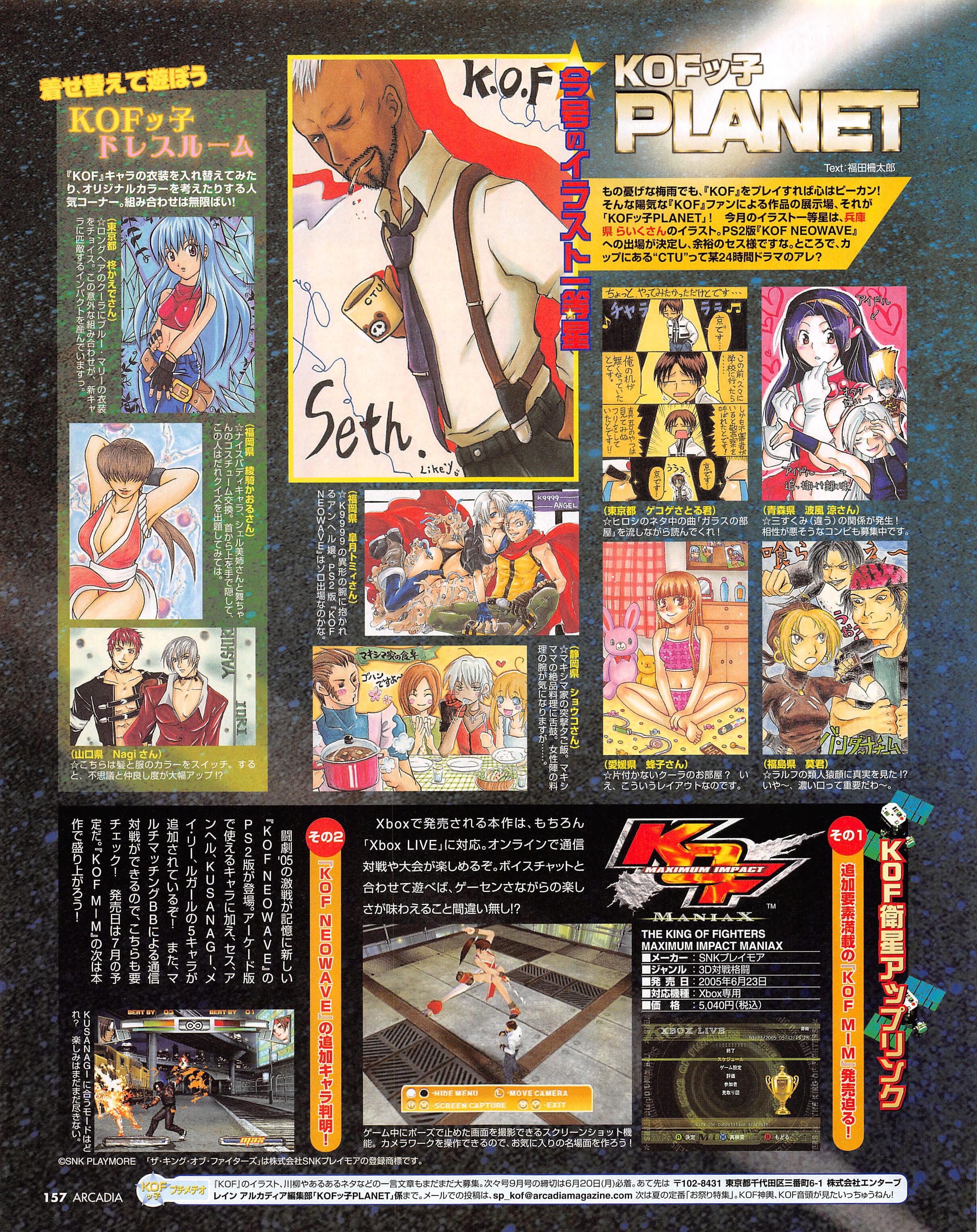
Additional October–November 2005 print corroboration
The October 2005 issue reports Mizuchi already released on August 7, with Shin Shishioh/Neo-Dio planned for mid-September. It explicitly directs AW-card users to earn shared AW points and obtain the bosses. Planned wording is retained; that article does not confirm exact release days for the latter two. The September CPU boss table is an encounter/ending table, not purchase eligibility.
The November 2005 network-service comparison lists AW-NET’s ¥315 monthly charge, mobile/PC access, a data medium shared across titles including points, and available data recovery. Its generic definitions of chat, delivered events, updates and network matches are not attributed as an exhaustive AW-NET feature list. The source gives no recovery procedure and does not change the more specific member-only FAQ qualification. KOFXI’s hoped-for playable Adelheid and MetalSlug6’s selectable Ralf/Clark are not evidenced AW-NET unlock purchases. Scoped print translations.
Public wallpaper promotion and ordinary unlocks: separate identities
Sammy's June 2, 2004 Rumble Fish announcement promises a Garnet premium wallpaper to every survey respondent. The recovered questionnaire and English reading ask gameplay-feedback questions without AWID, UAC, card, email, carrier or billing fields. This is a public publisher promotion; no AW-point relationship is stated. Its confirmation page and actual reward binary remain unrecovered. Sammy's separate public download page lists ten desktop designs in three resolutions, but the second Garnet design cannot be identified as the survey reward without additional evidence. Field translation/source structure.
The December 2005 KOFXI palette panel gives twelve ordinary button-selected colours: A–D, E+A–D, and Start+A–D. The February 2006 Gai and Silber panels specify cabinet time releases after960/1,200hours of board power-on time, with dates varying by arcade. These playable unlocks are distinct from the January CPU encounter table and Isuka's purchased EX move-set variants. The word EX alone does not establish an AW purchase. Scoped English readings.
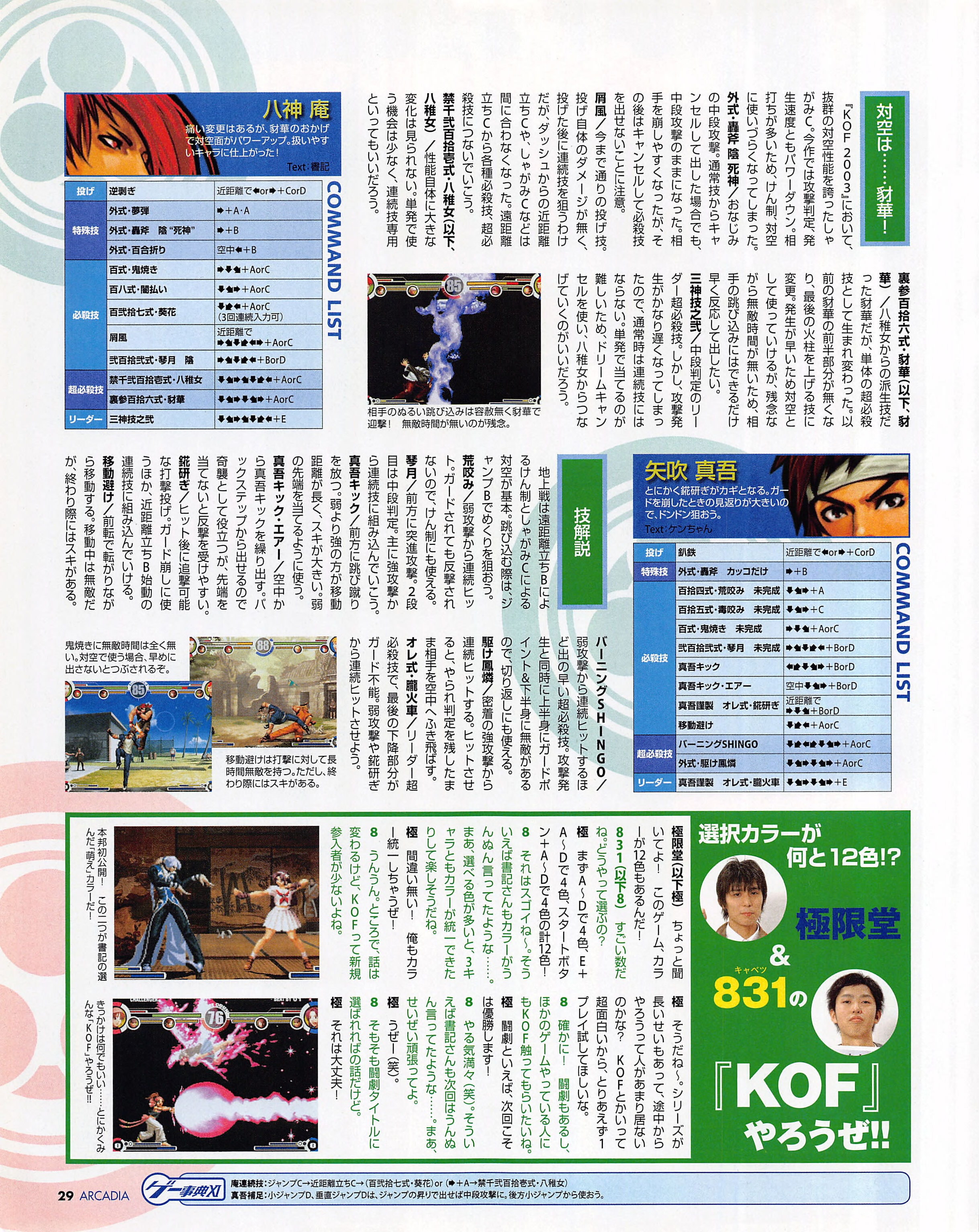
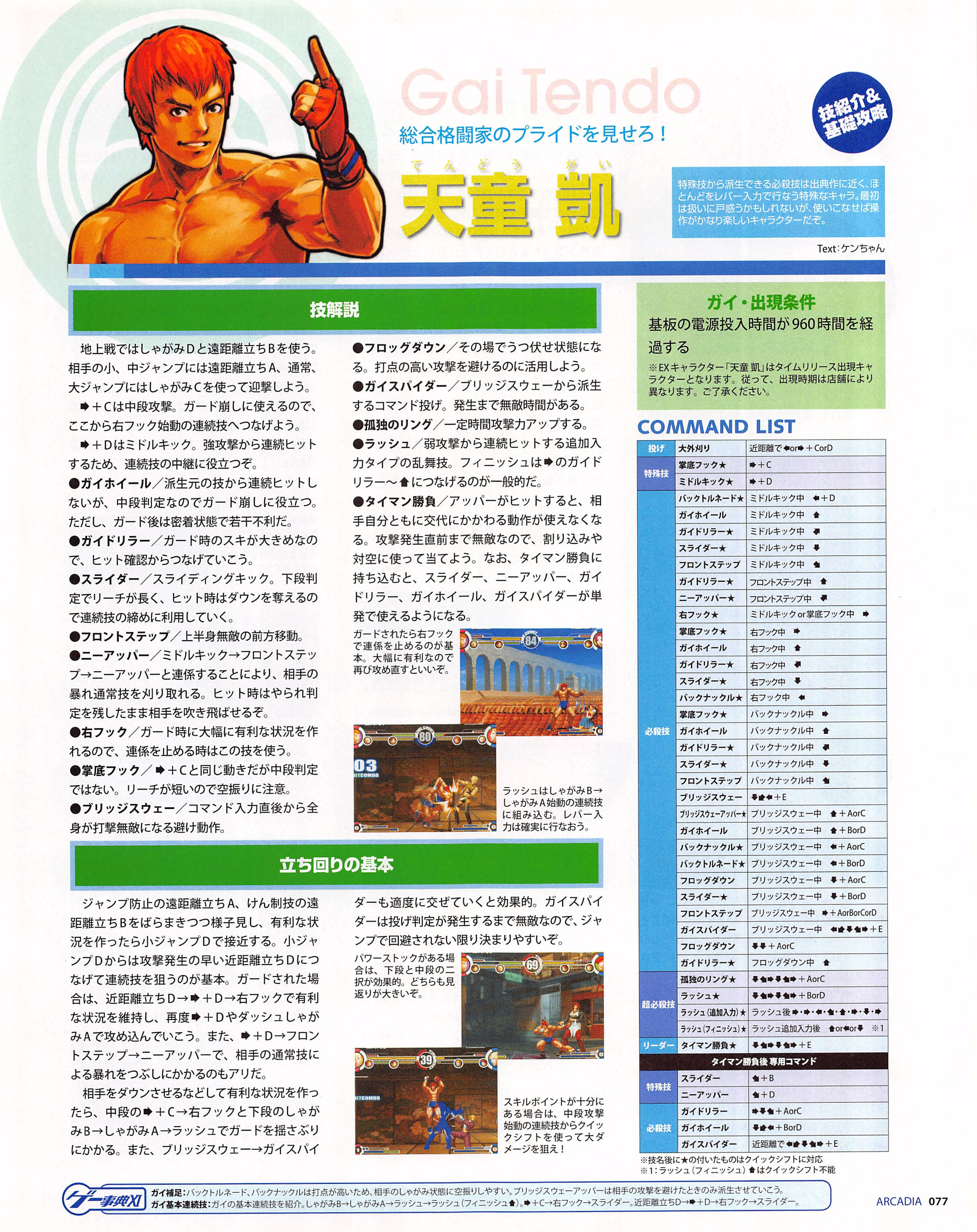
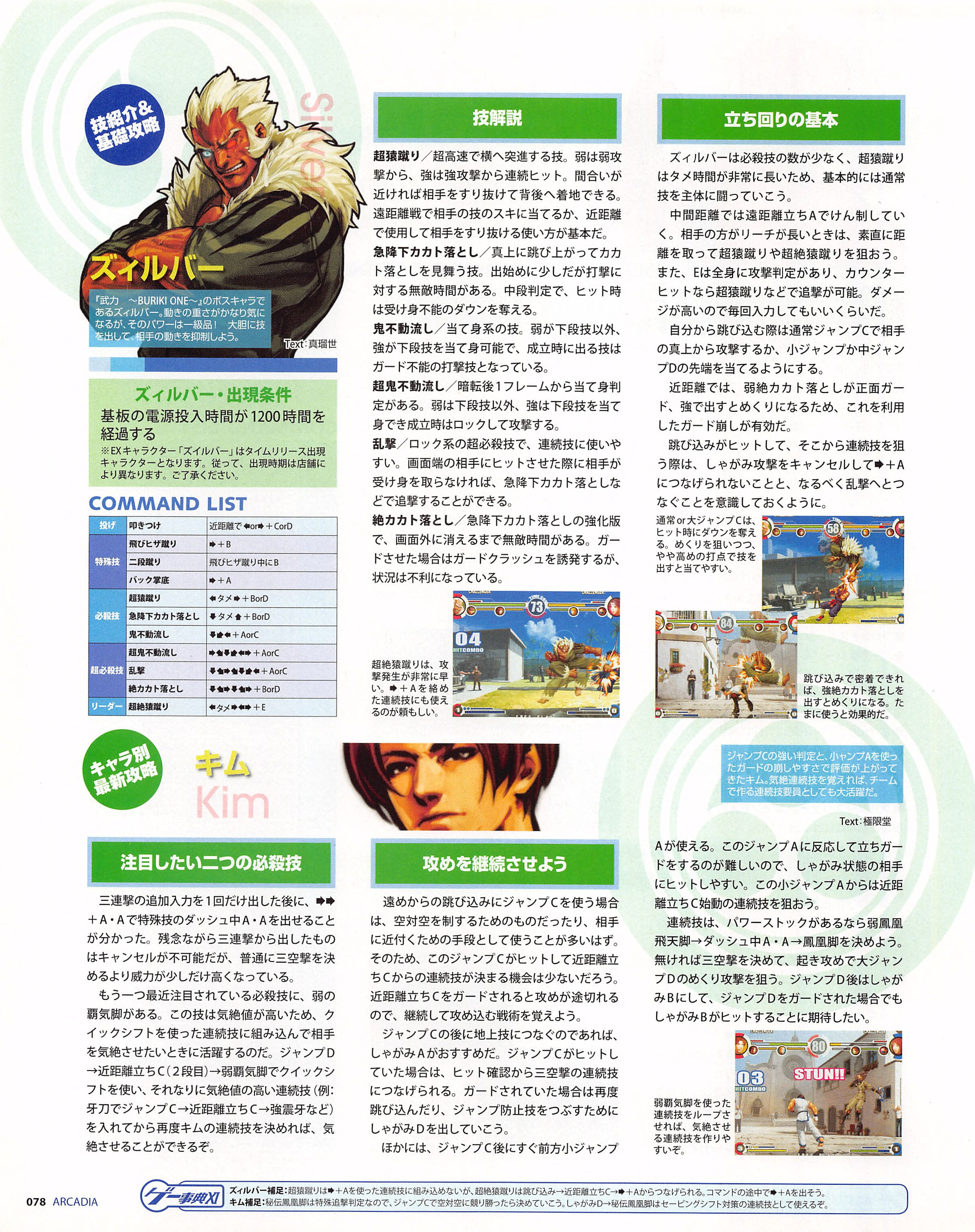
Tenka's December purple Nakoruru panel instead gives a local operator input sequence, with successful activation retained after power-off. It states ordinary move/stats remain the same while story/victory/ending presentation differs. These examples do not add KOFXI or Tenka to the five commercial AW-NET services. December readings.
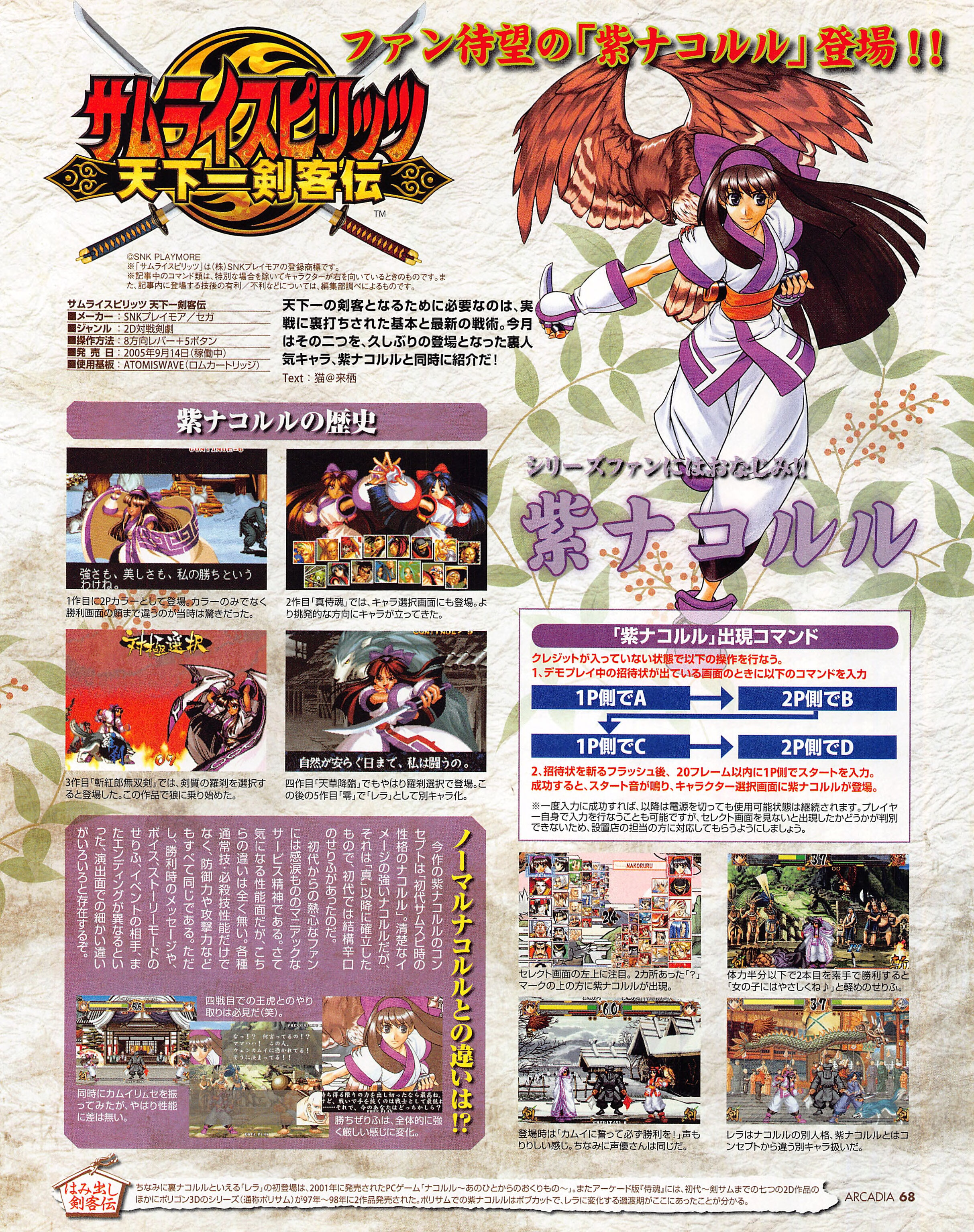
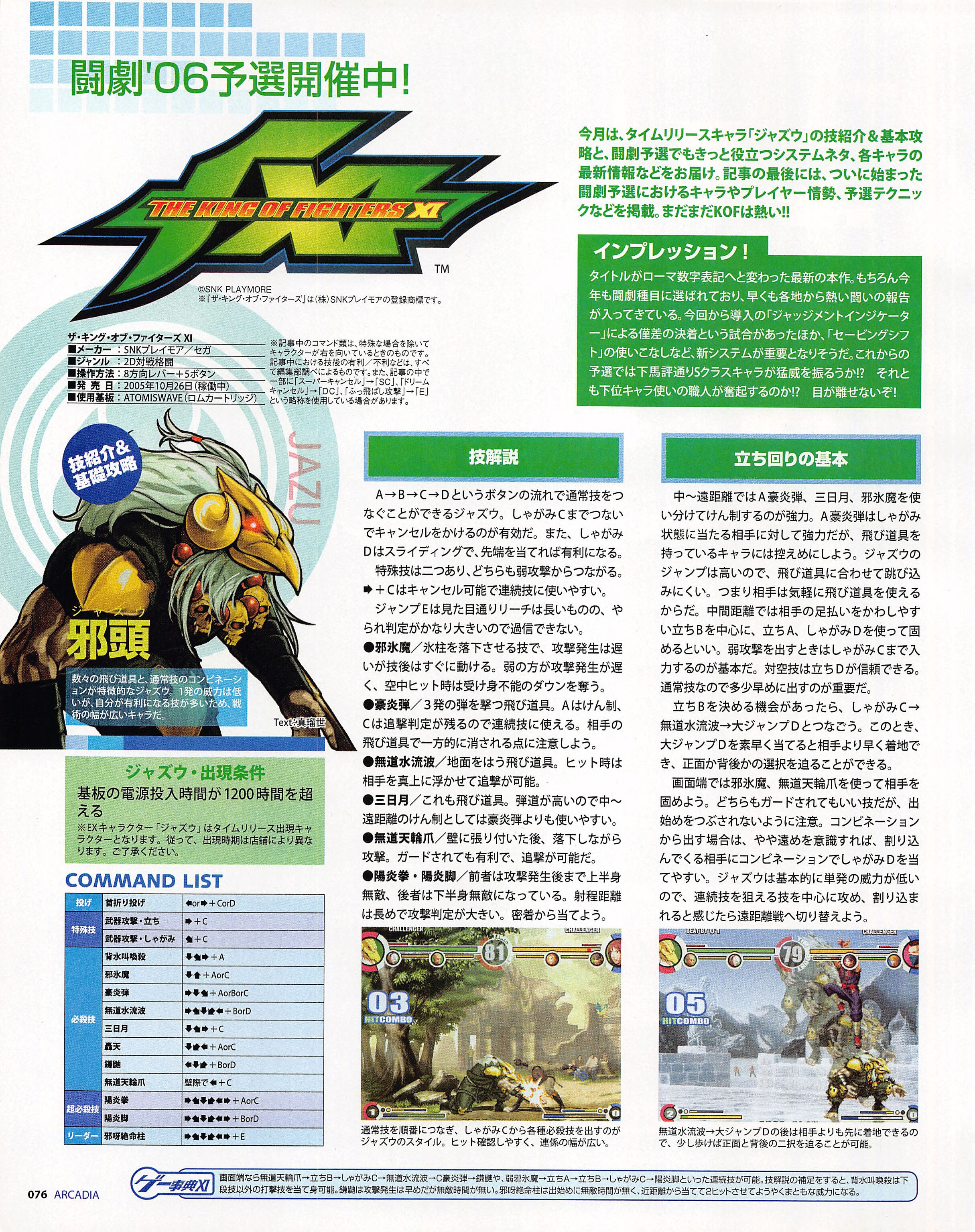
The next primary KOFXI installment also identifies Jazu as a time-release playable character requiring board power-on time exceeding 1,200hours, with arcade-dependent dates. ARCADIA March 2006, printed76, unchanged scan and scoped English reading. This is ordinary cabinet unlocking, separately documented from CPU encounters and AW-NET shop purchases.
April–June 2006 print and phone-service
The May 2006 NeoGeo Battle Coliseum qualifier report, printed53, carries the explicit heading “AW-NET purchased characters show their strength!” Its venue/date caption identifies March 18, 2006 at GameSpot21, Tokyo. The report describes Mizuchi/Kim against Athena/Hotaru and another semifinal featuring Shiki/NEO-DIO. This is contemporary evidence of purchased-character use in physical tournament play. It supplies no new price or account field. Its separate observation of rare Lee, Tung and Athena use does not label those characters as AW purchases. Scoped English reading.
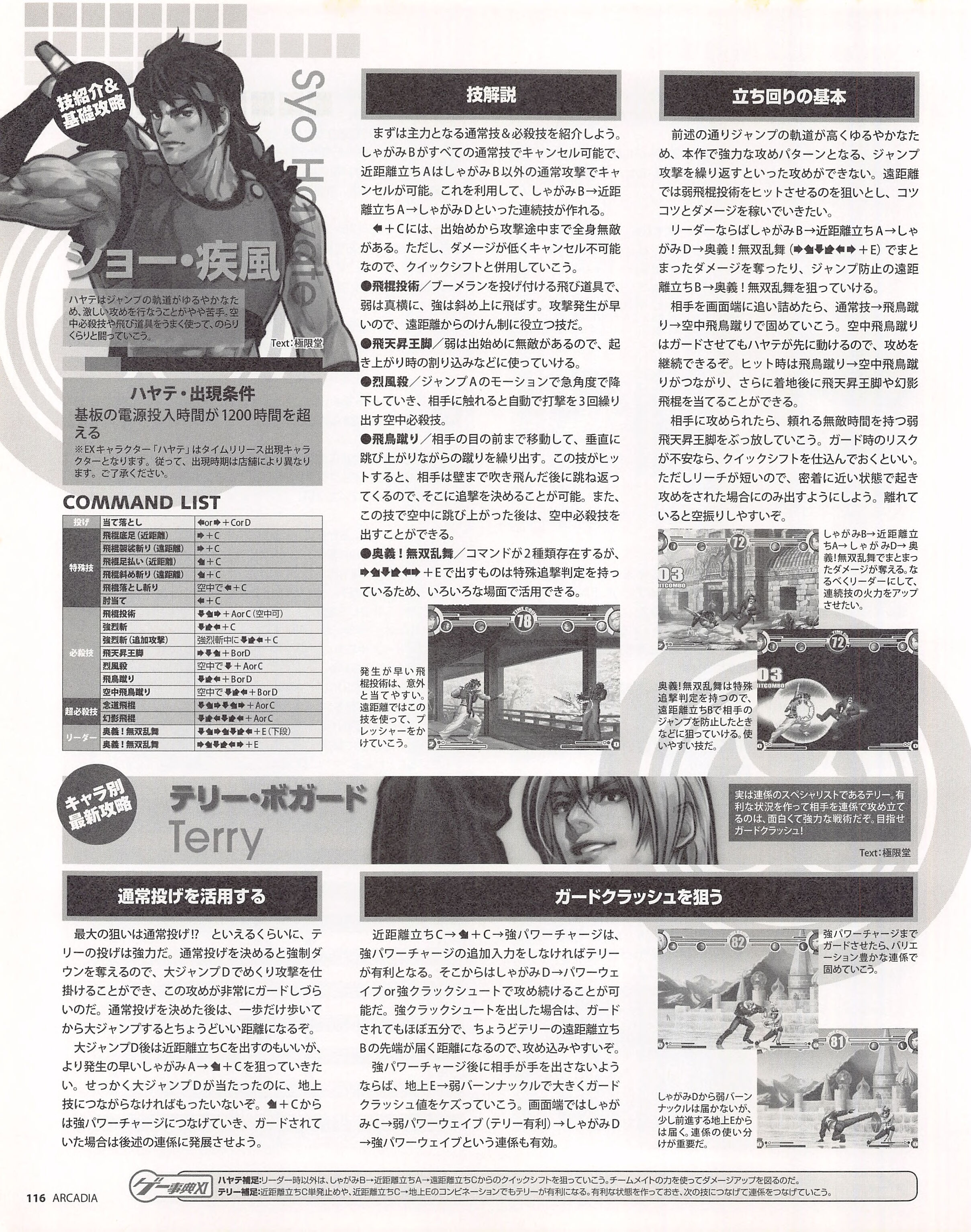
April’s KOFXI Hayate page, printed116, specifies playable release after more than1,200 hours of board power-on time, with dates varying by arcade. This extends the ordinary powered-on-hour unlock evidence for Gai/Silber/Jazu; it does not establish AW support. April’s NeoGeo Battle Coliseum guard-cancel tag power-bar rules are combat meter rules, not shared-point prices. English readings.
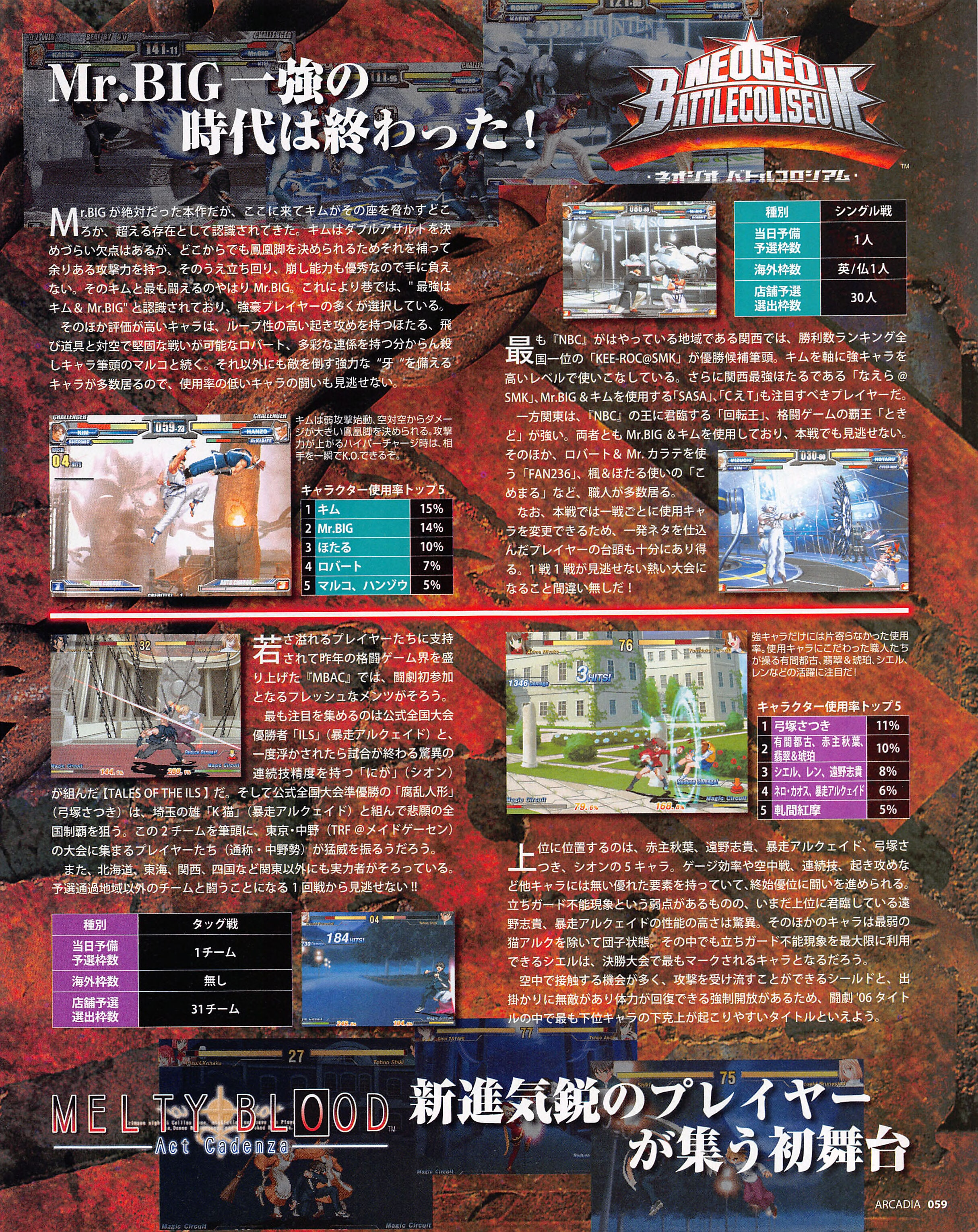
June’s NeoGeo Battle Coliseum preview, printed59, gives qualifier character-use percentages and regional tournament commentary without new AW purchase rules. On a different page, Sangokushi Taisen.NET is explicitly the service offering phone wallpapers/voices, minigame rewards, lost-card reissue and teams at a planned ¥315/month. Those real phone-screen examples belong to Sega’s separately named service. June English readings.
The 2004 Japanese music-thread comparison reports a four-point chaku-combo — chaku-combo phone download and mentions standby images. The posts call it Playmore’s mobile site and do not identify AW-NET. A later official release dated August 1, 2008 separately names SNK WORLD-i and SNK Character Sound; it is after AW closure and cannot establish2004 AW tariffs. Eight selected posts have English translations; the whole1,001-post thread is machine indexed rather than fully translated.
Prelaunch cards, Web Garage and test-specific limits
The newly recovered November 2003 Isuka test leaflet explains card-based identification, recorded results, rankings, analysis, Web Garage customisation and shared points usable across compatible games. Its point-funded examples include character colours. It also supplies the phone URL and a short player-information registration route. This corroborates the service concept before commercial launch; it supplies no phone reward file or commercial shop price. The test site/services last only for the location test, and data cannot transfer between test cards. Original leaflet and English reading.
The March 29, 2004 Kintaro test had narrower card compatibility: its cards could not play Guilty Gear, and retail Guilty Gear AW cards could not enter this test. The reported allowance was 200 plays despite a printed 20-use label, with no transfer and expiry after the test. Planned recognition of outstanding test performers in the commercial release remains an unverified plan. Attributed instructions and source limits.
The same recovered monthly archive contains a July 16, 2004 writer's question about whether cancelling Isuka at July's end implies an August closure. A question is not a confirmed shutdown notice; it does not establish an August 31 expiry. Other monthly items about physical tournaments, soundtracks and unrelated manufacturers' card services retain those separate scopes. Dated English readings.
Channel KOF commercial NEOWAVE account
The literal fan-link follow-up preserves 12 archived responses, all matching their indexed body SHA-1 and exact resolved capture timestamp, plus one unchanged NEOWAVE card photograph. The August 9, 2004 writer describes a ¥500 card purchase, two CPU plays before registering it, then phone registration and visiting the PC site. The reported shop offered colours 1–4 at 600 shared points per colour per character, and Orochi Yashiro, Chris and Shermie at 3,000 points each, alongside four entries with unknown prices. Character-use rankings were visible. A reported discrepancy between the arcade cumulative-point display and the site is an observation without a recovered diagnosis. English reading and source, original card.
The April 9 test report concerns local gameplay and ticketing. The July 12 forwarded launch notice contains price speculation, while August 9 describes an actual purchase. Early Ojakan March captures predate the cited NeoGeo Battle Coliseum visit; May roots expose literal March/April static logs, which remain open research leads.
Later Channel KOF account and Shop evidence
A further 19 indexed responses bring the literal fan-link selection to 31 preserved captures, all matching their indexed SHA-1 bodies and exact resolved timestamps. The added selection covers the other first-indexed 2004 monthlies, April–December 2005 blog monthlies and a distinct NEOWAVE home-port review. First captures can omit later entries; this is not every revision or a full article translation.
The September 2, 2004 writer reports Ramon, Vanessa and Kim at 3,000 points each, and says the Shop now lets members preview alternate character colours. One still-blank character is guessed to be Geese; that guess remains separate from confirmed announcements. The June 3 roundup forwards Sagami-Ono network-test dates of June 4–6 and June 11–13, without describing remote human matches. Dated source readings.
On August 13, 2005, Kyoko reports NeoGeo Battle Coliseum card/data-update and PC-login failures while her NEOWAVE card still worked. She speculates about a phone/number change and later buys another NeoGeo Battle Coliseum card. The August 30 entry reports Mizuchi at 1,000 points and adds an August 31 Shin Shishioh announcement at 1,500. It also reports that an incorrect PC password yields “No matching user”. The writer's wish to use her NEOWAVE balance does not establish separate game currencies: account continuity and the failure's cause are unverified. Account observations, original text and qualifications.
A July 22 home-port review describes immediate access to the arcade's six point-purchased fighters and a home colour editor. These are port features, not evidence of a free arcade palette editor or AW-NET unlock conditions. The May 30 forwarded last-supported-game report is not a shutdown date or proof of who decided to stop adding titles.
Alternate-host and primary-notice
The recovered original Sammy outage notice establishes a server fault from 10:50 on July 8, 2004, with Isuka and Kintaro offline. The notice promises another announcement after recovery but gives neither cause nor recovery time. Phone/PC website disruption remains the separate contemporary fan report's observation. Original notice and English reading.
Hamapika's August 5/7 reports corroborate the NEOWAVE album bonus-ID wallpaper campaign and promise early-September distribution. This was a product-ID redemption route, distinct from shared-point purchases and AW-card registration. The June 3 roundup reports the temporary shared-point campaign extended through June. Neither adds a recovered reward file or a permanent enrollment bonus. Scoped readings.
The TGS 2004 article's 120,000 users are an aggregate across six arcade-linked i-mode services, with AW-NET named separately by the fan roundup. No AW-NET individual adoption figure follows. Channel KOF's PC-online projects, KOF XI button-selected pink palette and mobile mahjong references do not add AW-NET features. Aggregate attribution, separate post readings.
Primary outage notices: actual recovery versus planned maintenance
AW-NET's notice headed March 15, 2004 says the PC/mobile content server interruption ran from March 13 at 02:00 to March 14 at 18:00, and confirms normal operation had resumed. It does not state that arcade games were offline. The separate July emergency homepage, captured July 10, says service contents are unavailable and plans maintenance completion for July 12. That date is a plan, not a confirmed recovery event. Sammy's July notice separately names Isuka and Kintaro offline from July 8 at 10:50. Five verified primary captures and separate English readings. No phone-reward stock, data-loss rule or compensation is inferred from these notices.
Manufacturer-section attribution and physical phone prizes
A recovered January 14, 2005 Hamapika entry explicitly reports Rumble Fish2 as AW-NET non-supporting. The selected English reading preserves its status as contemporary fan reporting. Proposed Guilty Gear real-time versus/card features carry explicit rumor warnings, and later Slash coverage identifies NAOMI hardware. These entries do not expand the five confirmed shipped AW-NET games. A Kenju tuning page on the AW-NET domain is test publicity, subject to the official notices’ proposed-support qualifications.
A NEOWAVE event report describes a physical five-kind mobile-phone cleaner set as a participation prize, not a phone download or point redemption. Its paragraph does not explicitly identify the game version and includes no recovered event-poster scan. English readings and preserved Japanese bodies.
Okinawan availability, portal attribution and alternate context
A contemporary Nami Maga page lists Isuka at four Okinawan venues. Its older installation block marks TRON in Naha as AW-NET unavailable and Yume Kukan in Chatan as AW-NET available; it gives no network-status annotation for Joy Box or Joy Jungle Goya. A January 8, 2004 roundup on the same page subsequently reports TRON’s Isuka becoming online and links a specific BBS. The page warns that submitted information is not guaranteed and its listed dates can differ from actual operation. Preserve the older and newer reports separately. Partly specified dates and unexplained numeric suffixes do not establish cabinet counts, connection times, continuous availability or remote fighter matches. Selected English readings and unchanged source, literal BBS citation proof.
A Nami Maga article dated July 8, 2004 at 22:24:45, as displayed by the site, says only AW-NET’s top page was available when posted. It links AW-NET as its source. The writer’s discussion of heat, dust, cable damage and server processing is general speculation, not the diagnosed cause of this outage. Two captured revisions of that same article are not independent witnesses, and neither establishes an actual repair time. English reading and capture verification.
Nami Maga’s username/password registration, mobile edition and download menus belong to that fan portal. An older venue report’s physical prize lottery belongs to the venue, not AW-NET shared points. Hamapika’s newly recovered physical collector merchandise and Channel KOF’s Korean POPORU online-service report likewise do not add AW-NET games, point-funded phone rewards or carrier enrollment screens. Game-project rumors remain explicitly qualified. Nami Maga attribution limits, Hamapika readings, separately recovered Channel KOF readings.
The new recovered shop inventory supplies521 structured evidence rows with original scan references, individual prices and availability limits. It is a starting inventory for the focused member/shop investigation; complete dated stock and original phone binaries remain missing. Current four priority gaps.
Printed shop and ringtone lists
The new print-list gallery links unchanged September/October 2004 Arcadia pages to18 announced NEOWAVE ringtone track names and144 purchased-colour examples across36 character groups. The October plate gives no per-example price or original SKU; the later November 600-point colour tariff remains a separately dated category price. The September ringtone table is an announcement of planned delivery, not evidence that18 particular files shipped. The structured inventory now contains683 evidence rows, including product families and printed/purchase-slot references; it is not683 independently verified shop products.
A Japanese Isuka fan guide explicitly labels twelve parenthesized names as ringtone-version titles, including BEACH for Exceptional Routine Work. It identifies neither provider nor point price, handset format, file URL or delivery date. A separate May 2004 Game Melody arrangement of that composition is attributed to contributorAlibaba and MA-3/40-polyphony; it is not authenticated as the original AW-NET/GGX Mobile reward. No official reward binary was acquired.
Isuka per-character inventory mapping
Twenty unchanged character plates now support260 individually numbered EX-colour print references and20 EX-character/moveset references, linked to the guide’s category tariffs of300 and1,500 AW points respectively. Ordinary five button-selected colours and the unused-colour example are excluded. The guide’s successive-release wording prevents treating the prepared set as a dated280-item shop screenshot. The structured rows now also cite the original31January2004 all20-EX announcement and28April2004 all-colour addition; the latter does not enumerate individual numbered palettes. No original SKU, thumbnail file, handset reward or new shop payload was recovered. Structured map.
Its six rank categories, name/status editing, play records, Gong voting and Web Garage purchases corroborate existing launch documentation. The2008 capture supplies no evidence that paid AW-NET remained available then. Fan card-display names and values explicitly described as hypothetical are unsuitable for recreating a real authenticated account.
The recovered publisher graphics and public icon archive add Web Garage/ranking previews, a rank-icon progression chart and twenty original web-use character icons in a preserved LZH. The publisher download page expressly identifies website materials; these icons are not verified AW-point phone rewards. Indexed2010 captures of launch-era material do not establish service operation in2010.
Physical soundtrack titles and anticipated phone tracks
A previously unpreserved official SNK soundtrack popup is now saved, reached through the literal soundtruck.html reference in its original publisher JavaScript. The physical CD announcement lists 19 tracks, identifies ULF Records / STF-0015 and gives a November 21, 2004 release date and ¥2,100 tax-inclusive price. All 18 separately documented anticipated ringtone names match the first 18 CD titles. This supports their spelling, without proving handset files, actual release dates or purchases. The CD bonus track SAND ROCKER is not added to the ringtone stock.
The August bonus-ID wallpaper reports concern an AW-card collector album. That product remains separate from this music CD. A new rate-limited Yahoo CD listing supplies no verified campaign insert or phone reward. Shop evidence remains 963 rows, with stronger title attribution rather than new verified products.
The original NeoGeo Battle Coliseum message-resource reading adds all156 paid victory messages for39 fighters, with Japanese transcripts and separate English translations. Matching English entries contain dummy1–dummy4, a finding limited to this Japanese cartridge. These enrich existing shop slots: the inventory remains963 evidence rows. Billing screens, successful authenticated member pages, actual phone-reward files and complete dated stock remain unrecovered.
The original NeoGeo Battle Coliseum title-name gallery preserves64 aligned CP932 literals with separate English glosses: ten month-end top-ten awards,34 priced printed examples, twelve hollow-star titles and eight additional unstarred titles. Acquisition rules for the latter twenty remain unresolved. The shared pointer array continues into card/error messages; it does not independently establish a64-entry runtime title enumeration or complete lifetime catalogue. Original web IDs, exact dated availability and phone-reward binaries remain unrecovered.
A priority path returns indices1–10 from single set bits among the lower15 flags; the returned names match the ten printed monthly ranking awards. The fallback checks a selected byte against an availability bit. These are client-side observations, not recovered server grant rules. A comparison with65 does not enforce a65-title limit in the examined guard; the complete catalogue and acquisition rules for twenty additional names remain unproven. Four more encrypted/decrypted code-excerpt pairs and a selected instruction listing preserve the evidence.
The exact October 10, 2004 album-campaign page changes the planned wallpaper distribution from early September to late September, compared with the August 6 capture. It still uses planned-release wording. Neither page contains the reward binary or redemption form, and the literal access-instructions graphic remains unavailable.
Recovered phone-distribution and campaign-end notices
A January 20, 2005 publisher announcement preserved in the March 5 news capture says AW-NET members could now download Guilty Gear X-series wallpapers and ringtones, including Isuka, with some handsets unsupported. No individual files or tariffs appear. The same capture carries a February 1 notice stating that the NEOWAVE card-album wallpaper campaign ended as scheduled on January 31. This is stronger evidence that the campaign operated than its earlier September release promises; its exact start date and successful individual deliveries remain unverified.